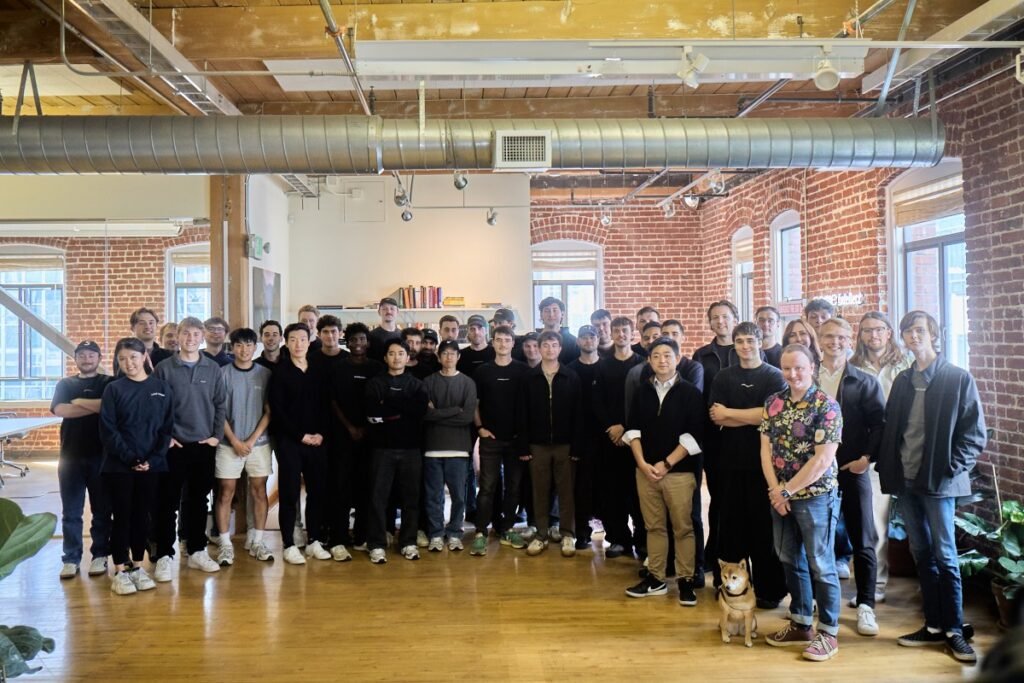
Prime Intellect, a startup that provides computing power and specialized software tools that help companies create artificial intelligence agents, has raised a $130 million Series A at a $1 billion valuation. The massive round was led by Radical Ventures, with participation from Nvidia Ventures, Intel Capital, Dell Technologies Capital, Iconiq, and a long list of
Prime Intellect, a startup that provides computing power and specialized software tools that help companies create artificial intelligence agents, has raised a $130 million Series A at a $1 billion valuation.
The massive round was led by Radical Ventures, with participation from Nvidia Ventures, Intel Capital, Dell Technologies Capital, Iconiq, and a long list of angel investors who are founders of notable companies, including Aravind Srinivas (Perplexity), Aaron Levie (Box), Winston Weinberg (Harvey), Jeff Wang (Cognition), and Brendan Foody (Mercor).
Founded in 2024, Prime Intellect’s goal is to provide organizations with capabilities to train their own agent systems without relying on cutting-edge AI labs. While this mission would have been difficult to achieve just a few years ago, the rise of reinforcement learning techniques, which iteratively reward successful task completion and penalize errors, can allow companies to become their “own AI laboratory” by honing models for specific business tasks.
Although it is now possible to avoid closed AI labs, the underlying infrastructure remains so complex that most companies lack the expertise to assemble these pieces into a production-ready system.
That’s where Prime Intellect comes into play.
The startup has developed what it calls a “full stack” for AI agent development, including access to computing, a reinforcement learning framework, and evaluation tools.
Prime Intellect’s platform works like a marketplace, providing modular access so customers can choose the specific tools they need without being locked into an all-or-nothing system.
“They’ve put it together and built it in such a way that they’re operating on the border in an affordable way,” said David Katz, a partner at Radical Ventures. He added that while others offer fragments, Prime Intellect is unique in providing the capabilities of a world-class AI lab as a “one-stop shop” for development.
The startup’s approach has attracted clients like Ramp, Zapier and Flapping Airplanes, which pay the startup for a hosted version of its tools. This rapid adoption has propelled the company to an annualized revenue rate of $100 million.
This growth is driven by tangible results. For example, Ramp used Prime Intellect to create an agent that helped the fintech find answers within spreadsheets. “The result outperformed state-of-the-art models in accuracy while running at faster speeds and at a fraction of the cost,” Ramp co-founder and co-CEO Karim Atiyeh said in a statement.
Another key factor driving Prime Intellect’s growth is the recent realization by companies that building on cutting-edge laboratories carries a number of risks.
Increasingly, companies do not want to provide their proprietary information to OpenAI and Anthropic due to the risk of losing control over their data. They are also wary of relying on models that can suddenly shut down, as happened with Anthropic’s Fable last month.
“How do I know I’m not working with a company that’s going to try to replace me and generalize what I’m doing?” Katz said. “All of these things are making people think, ‘How can I own my own business intelligence and not take these risks?'”
Prime Intellect co-founder and CEO Vincent Weisser believes companies are looking to move away from closed-source frontier models, and his company provides the infrastructure to make that transition possible.
“It shouldn’t just be a few nerds in a glass tower in San Francisco who have the ability to train AI models,” he told TechCrunch. “It should be all companies, all nation states.”
When you buy through links in our articles, we may earn a small commission. This does not affect our editorial independence.
For more tech updates, stay tuned to our blog.