Nine people aboard a private jet were killed when it crashed and exploded in a fireball near Palm Beach, Florida, Sunday afternoon. The plane, a Learjet built in 2004 and registered as N722BD, had departed from Austin and was en route to the Bahamas. The identities of the passengers and pilots were not immediately available.
Nine people aboard a private jet were killed when it crashed and exploded in a fireball near Palm Beach, Florida, Sunday afternoon.
The plane, a Learjet built in 2004 and registered as N722BD, had departed from Austin and was en route to the Bahamas.
The identities of the passengers and pilots were not immediately available. Authorities have not said what caused the crash.
“Please join me in praying for the families and loved ones of those we lost,” Transportation Secretary Sean Duffy wrote on X on Sunday.
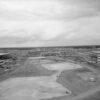
National Transportation Safety Board Member Tom Chapman said during a press conference on Monday that access to the crash site is challenging because of the bad weather on the ground, causing the impact crater to fill with water. Officials also said crash debris was scattered across fields, homes, and businesses.
The crash occurred less than 10 miles from President Donald Trump’s Mar-A-Lago resort. Trump left West Palm Beach around noon aboard Air Force One to attend a rally in Iowa, according to White House pool reports.
What we know about the flight
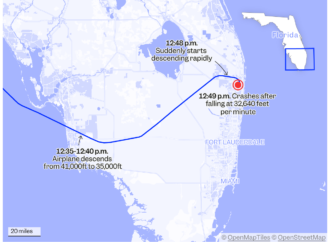
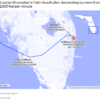
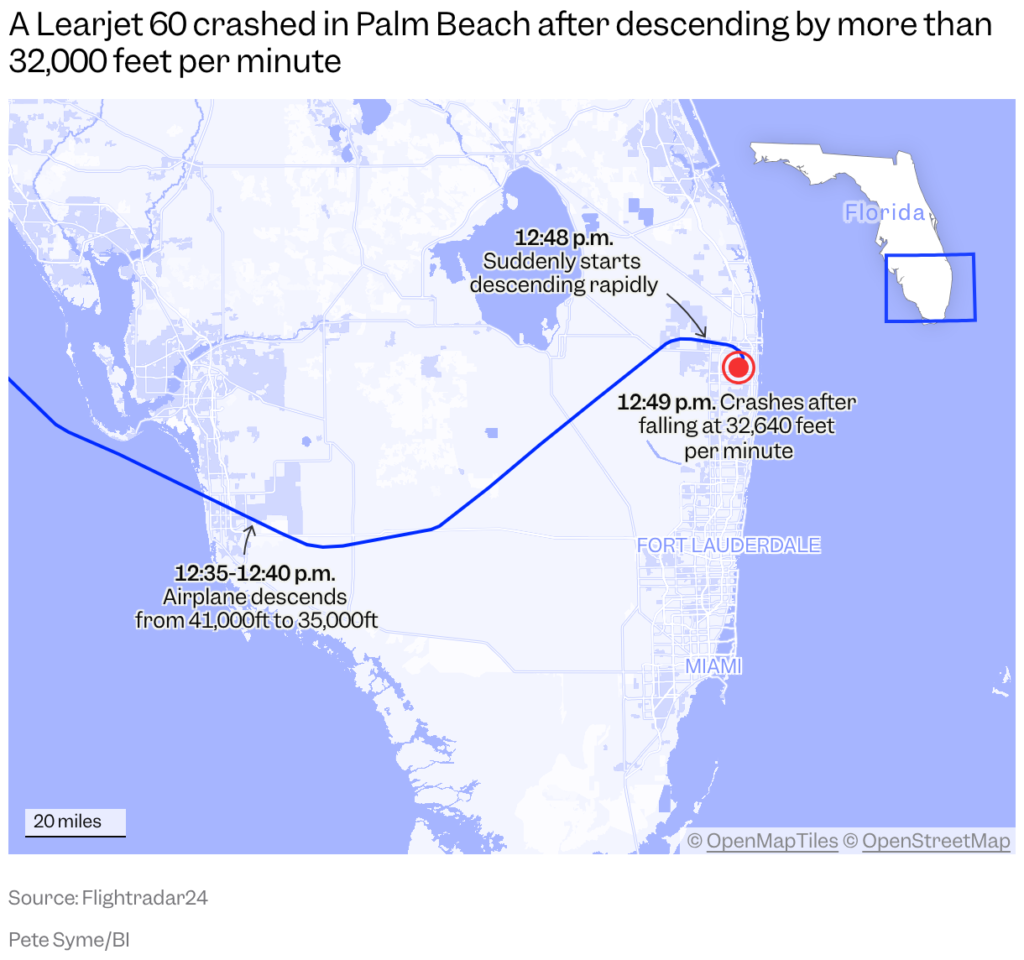
Aviation-tracking data from FlightRadar24 showed the plane descending from 41,000 feet to about 35,000 feet as it entered Florida, then crossed the state before plummeting about 27,000 feet in about a minute to the ground near Palm Beach.
The plane was about two hours into the flight to North Eleuthera Airport in the Bahamas when it crashed.

In the minutes before the accident, a pilot can be heard on air traffic control recordings reporting the air temperature outside as -47 degrees Celsius (about -52 degrees Fahrenheit), as well as icing, precipitation, and moderate turbulence.
The pilot later declared “mayday,” saying the plane was descending at 10,000 feet per minute, and moments later, reported an overspeed condition before impact.
Video footage shared online of the crash shows that part of the Learjet’s T-tail may have separated from the plane.
Chapman said there is “some evidence that there was some breakup of the aircraft before impact” and the NTSB is “still seeking to determine that.” He also said the agency hopes to recover the cockpit voice recorder, but it’s unclear if the particular jet had one installed.
NTSB investigator Timothy Monville said during the briefing that the Federal Aviation Administration and the manufacturer Learjet, which is now a part of Bombardier, will assist the NTSB with the investigation.
“We at Bombardier are deeply saddened by this tragic event and extend our sincerest sympathies to all those affected,” Bombardier said in a statement. “We cannot comment on the potential cause of this accident until the investigation is complete and we will fully support the investigating authorities and cooperate as needed.”
What we know about the weather
Widespread thunderstorms moved through South Florida on Sunday afternoon. Aviation weather data for the area showed heavy rain, low visibility, and turbulence around the time of the crash.
“The weather conditions are a major focus of the investigation,” Chapman said. “You all saw what the weather was like here at the surface; what we have to determine is what the weather conditions were like at altitude.”

Saul Martinez/Getty Images
It’s not yet known what caused the crash, but retired Delta Air Lines pilot Mark Stephens told Business Insider that icing can occur at any altitude and, in some circumstances, cause a wing to lose lift and an aircraft to stall.
“If there was a failure on one wing, meaning that wing iced up, then the good wing would still fly, but the other would lose lift,” he said. “You’d have such an uneven lift that it would basically do close to exactly what the Learjet did; it can flop out of the sky.”
Stephens warned against immediately placing blame on the pilots, adding that anti-ice and weather radar systems can fail and that a number of factors beyond human error could have contributed.
‘She was doing her job’
NASA administrator Jared Isaacman, who is also a pilot, shared his thoughts on the crash on X and urged the public not to criticize the woman pilot in the ATC calls.
“She was the second-in-command (SIC), and while she was empowered to point out mistakes as part of good crew resource management, she was doing her job, communicating with ATC right to the end in a terrifying situation,” he wrote.
He added that she “likely knew before many of those calls that she was going to die,” and the public does not know factors such as the jet’s maintenance history, or whether there was structural failure and why. Isaacman also said that charter companies often hire commercial pilots “very early in their careers to gain experience,” alongside airline-qualified captains.
“She would still have the appropriate training, qualifications, and checkouts by an FAA examiner or designee,” he said. “Let people investigate, learn, and share the facts. Be respectful to those who perished and the families who carry their memories.”
This is a developing story. Check back for updates.
{For more tech updates, stay tuned to our blog.|Keep following us for the latest insights.|Check back often for more exciting news!}