
California Attorney General Rob Bonta says it’s not his job to protect Hollywood giants from the rise of Netflix and other streaming insurgents. This week, Bonta and 11 other attorneys general sued Paramount Skydance to stop its deal to buy Warner Bros. Discovery. Paramount says it needs the agreement to compete with the technology giants
California Attorney General Rob Bonta says it’s not his job to protect Hollywood giants from the rise of Netflix and other streaming insurgents.
This week, Bonta and 11 other attorneys general sued Paramount Skydance to stop its deal to buy Warner Bros. Discovery. Paramount says it needs the agreement to compete with the technology giants in streaming and the transition to a new media model.
Bonta told Business Insider that’s irrelevant to his antitrust case.
“We are indifferent (I assume from a legal perspective) to which markets are growing and which are contracting,” Bonta said in an interview. “Maybe the movie theater market is shrinking, the cable market is shrinking, the streaming market is growing. We don’t have a specific opinion on that in this case. And we’re not trying to help one grow or keep one from shrinking.”
Bonta said his lawsuit focuses on how Paramount’s WBD deal could affect market concentration in three areas: distribution of wide-release films, distribution of big-budget blockbuster films and licensing of cable channels.
Bonta argues that buying WBD would give David Ellison’s Paramount too much power over movie theater owners, pay-TV distributors and, by extension, consumers. It is seeking a preliminary injunction or temporary injunction to pause the Paramount-WBD transaction.
“They will be able to dictate conditions with the cinemas,” Bonta said. “They will be able to ask for more money. Theaters will have to pay more. That means higher costs for moviegoers.”
Paramount says its merger would create “a stronger competitor against the dominant streaming and technology platforms that have hurt the theatrical exhibition market and jobs in the entertainment industry.”

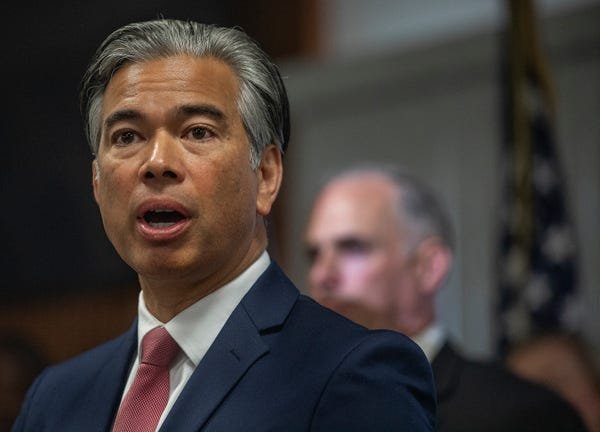
Bonta believes that controlling Paramount Pictures and Warner Bros. Studios would make Ellison’s company too powerful. Mel Melcon/Los Angeles Times via Getty Images
Bonta said his lawsuit is not about the streaming business and called Paramount’s view of tech giants like Netflix and Amazon a “distraction and a turnoff.”
“The streaming market is not one of the markets that we have identified as a market that will create so much market concentration through merger that it will be illegal under the Clayton Act,” Bonta said. He added that Ellison and company “want Netflix to be the black cat, but Netflix is not part of our case.”
A supercharged Paramount-WBD would control HBO, CBS and CNN; streamers HBO Max, Paramount+ and Pluto TV; Television networks such as TNT, HGTV and Comedy Central; and two major film studios in Paramount Pictures and Warner Bros. Studios.
Star actors and directors like Ben Stiller have also spoken out against the deal, which the US Department of Justice has already approved, warning that the alliance would result in “fewer opportunities for creators.”
Corey Martin, an attorney who chairs the entertainment finance practice at Los Angeles-based Granderson Des Rochers, told Business Insider that Bonta’s decision to exclude streaming from the market concentration calculation was a “novel approach.”
“It’s hard to imagine this deal in its entirety without considering streaming,” Martin said, given that “streaming is the driver of the deal.”