
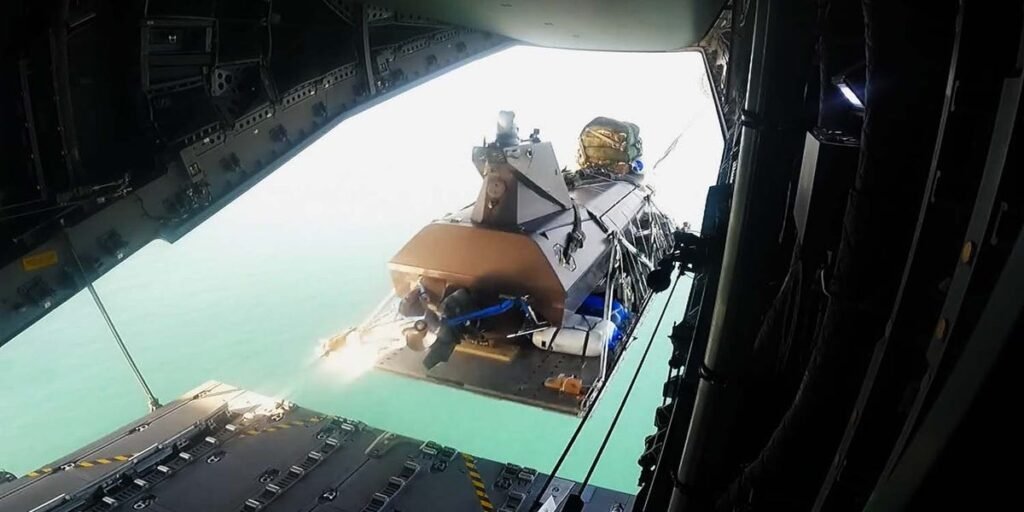
The Royal Navy said Wednesday it has been testing launching marine drones from a turboprop aircraft at 1,300 feet, in what it described as tests for a “first air launch of its kind.” The tests were carried out by Kraken Technology Group, which provided its K3 Scout unmanned surface ship, and by Capewell, which provided
The Royal Navy said Wednesday it has been testing launching marine drones from a turboprop aircraft at 1,300 feet, in what it described as tests for a “first air launch of its kind.”
The tests were carried out by Kraken Technology Group, which provided its K3 Scout unmanned surface ship, and by Capewell, which provided an air-launch system featuring a sled and a parachute.
The Royal Navy said the K3 Scout, a 27-foot-long multi-purpose marine drone, was parachuted four times from an Airbus A400 transport aircraft in a six-day campaign over the North Sea.
The air-launch capability “instantly expands the speed, range and flexibility” by which such a marine drone can be deployed because it does not require a port or nearby support ship, the Royal Navy said.
“One of the limitations of small unmanned surface vehicles is their ability to self-deploy, so we are actively looking at concepts for deployment from mother ships or ‘mother planes,'” said Cpt. Adam Ballard, Royal Navy unmanned surface ship program officer, said in the statement.
Kraken said the K3 Scout was airdropped into the North Sea in Sea State 4, meaning waves could reach up to 8 feet.
The unmanned surface ship is equipped with electronic warfare systems, can carry a payload of up to 600 kilograms and is intended to operate for up to 30 days in the field.
Kraken lists the drone as capable of conducting sea and shallow water strikes, casualty evacuation, and advanced detection missions.
Marine drones have quickly risen to prominence after Ukraine used them to strategically defeat the Russian Black Sea Fleet, one of the Kremlin’s most dominant naval forces.
The UK navy has said it wants these drones to work in conjunction with its manned warships and human forces. In March, it announced it would purchase 20 of Kraken’s unmanned surface vessels to “lay the groundwork” for the future use of marine drones.
The contract is worth about $16.5 million, putting the cost of each drone at approximately $825,000.