
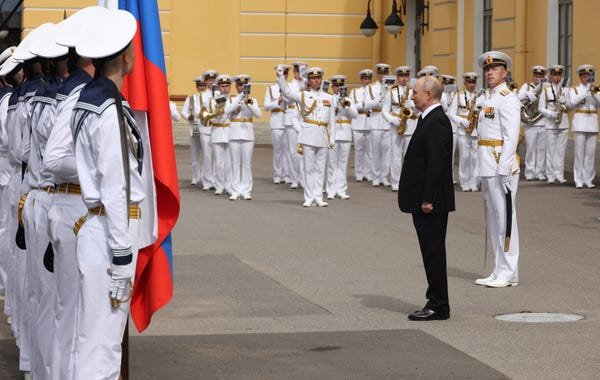
Russia canceled its historic Navy Day parade for the second year in a row and instead held a silent event featuring only large banners of warships. Two lines of about 30 sailors greeted the country’s leader, Vladimir Putin, as he arrived Sunday at the Russian Navy’s headquarters in St. Petersburg, where the Kremlin said he
Russia canceled its historic Navy Day parade for the second year in a row and instead held a silent event featuring only large banners of warships.
Two lines of about 30 sailors greeted the country’s leader, Vladimir Putin, as he arrived Sunday at the Russian Navy’s headquarters in St. Petersburg, where the Kremlin said he met with commanders and presented several awards to naval personnel.
A small military band greeted Putin in a cordoned-off courtyard of the Admiralty headquarters to mark the 330th anniversary of the Russian navy.
The scale of the reception, held in front of a towering banner for the Alexander Nevsky, a Borei-class nuclear-powered missile submarine, contrasted sharply with Russia’s usual fanfare for Navy Day. In another section of the yard, a second sign depicting two large surface combatants was displayed.

Putin greets officers during his visit to the Admiralty. Contributor/Getty Images
The Kremlin often holds large parades of sailors and surface ships in Kronstadt, a naval base near St. Petersburg, and on the Neva River to mark the national holiday. In 2023, the exhibition featured more than 40 warships, four submarines and 3,000 people, and was attended by foreign dignitaries.
But repeated Ukrainian drone attacks on Russian soil forced the Kremlin to hold a smaller version of the parade in 2024 on the Neva River, with 2,500 people and about 20 boats on display.
The following year, Russia canceled its Navy Day parade entirely, with Kremlin spokesman Dmitry Peskov citing the “general atmosphere” and “security reasons.”
The Kremlin did not immediately respond to a request for comment sent outside normal business hours by Business Insider.

Putin and two senior officials attended the 2023 Navy Day parade along with a full lineup of warships. ALEXANDER KAZAKOV/POOL/AFP via Getty Images
Ukraine has continually evolved its long-range attack drones to more consistently bomb Russia’s cities, military-industrial production sites, and oil and gas facilities. The attacks have triggered an energy crisis in Ukraine, where independent media reported a 45% rise in gasoline prices since January.
St. Petersburg, approximately 600 miles from the Ukrainian border, is within easy range of these explosive-laden fixed-wing drones.
Ukrainian forces said in July that they had increased long-range strikes on Russian soil tenfold since the beginning of the year, carrying out more than 2,350 individual strike missions in June alone.
The threat has forced the Kremlin to concentrate its air defense systems around the Moscow metropolitan area, including multiple rings of S-500 and S-400 surface-to-air missile launchers around the city and dozens of Pantsir point defense systems on the capital’s rooftops.
Russia’s Victory Day parade, which is its largest annual military display, has been repeatedly dogged by Ukrainian drones that forced airport closures and intermittent outages of cell service due to the activation of electronic warfare.
More recently, the St. Petersburg International Economic Forum was disrupted in June by a drone attack on an oil terminal there.