Artificial intelligence has a huge appetite for electricity and South Australia is stepping up to feed the beast. ASX-listed clean energy company 1414 Degrees has just announced a major deal to build a massive AI data center campus near Port Augusta. The company has signed a master agreement with an Australian data center operator to
Artificial intelligence has a huge appetite for electricity and South Australia is stepping up to feed the beast. ASX-listed clean energy company 1414 Degrees has just announced a major deal to build a massive AI data center campus near Port Augusta.
The company has signed a master agreement with an Australian data center operator to develop up to 1 gigawatt of AI infrastructure at its Aurora Energy Precinct. This is equivalent to 1,000 megawatts of processing power, backed by local solar generation and grid-scale battery storage.
If you’ve followed the explosion of generative AI in recent years, you’ll know that the biggest bottleneck right now isn’t just GPU supply. The real limitation to training the next generation of AI models is finding enough steady, clean power to keep thousands of high-performance chips running 24 hours a day.
Solving the huge energy problem of AI in the South Australian region
Training large language models requires an immense amount of continuous electricity. Running clusters of tens of thousands of modern GPUs generate massive thermal loads and drain power grids faster than traditional cloud workloads.
Data center developers around the world are struggling to find sites that offer three critical ingredients: high power capacity, fast network connectivity and a large volume of cooling water. 1414 Degrees sits on a goldmine of land and energy infrastructure in South Australia that ticks all the boxes.
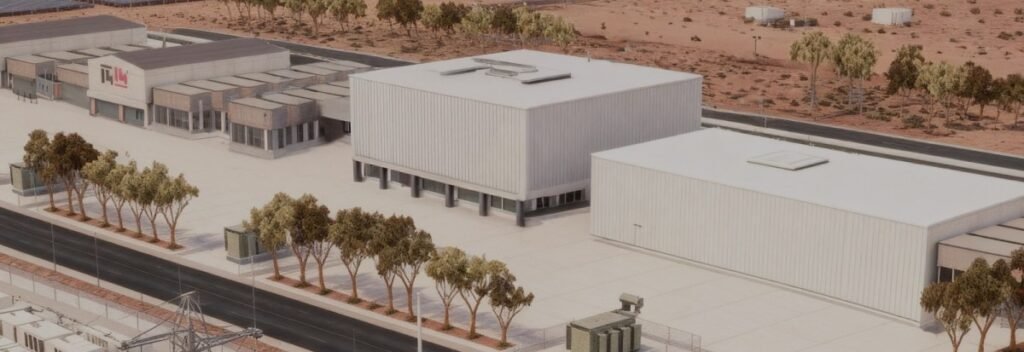
Aurora Energy Precinct sits on a massive 15.8 square kilometer parcel of land near Port Augusta. The site features up to 900 MW of solar generation potential, an approved 140 MW/280 MWh battery energy storage system, high voltage transmission lines and existing access to fiber and water.
A three-stage launch to bring gigawatt scale online
Building an entire gigawatt of infrastructure doesn’t happen overnight. The partnership outlines a smart, phased approach that allows computing hardware to start working almost immediately rather than waiting years for major upgrades to transmission lines.
Under the agreement, the unnamed Australian operator of the data center receives exclusive access to an initial 40-hectare plot within the facility. The development will unfold in three distinct phases as the generation and transmission infrastructure grows.
The first phase begins with an initial 17 MW campus using a recently announced 33 kV grid connection. This allows the association to deploy computing capacity early and begin generating revenue almost immediately.
Phase two moves towards a major 200 MW anchor campus once the larger 275 kV transmission line comes online. This stage will connect directly to Aurora’s co-located solar and battery assets to provide clean, cheap power during peak production hours.
Phase three represents the ultimate vision, expanding the footprint incrementally towards 1,000 MW as additional solar generation and long-duration thermal storage are built across the site.
Why modular containerized computing makes a lot of sense
One of the most interesting aspects of this agreement is the choice of modular data center technology. Instead of building monolithic concrete data rooms that take five years to build and are obsolete in ten, modular configurations use high-density containerized computing units.
These modular pods are specifically designed to work in conjunction with variable energy storage and renewable energy systems. They can be quickly deployed on site, expanded in blocks, and upgraded or relocated as chip architecture evolves.
When hardware cycles advance at the breakneck pace of modern AI chips, flexibility is everything. Being able to place prefabricated, liquid-cooled computing modules right next to a giant solar farm and battery bank is a huge competitive advantage.
Land and energy combine with capital and operational experience
The division of responsibilities under the proposed agreement structure is simple and is played for strength. 1414 Degrees provides the development site, high voltage grid connections, fiber infrastructure and behind-the-meter renewable energy.
The data center partner provides the necessary investment capital, specialized technical designs, and operational capacity necessary to run a high-density AI infrastructure. 1414 Degrees receives long-term revenue streams from land access leases, energy supply agreements and constituency management services.
Both companies are now working to reach definitive agreements while discussions continue with SA Power Networks, ElectraNet and local authorities to secure final connection approvals.
Global tech giants seek Australian clean energy
This partnership comes at a time when global technology heavyweights are actively pursuing massive energy capacity in Australia. Leading AI research labs, such as Anthropic, have publicly stated requirements for 500 MW sites in Australia to support future model training needs.
At the same time, major cloud providers, including Microsoft, Amazon and Google, have committed to powering 100 percent of their data operations with renewable energy. Finding large, contiguous sites with pre-approved grid connections and co-located renewables in Australia is incredibly difficult.
South Australia has positioned itself as a world leader in renewable energy generation, often running on more than 70% wind and solar energy. By combining that clean energy profile with a gigawatt-scale computing landscape, the state becomes an extremely attractive destination for global tech capital.
This deal validates Aurora’s strategy of attracting energy-intensive industries to a purpose-built site for renewable generation, storage and grid connectivity. The 33kV connection allows us to start generating value from part of the campus now, while Aurora’s 275kV construction and solar and battery storage development continue in parallel.
– Dr. Kevin Moriarty, CEO, 1414 Degrees.
The bigger picture for Australian technology and energy
For 1414 Degrees, this announcement represents a significant strategic shift toward co-locating heavy industrial power users directly at the point of generation. Instead of selling all of its solar power to a wholesale market that often sees negative prices during peak sun periods, the company can sell behind-the-meter power directly to a high-demand customer.
For the Australian tech ecosystem, securing local AI training infrastructure is crucial to sovereign capabilities. Having gigawatt-scale computing campuses operating in our country ensures that local researchers, startups and companies have access to low-latency processing without completely relying on overseas facilities.
While there are still definitive contracts to be finalized and transmission milestones to be achieved, this agreement marks one of the most ambitious clean energy IT projects ever announced in Australia. We will be watching closely as the project progresses through its connection stages in South Australia.
For more information, go to 1414 degrees.
For more tech updates, stay tuned to our blog.