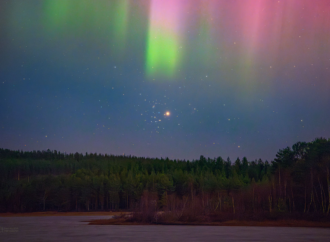
Explanation: What a cosmic coincidence! In today’s image, Mars joins the Beehive cluster (M44 or Praesepe) below an auroral curtain and above a horizon of happy little trees near Lansjärv, Sweden. An eruption off the Sun reached Earth on October 10th, 2026 causing strong disturbances in Earth’s magnetic field. Energetic particles from the eruption collide
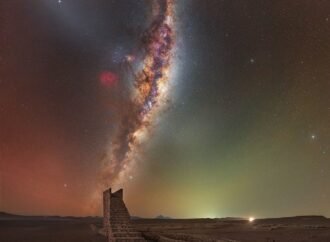
Explanation: This stairway in Chile brings you only a little bit closer to heaven. But ooh, the sky above it makes you wonder. For example, you may wonder about the dark lane of our own Milky Way galaxy rising behind the expansive Atacama Desert in Chile, the band of zodiacal light on the upper left,
Explanation: On August 15, this perseid meteor streaked through night skies over the Observatorio del Roque de los Muchachos at La Palma, Canary Islands, Spain. The bright and colorful meteor trail was captured next to the central Milky Way, whose dark interstellar dust clouds and luminous starlight reach above the horizon. In the foreground of
Explanation: Globular star cluster Omega Centauri packs about 10 million stars much older than the Sun into a volume some 150 light-years in diameter. Also known as NGC 5139, at a distance of 15,000 light-years it’s the largest and brightest of 200 or so known globular clusters that roam the halo of our Milky Way
Explanation: When does a nebula look like a comet? In this crowded starfield covering over two degrees within the high-flying constellation of the Swan (Cygnus), the eye is drawn to the Cocoon Nebula. A compact star forming region, the cosmic Cocoon punctuates a nebula bright in emission and reflection on the lower right, with a
Explanation: The small, northern constellation Triangulum harbors this magnificent face-on spiral galaxy, Messier 33. Its popular names include the Pinwheel Galaxy or just the Triangulum Galaxy. M33 is over 50,000 light-years in diameter, third largest in the Local Group of galaxies after the Andromeda Galaxy (M31), and our own Milky Way. About 3 million light-years