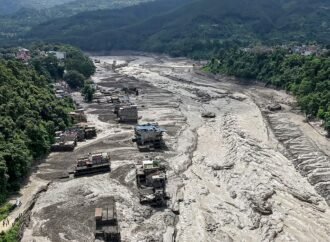
Houses are partially submerged in muddy water following flash floods in Nepal.Credit: Prabin RANABHAT/AFP via Getty Around 350 people have died and more than 1,000 are missing, after a deadly deluge of rocks, mud and water hit villages along the border of Nepal and Tibet on Wednesday. The US Geological Survey says the event was
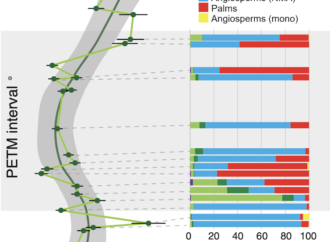
The fossil record preserves this same fragmented leaf litter. Comparing the shapes of thousands of epidermal cells with the leaf area index we measured revealed a remarkably strong relationship: The more elongated the cells, the denser the forest canopy above them. That relationship allowed us to reconstruct the structure of Wyoming’s forests millions of years
Weeping willow trees are found in many cities globally.Credit: avada/Alamy Across Beijing, millions of weeping willows and poplar trees turn the megacity into a green metropolis. But compounds released by these trees are becoming a major contributor to air pollution1, finds a study. Beijing is not alone. Many trees planted in urban areas — species
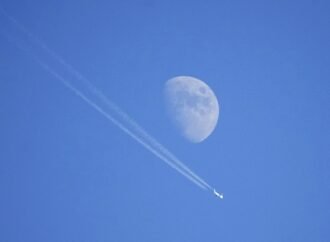
Hundreds of commercial flights will be told to change their paths over the northeastern Atlantic Ocean during the next two winters to show how minor altitude adjustments can reduce aviation’s climate impact. The British government is backing the landmark airspace-scale trial, launched Tuesday, to avoid creating condensation trails, or contrails. Google UK is contributing its artificial intelligence-powered
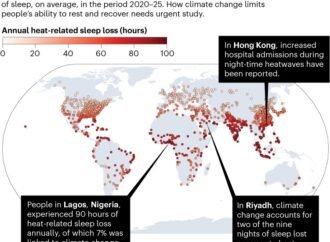
Global warming isn’t just about heat during the day. Nights are also getting hotter1–3. In May, Delhi recorded an overnight minimum temperature of 32.4 °C, and other parts of India remained 3–5 °C above normal after dark. As Western Europe experienced its hottest June on record, France registered a record overnight low of 22 °C, and East Saxony,
Fossilized microbial mats known as stromalites provide important records of some of Earth’s earliest life.Credit: Jon G. Fuller/VW Pics/UIG via Getty Earth & Life: A Four Billion Year Conversation Andrew H. Knoll Princeton Univ. Press (2026) On 14 February 1990, NASA’s Voyager 1 spacecraft turned around briefly to snap a picture of Earth before heading