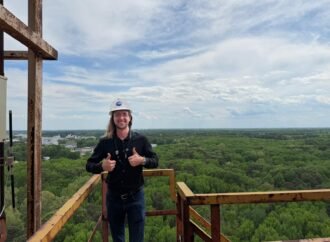
Jaden Caradine knew he wanted to be an engineer at eight years old. He just took a winding road to get there. Before he enrolled at Embry-Riddle Aeronautical University, before he discovered the field that would become his focus, and before he landed a Pathways internship at NASA’s Langley Research Center in Hampton, Virginia, Caradine
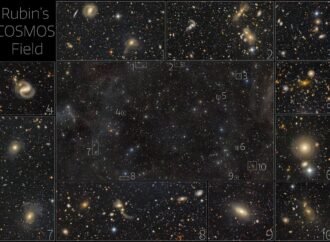
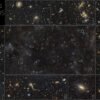
Explanation: There are more than half a million galaxies in the central panel of this image from the NSF-DOE Vera C. Rubin Observatory in Chile. This is the COSMOS field, a patch of sky several times larger than the full moon, first observed by Hubble. It has also been observed by Webb and other telescopes because it contains comparatively few bright stars from our own galaxy, offering
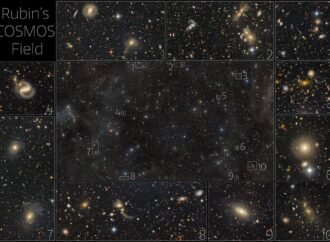
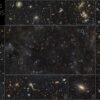
Explanation: There are more than half a million galaxies in the central panel of this image from the NSF-DOE Vera C. Rubin Observatory in Chile. This is the COSMOS field, a patch of sky several times larger than the full moon, first observed by Hubble. It has also been observed by Webb and other telescopes because it contains comparatively few bright stars from our own galaxy, offering
To test these new ideas, researchers are exploring the infant universe through simulations. “There’s actually been really remarkable progress since Webb launched, really in the last year or so, on numerical simulations,” Somerville told attendees, adding that these new simulations “perhaps are more appropriate and more informative for interpreting observations in the high-redshift universe.” As