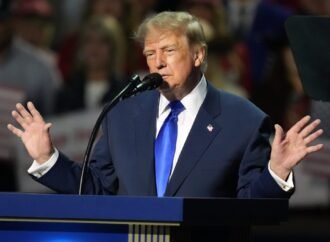
President Donald Trump came to battleground North Carolina doubling down on a tantalizing and implausible midterm promise. “If we win,” he said, “we’re going to get you $5,000. So that’s it. Very simple.” The Republican candidates who spoke at the rally had nothing to say about it. Their silence reflects a broader pattern. About a
President Donald Trump’s proposal to send $5,000 to every American adult if his Republican Party maintains control of the House and Senate in the November election needs congressional approval, House Speaker Mike Johnson said Sunday, while pledging to try to make it happen. Trump made the unusual pitch at the party’s midterm convention in Dallas last
President Donald Trump’s pledge to send every American adult a $5,000 check if Republicans hold Congress in November carries a price tag that economists say has no clear funding source — and would land on a federal balance sheet already strained by a nearly $2 trillion annual deficit. Kent Smetters, faculty director of the Penn Wharton
President Donald Trump pledged Wednesday to send every American adult $5,000 if Republicans retain control of the House and Senate in the midterm elections, an extraordinary gambit to reverse his party’s sagging fortunes in November. The dubious promise would most likely cost more than $1 trillion and require congressional approval, and would further exacerbate the country’s nearly $1.8 trillion
President Donald Trump promised every adult US citizen a $5,000 payment if Republicans win both chambers of Congress in November, dangling a cash incentive as he urged supporters to treat the midterm elections like another presidential race. Speaking at the Republican Party’s midterm convention in Dallas on Wednesday, Trump unveiled what he called the “Trump
I meet with health system executives routinely, and I hear very common themes: rising demand for care, a strained workforce and significant cost pressures. Clinicians are stretched. Patients are waiting. Hospitals are working to create more capacity without adding more complexity to a system already struggling to keep up with demand. This “triple threat” is