
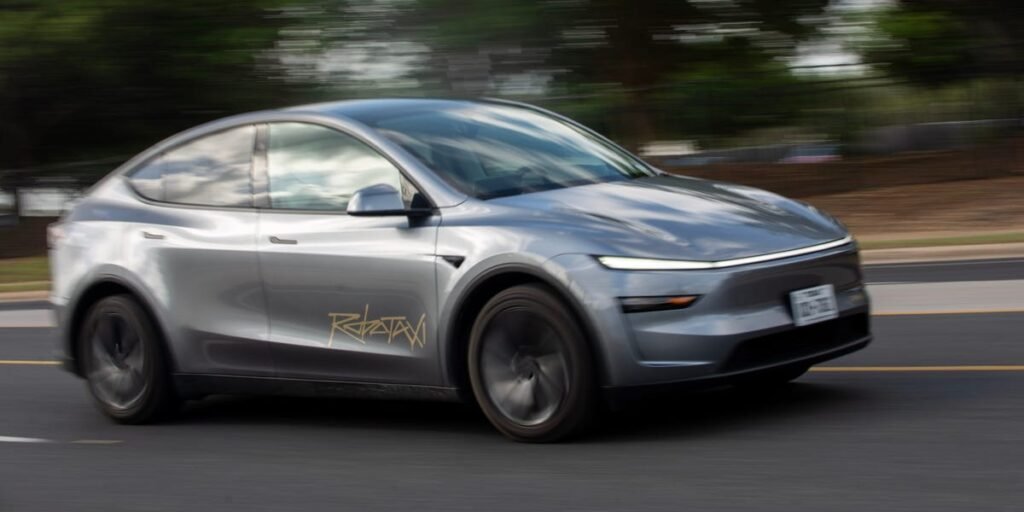
Tesla has some numbers to tout its progress on Robotaxi. CEO Elon Musk and other executives said during Tesla’s second-quarter earnings conference call Wednesday that the company continues to expand its autonomous ride-sharing platform, adding more cities and more unattended rides. Since Tesla first launched Robotaxi in June 2025 with a small fleet of Model
Tesla has some numbers to tout its progress on Robotaxi.
CEO Elon Musk and other executives said during Tesla’s second-quarter earnings conference call Wednesday that the company continues to expand its autonomous ride-sharing platform, adding more cities and more unattended rides.
Since Tesla first launched Robotaxi in June 2025 with a small fleet of Model Ys and safety monitors, the launch of the company’s ride-hailing service has been slower than Musk’s predictions.
The CEO said in July 2025 that Tesla could reach half of the US population by the end of 2025, pending regulatory approval.
Tesla now lists seven US metropolitan regions, including two Florida cities, Orlando and Tampa, announced on the eve of the company’s second-quarter earnings call.
The company has yet to disclose the size of its overall fleet, the number of paid trips, turnaround rates or the economics of each trip.
Musk said during the earnings call that safety is central to limitations on the scale of Robotaxi’s deployment.
“If we injure even one person, it will be front-page news around the world and regulators will immediately clamp down on our activities,” he said. “We’re going to scale Robotaxi as fast as humanly possible, but at the same time we’re trying to make sure we don’t hurt anyone at all and ideally not even run over a pet.”
Here are seven numbers that demonstrate the progress of Tesla’s Robotaxi:
1. Almost 2.5 million miles paid in total
Tesla said in its report to shareholders that Robotaxi had reached nearly 2.5 million accumulated paid miles at the end of the second quarter.
The figure includes trips with a safety monitor (a human supervisor who oversees the autonomous software) in the car. In the San Francisco Bay Area, a safety monitor remains behind the wheel.
2. Over 380,000 miles unattended
Ashok Elluswamy, vice president of AI at Tesla, said Robotaxi has driven more than 380,000 miles unsupervised in six cities in two different states.
This is one of the most concrete figures Tesla has provided about its progress on unsupervised rides. Tesla has yet to reveal how many cars operate without a safety monitor.
For comparison, Alphabet’s Waymo has driven more than 200 million fully autonomous, passenger-only miles.
3. Weekly mileage growth of more than 10%
Musk said Robotaxi has seen a growth rate of more than 10% in miles traveled per week.
Similarly, Elluswamy said unattended mileage has increased at “double-digit growth rates” per week since the beginning of the year.
“We expect to continue growing at such a high rate for the rest of this year,” Elluswamy said.
4. Seven US metropolitan regions
Tesla said Robotaxi is now active in seven US markets: Austin, Dallas, Houston, Miami, Orlando, Tampa and the San Francisco Bay area.
All regions except the Bay Area are “increasing unattended travel,” the company said on the shareholder platform.
Tesla is also targeting Phoenix and Las Vegas, with “preparations underway.”
Meanwhile, Waymo operates in 11 US regions.
5. Zero ‘notable incidents’ from Robotaxi
Elluswamy said there have been “zero notable incidents” in the more than 380,000 miles driven by Robotaxi without supervision. He added that the known incidents involved other road users crashing into stationary Teslas.
Tesla has reported accidents to federal regulators, including two low-speed accidents that occurred after Tesla’s teleoperator assumed direct control of the car. In both incidents he had a safety monitor at the wheel.
Elluswamy said the progress was a “great validation of Tesla’s entire AI approach.”
6. More than 125,000 Cybercabs in manufacturing capacity.
Tesla said it has installed an annual manufacturing capacity of more than 125,000 Cybercabs (the company’s purpose-built robotaxi) at Gigafactory Texas. Production began during the second quarter.
For comparison, Zoox, Amazon’s robotaxis company, says its factory in Hayward, California, can assemble more than 10,000 specially designed robotaxis a year once it operates at scale. Waymo has said its Arizona plant can build “tens of thousands” of robotaxis under construction.
Tesla’s number does not represent the current production rate, which was not disclosed.
Musk said Cybercab needs to accumulate more driving data specific to its chassis before the company can put more into circulation.
Employees have started taking autonomous rides in the Gigafactory car, Tesla said.
7. Nearly 1.5 million FSD paid customers
Tesla reported 1.48 million paying customers of Full Self-Driving, the automaker’s advanced driver assistance system. That represents a year-over-year increase of 56%.
While FSD for personally owned vehicles requires constant human supervision, one of Tesla’s long-standing promises is that the technology will no longer require driver monitoring.