Yesterday’s punk, grunge, and rebel-outsider upstarts have an uncanny way of evolving into today’s elder statesmen of respectable infamy. (Hello, John Waters, Patti Smith, John Lydon, Henry Rollins, and Robin Byrd.) But it’s doubtful that Tom Six will ever be in the mix of latter-day prestige. His desire to stand apart from it is too
Yesterday’s punk, grunge, and rebel-outsider upstarts have an uncanny way of evolving into today’s elder statesmen of respectable infamy. (Hello, John Waters, Patti Smith, John Lydon, Henry Rollins, and Robin Byrd.) But it’s doubtful that Tom Six will ever be in the mix of latter-day prestige. His desire to stand apart from it is too great.
In case he’s not on your radar, Tom Six is the Dutch director of the “Human Centipede” trilogy, a series of horror films so grotesque that the idea of sitting through them would be a deal-breaker for 97 percent of moviegoers. Six was after the other three percent: the kind who feed off shock and transgression, and who recognize that a horror movie that makes hardened veterans of the genre feel like they have to watch parts of it peeking between their fingers is either a movie that has gone too far…or one that’s the definition of what true horror is. The “Human Centipede” films — especially “The Human Centipede 2 (Full Sequence),” a hellacious “Götterdämmerung” of torture porn — were both.
Released in 2009, 2011, and 2015 (and watched mostly on VOD), the “Human Centipede” films carved out an extreme niche on the edge of global movie culture. Yet they also found a perverse mainstream foothold, becoming a cheeky meme (sorry! pun intended) referenced on “South Park,” “The Simpsons,” “Saturday Night Live,” “Unbreakable Kimmy Schmidt,” “Deadpool 2,” “Beavis and Butt-Head,” and the Childish Gambino video for “Bonfire.” Tom Mix wasn’t aiming for respectability; he was going as far as possible in the opposite direction. But he was courting notoriety and fame, and he did it by working in the carny-barker freak-show tradition of exploitation-world self-marketers like Herschell Gordon Lewis, Russ Meyer, Ted V. Mikels, and (of course) John Waters. These were filmmakers who specialized in selling a vibe of on-the-fringe danger, creating an underground mystique that was part of what made them successful. (By the time Waters was done peddling “Pink Flamingos” on the midnight-movie circuit, he had made a fortune, which became the basis of his trash-art empire.)
“The End of Tom Six” is about how Tom Six made and sold his films in the same spirit. But it’s also about how his dark dream came crashing down. The movie, which premieres this weekend on YouTube, is a DIY schlock- umentary that’s also a real documentary, one that captures how Six’s life became his own private horror film, after he was diagnosed with multiple sclerosis.
He first learned that he had the condition 14 years ago, and for a long time he was able to manage its symptoms comfortably (and in secret). But MS is incurable and progressive. For the last six years, Six has lived as a recluse in Amsterdam, lying in bed and going out twice a day for decaf coffee (the regular brew is too hard on his shattered nerves). “The End of Tom Six” is a self-styled confessional memoir in which Six fuses his life and career and illness into a kind of parable. He’s asking: Is there room anymore for movies like his, that stray over the line? And if not, what does that mean?
Shot in black-and-white, “The End of Tom Six” opens with noirish images of an Amsterdam canal, lined with street lanterns that look right out of the London of “Dr. Jekyll and Mr. Hyde.” The images are accompanied by a doomy romantic Hollywood/classical score, and then, in old-fashioned letters, the words “The End” appear (with the added words “…of Tom Six”). So this will be the story of the end of Tom Six’s life. But it’s really the story of how he made his movies, and sold his image, and is still doing it, to the point that you may wonder at moments if his battle with MS is actually an Andy Kaufman stunt. (I don’t think it is; but one wouldn’t put it past him.)
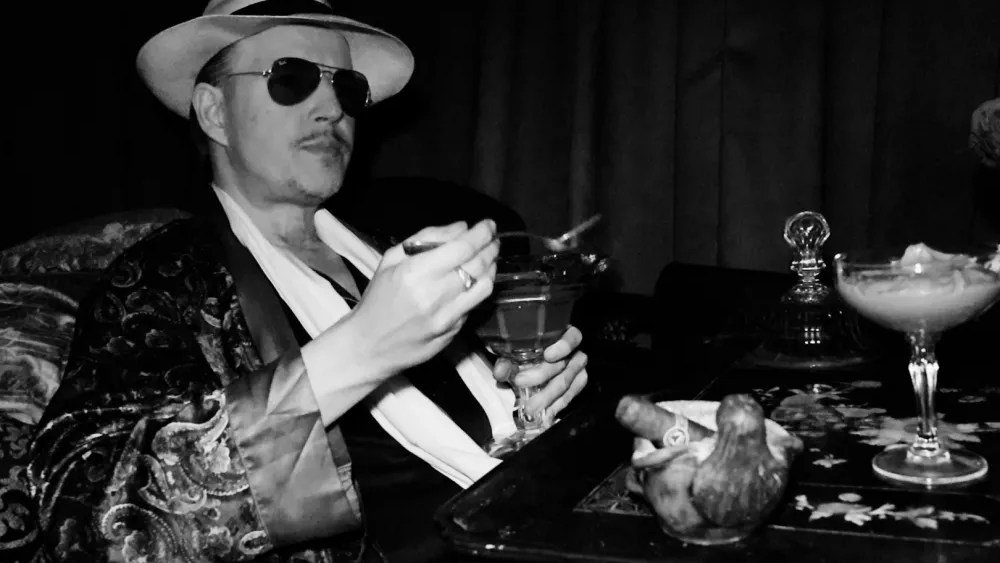
The film moves inside Six’s home, where he’s lying in a paisley silk bathrobe on an antique Chinese opium bed, wearing a dandified mustache and Panama hat and dark aviator shades, smoking a Havana cigar, looking like Hunter Thompson’s hip Euro brother crossed with Michael O’Donoghue crossed with a svelte version of Rainer Werner Fassbinder. Mix is surrounded by a small crew and entourage: his paramour, Marci (Maartje Willems), who beams and insinuates like Morticia Addams; the film’s megaphone-wielding director, also played by Six; the camera man, boom operator, and butler, all played by the dwarf actor Edwin Alofs; a uniformed Nazi (Servaes Nelissen) who’s on hand to gloweringly comb the proceedings for trigger warnings and ideas worthy of censorship; and a first assistant director (Demian Kurosa) who looks like a circus tattooed man and talks with a post-operative vocoder.
Six keeps cutting between himself and this kitsch gallery of jokers, tossing in B-movie “All About Eve” exchanges (“Alcohol is killing you slowly, baby.” “That’s okay, I’m not in a hurry”), which keeps the tone light. It also purges the movie of self-pity and helps to break up what is basically an amusing and irascibly witty Tom Six monologue of self-justification. Is “The End of Tom Six” for fans only? No question. But I count myself among the three percent who watched “The Human Centipede 2” and found it to contain a hint of the awesome within its awfulness, the same way I felt when I read the Marquis de Sade’s “The 120 Days of Sodom.” These are not works you recommend to people. But they’re works that, in their sick way, might be said to expand one’s vision of human evil.
I was interested, after 15 years, to discover what sort of dude Tom Six is, and to hear him explain to his audience why he made these movies, and about how it shaped his experience (“To this day, I get marriage proposals and death threats”), and to listen to his diary of debilitating illness. “The End of Tom Six” is not a work of true-life body horror. Six describes his symptoms, and drug regimen (Oxycodone for the chronic pain), with tough understatement. At one point, though, he does admit, “I’m a fucking living X-ray. I’ve got massive brain fog from all the medications. My thoughts are like scrambled eggs.”
What he wants to talk about is the movie he made after the “Human Centipede” trilogy. It’s called “The Onania Club,” and it’s the story of a group of chic women in Los Angeles (Chloë Sevigny is one of the stars) who get aroused by the misery and suffering of others. It is, as Six describes it, a story about the opposite of empathy. But in that sense, it’s about the loss of empathy, and maybe the end of it.
Tom Six made “The Onania Club” in 2019, and though he had struggled to find a distributor for “The Human Centipede” and its sequels, he eventually did. With those films having crossed over into the pop consciousness, he figured he’d have no problem nailing down a distributor for a movie less grotesque and more serious. But no distributor would touch it. What he kept hearing was “The marketplace has changed.” In other words, no one wanted to deal with the controversy that might rear its head in an increasingly censorious environment. Six claims that the stress of all this exacerbated his illness. The way he portrays it, his health disaster was the crucifixion a clampdown society helped to reinforce. We’ll have to take his word on that. But while I haven’t seen “The Onania Club” (it remains unreleased), and therefore can’t comment on it, I will say this much. “The End of Tom Six,” an underground-cinephile-on-acid curio, is worth seeing for the question it raises: Do we want the arena of cinema to be a place where anything can happen, or do we want it to be a safe space?
Keep following us for the latest insights.