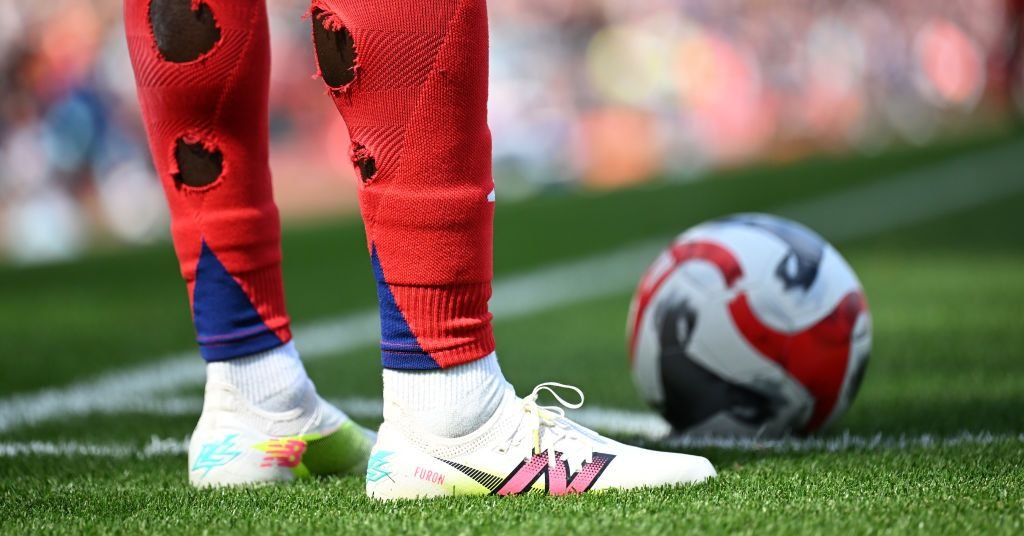
During this year World Cup, a scene is repeated match after match: several players take the field with holes in the calves of their socks. Social networks are full of theories about the supposed competitive advantage this could give them. But the practice is not new. It has been seen at the European Championships, Olympic
During this year World Cup, a scene is repeated match after match: several players take the field with holes in the calves of their socks. Social networks are full of theories about the supposed competitive advantage this could give them. But the practice is not new. It has been seen at the European Championships, Olympic Games and other international competitions over the last decade. Still, science has yet to find evidence that it improves performance.
Professional soccer socks are, by design, tight fitting. In addition to holding the shin guards in place, they provide support to the ankle, arch, and calf; They help control moisture and reduce foot movement within the cleat to improve stability. This design principle has been used in professional football for decades. Although materials have evolved to become lighter and more durable, they are still primarily based on synthetic fibers such as polyester, nylon, and spandex.
But many players have complained that the socks are too tight and cause a tingling and numb sensation in the calf area. The discomfort is so great that, halfway through the game, they make several holes in the calf area to “release tension” and run better.
There is a biomechanical component to this sensation. During a sprint or change of direction, the largest muscle in the calf contracts and increases in thickness to generate the force that propels the athlete forward. This shapeshifting occurs thousands of times during a game. For some, the repeated expansion of the muscle is enough to create a sensation of pressure as the sock exerts constant compression on the calf.
Over time, the practice of making holes in socks has acquired an almost intuitive explanation among players themselves: opening the fabric allows the muscle to “breathe,” relieving pressure and reducing the likelihood of pain or cramps. However, sports medicine and recovery specialists point out that there are no studies that show that putting holes in socks provides any benefit. In fact, much of the research on compression garments concludes that, when designed and fitted properly, they can help limit muscle inflammation after intense exertion.
Despite the lack of evidence on physiological benefits, the practice continues to spread among professional footballers. Today, it is primarily considered an anecdotal phenomenon, based on each player’s personal experience rather than scientific evidence. Furthermore, the rules of the game do not prohibit modifying socks, as long as the equipment remains secure and the shin guards are properly covered. (A soccer player, however, cannot play with a torn jersey.)
Given the lack of scientific evidence, several specialists believe that part of the phenomenon could be explained by the player’s own perception of comfort. In high-performance sports, the feeling of comfort can influence the confidence with which an athlete competes. If a soccer player believes a piece of clothing is restrictive, eliminating that perceived discomfort can make him feel freer to run, accelerate, or change direction, even if his performance remains objectively unchanged.
Although there is no evidence that cutting socks provides a competitive advantage or reduces the risk of injury, that doesn’t mean the feeling of discomfort is imaginary. The perception of pressure, restriction or comfort depends on multiple factors, ranging from anatomy and individual sensitivity to the athlete’s past experiences. In other words, two players can react differently if they use the exact same equipment.
For now, it looks like the sock cutting will continue. The available evidence points to a mechanism similar to that of other sports rituals: its effect is mainly psychological, not necessarily physiological.
This article originally appeared in WIRED in Spanish and has been translated from Spanish.
Keep following us for the latest insights.