
US forces shot down an Iranian Shahed in the Middle East this week using an interceptor drone tested in Ukraine, a US official told Business Insider on Friday. The engagement marks the first time U.S. troops have used the U.S.-made Merops system to intercept a hostile drone in combat. Ukraine has used it to take
US forces shot down an Iranian Shahed in the Middle East this week using an interceptor drone tested in Ukraine, a US official told Business Insider on Friday.
The engagement marks the first time U.S. troops have used the U.S.-made Merops system to intercept a hostile drone in combat. Ukraine has used it to take down over 1,000 Russian Shaheds. Several Eastern European countries have purchased and implemented the system.
Drones are playing an increasingly central role in warfare, as conflicts in Ukraine and the Middle East have demonstrated in recent years, creating greater demand for low-cost interception systems.
U.S. Army soldiers in Kuwait recorded at least one intercept of an Iranian Shahed, a type of explosive one-way attack drone, this week, the U.S. official said, speaking on condition of anonymity to discuss sensitive military developments.
The United States and Iran have been exchanging fire for weeks after the collapse of a fragile ceasefire. US forces have bombed Iranian military sites, while Tehran has launched drones and missiles across the Middle East, targeting countries hosting US bases.
A US official told Business Insider last week that US forces had intercepted dozens of Iranian missiles and drones since fighting restarted earlier this month. Some Iranian weapons, however, have found their mark. At least four U.S. service members have been killed and nearly 100 more wounded this month.

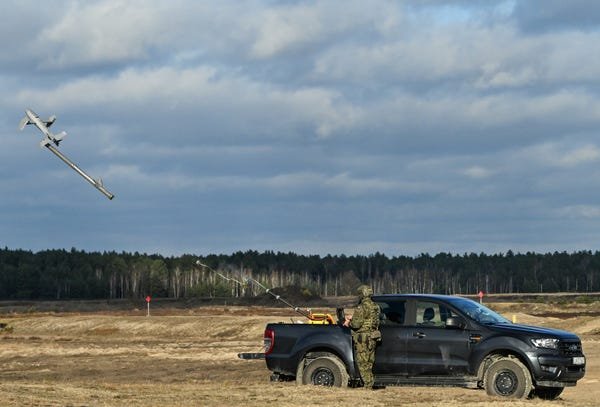
The Merops system consists of a $15,000 interceptor drone. Photo by Artur Widak/NurPhoto via Getty Images
The Army deployed the Merops system to the Middle East in March, at the start of the war with Iran, along with troops to operate it. US personnel have been training to use it in the weeks since.
Merops, manufactured by the US initiative Project Eagle, consists of a radar, a launcher, a ground control system and a $15,000 interceptor that can reach speeds of more than 175 mph. The interceptor can use artificial intelligence to navigate through areas saturated with electronic warfare.
Merops is operated by a small crew that can be trained in just a few days. The interceptor, which destroys Shaheds by colliding with them or exploding in close proximity, is piloted using commercially available tools. xbox controllers.
The interceptor is cheaper than many other anti-drone systems in the Pentagon’s arsenal and, at $15,000 each, offers the United States a cost-effective way to shoot down Shaheds without wasting its much more expensive missiles.
US Army Secretary Dan Driscoll told lawmakers in April that the service bought thousands of interceptors after the war with Iran began and said he expects the price to fall below $10,000 each as production ramps up.
The Army’s acquisition of Merops underscores growing interest by the United States and its NATO allies in cheap interceptor drones, which have been used with resounding success in Ukraine. The Merops system was first deployed in Ukraine and, by November 2025, had already intercepted more than 1,000 Russian Shahed-type drones.
Poland and Romania purchased Merops following Russian incursions into NATO airspace in September 2025. Lithuania said in April that it intends to purchase the system, becoming the latest ally on the eastern flank to do so.