Scaling a recipe up or down is often more complicated than just increasing or decreasing the ingredients and cook time. Eden Faithfull November 8, 2026 Save You have reached your maximum number of saved items. Remove items from your saved list to add more. No gift articles left You’ve used all of your gift articles.
Scaling a recipe up or down is often more complicated than just increasing or decreasing the ingredients and cook time.
Eden Faithfull
It seems simple enough: if the head count at your next dinner party doubles, the ingredients for your dinner do the same. Conversely, if you’re looking to scale down the size of your favourite cake for a late-night treat, you should be able to simply halve the recipe.
Unfortunately, it’s not quite that simple. You’ll probably end up with bland curry and sunken cakes if you don’t account for a few things first.
It’s easy to look at a recipe as a set of ratios you can multiply or divide at will. But recipe developers have to account for the physical and chemical processes that ingredients go through when you combine and cook them, and many of those processes don’t scale in lockstep with your shopping list.
Sometimes, making two batches of a recipe and serving them together is the safest way to ensure that you’re not walking into the pitfalls that inadequately scaling your recipe can present. But if you must scale a dish, whether up or down, here are five scenarios where you might run into trouble.
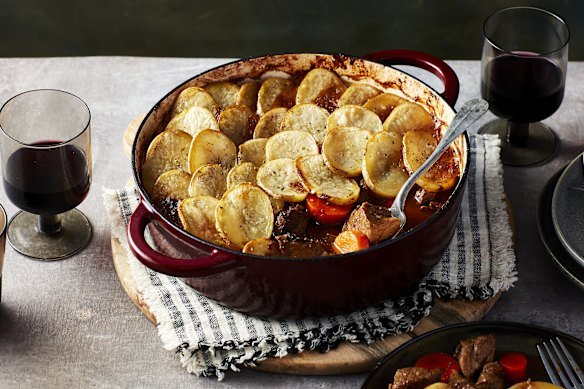
Braising
The best recipes from Australia’s leading chefs straight to your inbox.
Sign up
If you want to double the quantity of your favourite dinner party stew, you’ll end up with twice the volume of ingredients (great!) and the same pot you started with (not so great). Evaporation is a function of surface area, not volume, and your surface area hasn’t budged — so in the hour the recipe allots, you’ll drive off the same amount of liquid you would have before. Against twice the volume, that’s only half the reduction you need.
Halving your ingredients presents the same issue but in reverse. The surface area remains the same, but there’s only half as much liquid to lose. The same hour’s evaporation leads to scorched meat and a dry pot.
The safest fix is to adjust your cooking vessel. If you can’t do that, here’s a good rule of thumb: Instead of directly doubling the entire recipe, use about 1½ times the liquid ingredients, and double the rest. If you’re halving the recipe, use about 60 per cent of the liquid and half of the rest of the ingredients.
This all matters most for braises you finish uncovered, or ones that you reduce at the end of cooking. If your pot stays lidded in the oven, evaporation is admittedly a much smaller factor. But you’re not out of the woods yet. Even when evaporation isn’t a factor, you still have to adjust the clock when scaling a recipe. A much larger volume of food is going to take considerably longer to finish cooking, and vice versa with a smaller volume.
Grains and (some) beans
While cooking, rice absorbs a fixed amount of water — but the amount of water called for in a recipe doesn’t just account for what the grain absorbs. Part of it is to account for what escapes as steam, which depends on the surface area available and the time it takes to cook, so it doesn’t change when you double the rice. Double both quantities, and you’ve doubled the water allowance for steam that should have stayed put.
So, when scaling a recipe for grains (or beans that cook using the absorption method), adjust the absorption and leave the allowance alone. A safe bet is to figure about 1¼ cups of water per 1 cup of rice, then add about ¼ cup for what steams off, no matter how much rice is in the pot.
For example, if a recipe calls for 1 cup of rice cooked in 1½ cups of water, your gut instinct might tell you that to double it, you should use 3 cups of water; not so. Instead, you would use 2 cups of rice cooked in 2¾ cups of water.
Baking
When baking a cake, the oven’s heat works its way in from the outside. With double the batter for the heat to penetrate, the centre stays liquid much longer. The leaveners in the batter are working faster than it takes for the other ingredients to set and bake, due to that larger quantity needing more time to reach the right temperature. This creates air bubbles that usually help to inflate our baked goods (creating a beautifully domed cake), but without the structure of a set crumb the cake will crumble and crater, as the air pockets created by the leaveners merge and escape through the batter that hasn’t fully set.
When scaling a baking recipe, your safest option is to simply make two batches. If you must scale your ingredients, be sure to swap your pan out (if doubling, for a larger pan; if halving, for a smaller one), so the batter sits at roughly its original depth. That way, the oven’s heat can uniformly bake your sweet treat without allowing your cakes to collapse.
A few more quick tips when scaling a baking recipe up or down:
- Weigh your ingredients. The volume of a cup of flour can vary significantly depending on how it’s packed, and doubling a recipe can compound those errors.
- Need to halve an egg? Crack it into a small bowl, whisk to combine the white and yolk, and measure out half of that mixture.
- Go off visual and flavour cues. If you can see that your cookies have reached that perfect golden brown, or that your dish is already salty enough before reaching the “double” mark, trust your gut.
Fat in the pan
Finally, the fat in your skillet (the tablespoon or so of oil you sauté your garlic and onion in) doesn’t need to be doubled along with the ingredients that you’re cooking in it. Its job is to cover the pan and conduct heat into whatever you’re cooking, so it scales with the pan, not with the food.
If you need to double a stir-fry, you don’t need to double the oil that’s in the pan all at once, but you do need to make two batches. By simply dumping double the ingredients into a single wok, you’re going to steam the food rather than allowing it to develop a flavourful browning.
This is only the case for browning, though. If you want to sweat some onions for a soup or a braised recipe, crowding isn’t an issue, so you’re welcome to add double the onions and just enough fat to coat the larger volume of ingredients.
Washington Post
From our partners
Check back often for more exciting news!