
The hype over AI seems endless, and investors are salivating at the opportunity to finally buy shares of some of the biggest names in the industry. But as Anthropic and OpenAI prepare to go public, and as SpaceX stock struggles after a historic initial public offering, there is reason for investors to tread carefully, says
The hype over AI seems endless, and investors are salivating at the opportunity to finally buy shares of some of the biggest names in the industry.
But as Anthropic and OpenAI prepare to go public, and as SpaceX stock struggles after a historic initial public offering, there is reason for investors to tread carefully, says Apollo chief economist Torsten Sløk.
SpaceX kicked off the summer with the largest initial public offering in history, setting the stage for this year’s avalanche of stock offerings from some of the most coveted private tech companies.
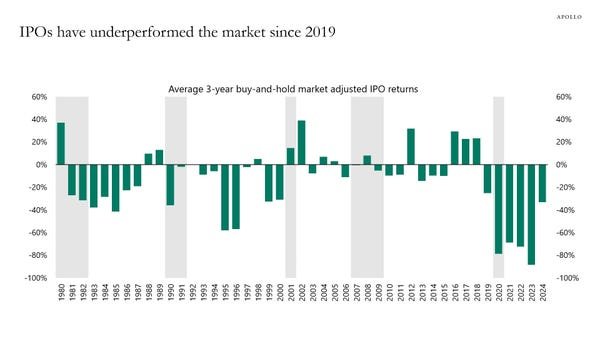
But as a chart shared by Sløk shows, recent history suggests that shares of new public companies are a risky bet in the years after an IPO.

Apollo Global Capital/The Daily Spark
Since 2019, the market regime influencing companies’ post-IPO stock performance has been characterized by three things: “peak valuations,” “a hostile rate regime” and “low quality, high standard,” Sløk said.
“The boom pushed marginal companies to go public before they were ready, while the market-adjusted benchmark was compared to an index carried by a handful of mega-cap winners,” he wrote.
The economist noted that this was particularly true during the pandemic-era boom of 2020 and 2021. The combination of zero interest rates and high retail demand fueled by government stimulus created an environment that generated rich valuation for companies rushing to go public.
A new wave of mega-IPOs is now taking shape, as OpenAI and Anthropic prepare to debut. Despite some concern about its high valuations, investor enthusiasm is high.
Other market professionals have raised similar concerns about the rush to public markets. Economist and IPO market veteran Jay Ritter told Business Insider that the story suggested SpaceX stock would underperform. His decision has proven accurate about six weeks after the offering, with shares falling about 18% from the IPO price of $135.
“Each of these forces could persist,” Sløk added of the factors that hampered IPOs in the years after 2019. “Valuations may become inflated again in the next IPO window, rates appear to remain structurally higher than in the 2010s, and index returns remain concentrated in a few megacaps that keep the bar relatively high.”