Hulu’s crime drama “Furious” may be (loosely) inspired by the 1987 thriller “Black Widow,” but the series has several other, and frankly stronger, influences at play. After all, by swapping out a wealthy male serial killer whom she marries for money in favor of a child trafficking victim who attacks her former abusers, creator Elizabeth
Hulu’s crime drama “Furious” may be (loosely) inspired by the 1987 thriller “Black Widow,” but the series has several other, and frankly stronger, influences at play. After all, by swapping out a wealthy male serial killer whom she marries for money in favor of a child trafficking victim who attacks her former abusers, creator Elizabeth Meriwether (“New Girl,” “The Dropout”) has left only the most basic outline of the original film. But by turning one of those abusers into a New York mogul with an atrocious interest in underage girls, Meriwether consciously evokes the ghost of the late financier Jeffrey Epstein. And by making both Catherine (Lola Petticrew of “Say Nothing”), the murderer in question, and Alice (Emmy Rossum, also an executive producer), the rookie FBI agent hot on Catherine’s trail, survivors of a trauma that sometimes explains their connection too clearly, “Furious” fits comfortably into the current taste for psychologized storytelling.
But if “Furious” can sometimes be weighed down by these associations, particularly as its eight-episode season nears its conclusion, the show often transcends them as well. That’s largely due to a stellar cast that deepens and complicates the assigned archetypes. (Though not exclusively: Ariel Marx’s haunting, partially vocalized music sets a gripping tone.) Rossum’s Alice is a recent NYPD transfer, trying to escape both the shadow of a long-term abusive relationship and her real ex (Jake Lacy, king of well-presenting assholes) still working as a detective. However, as is often the case in cat and mouse stories, it is Catherine who truly captivates. Petticrew broke into America playing IRA activist Dolours Price, a woman whose understandable grievance led her to harm innocent civilians and herself. Catherine takes that description to new extremes, embodied by Petticrew with terrifying intensity.
“Furious” takes its name from Alice and Catherine’s preferred coping mechanism for their emotional wounds. Alice’s new supervisor, Nora Washington (Quincy Tyler Bernstine), compares her target to Medusa, the legendary Gorgon with a petrifying gaze and snakes for hair, although she only became that way after being raped by the sea god Poseidon. “She’s a victim, but that doesn’t make her a good person,” Nora explains. “It turns her into a monster.” Interesting Nora in antiquity makes her a source of solemn speeches, including a sermon on the various ancient Greek terms for different types of anger. These platitude-filled monologues can seem more like an assigned role than authentic expression. But Nora, a jaded cynic whose time in charge of the sex crimes unit has turned her into a burned-out alcoholic who doesn’t even bother to hide her addiction, is also able to express the show’s ideas more clearly. “I’m fucking angry,” she says.
Catherine says the same thing when an unsuspecting guy asks her about her sex work history. What she doesn’t realize is that she was forced into the profession at a criminally young age, an experience that left her frozen in time. From her lack of impulse control to her swinging emotions and the beat-up backpack she carries around like a talisman, Petticrew’s Catherine is disturbingly childish even when she’s engaging in adult activities like trapping men before injecting them with fatal doses of fentanyl. We first see her wearing a Halloween mask, offering candy to children who are unaware that there is a dying captive climbing the stairs.
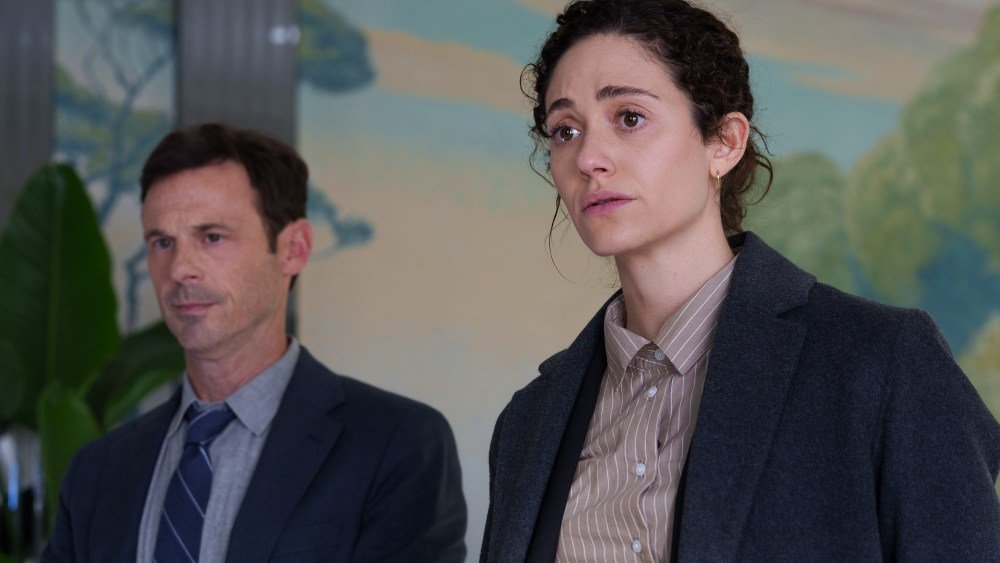
Alice, on the other hand, is told by someone who has known her for decades that she “was never a child.” The former Fiona Gallagher of “Shameless” returns to play the blue-collar survivor of a difficult upbringing in a major city, although the script can make America’s largest city seem like a small village. Catherine’s case becomes a joint operation between the feds and local authorities, putting Alice on the same team as her former supervisor Danny (Scoot McNairy), the only cop who backed her up when she trusted him, and Lacy’s own Marshall. That the former couple’s employers would tolerate such a conflict of interest in a high-stakes investigation is quite absurd. Then “Furious” doubles down, making the parallels between Alice and Catherine more explicit than a shared history of dealing with powerful, protected men that is more than enough on its own.
Fortunately, “Furious” has periodic reminders that Meriwether is also the force behind “The Dropout,” a pitch-perfect portrait of female sociopathy, and “Dying for Sex,” a more positive but no less thoughtful view of how sexuality squares with physical vulnerability. I thought about the latter while watching Petticrew’s scenes with “Ramy” star Steve Way, who plays Catherine’s client at her day job as a home health aide. In the presence of the rare man at her mercy without She jams a syringe in his arm, Catherine lets her guard down, and the actors form a warm, wounded chemistry that’s a respite from some of the bleaker material.
Alice finds her own romantic solace in anonymous app-based men whom she asks to abuse her on her own terms. This character detail does little to darken Alice’s profile as a damaged but defiant adrenaline junkie, but the nuance missing from these encounters can be found in the handful of scenes between Rossum and Lacy. Both performers excel at removing the layers of anger, resentment, love and longing between two sides of a society that had its good side along with the terribly bad. Alice can’t bring herself to shower, the site of Marshall’s worst attacks, but admits she still misses the smell of his neck.
The drastic measures Alice takes to end this vicious cycle naturally bring her closer to Catherine’s school of violent retaliation. Alice and Catherine don’t rise to the level of great hunter-prey couples like Hannibal and Clarice or Eve and Villanelle, but “Furious” still offers a compelling study of female victimhood and what happens when women break the limited scripts of our culture. “Everyone likes to see a sweet little woman lying on the ground, cut into pieces,” Nora observes. (Bernstine is not only great; she’s often quite funny as a seasoned pro, so she doesn’t bother to mince words.) By refusing to become that woman, both Catherine and Alice become something less desirable. The QAnon era may be addicted to stories about trafficking and children in danger, but “Furious” is at its best when it leaves the buzzwords behind to offer an unflinching look at those affected, warts and all.
The first three episodes of “Furious” are now streaming on Hulu, with the remaining episodes streaming weekly on Mondays.
For more tech updates, stay tuned to our blog.