The shipping industry needs low-carbon fuels if it is to reach net-zero greenhouse-gas emissions by 2050. But options are limited. Batteries can power ferries and vessels for use in harbours, but are impractical over long distances1. Methanol is hard to produce sustainably2. Ammonia is toxic and its supply chain is polluting3. Hydrogen is too bulky
The shipping industry needs low-carbon fuels if it is to reach net-zero greenhouse-gas emissions by 2050. But options are limited. Batteries can power ferries and vessels for use in harbours, but are impractical over long distances1. Methanol is hard to produce sustainably2. Ammonia is toxic and its supply chain is polluting3. Hydrogen is too bulky and difficult to store safely at sea4.
Nuclear reactors are being eyed as a solution. Atomic energy produces no direct carbon dioxide emissions and avoids the need to store several thousand cubic metres of fuel on board, freeing up space for cargo. Using nuclear power could shorten voyage times by eliminating refuelling stops and attaining higher speeds. It could save a ship owner tens of millions of dollars per ship per year in marine fuel costs and carbon taxes (see go.nature.com/4hs7u3r).
China reins in the spiralling construction costs of nuclear power — what can other countries learn?
A new generation of nuclear-powered commercial ships could be ploughing through the waves in the next decade. Interest from industry and governments is growing. In May, the US Maritime Administration sought public input on a commercially viable, scalable small modular reactor system for marine use. In 2028, London-based Core Power plans to open an order book for mass-produced floating nuclear power plants, with full commercialization in the mid-2030s and nuclear civil ships to follow. In China, the state-owned Jiangnan Shipyard, based in Shanghai, plans to build the world’s first thorium-powered container vessel by 2035.
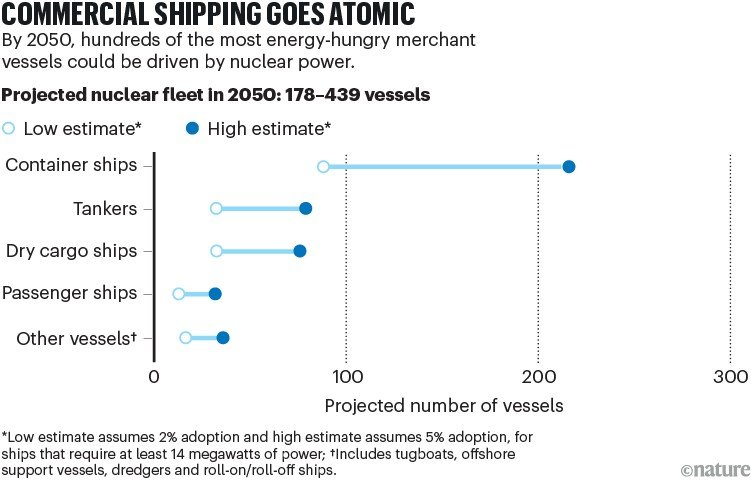
A 2023 US report estimates that several hundred nuclear-powered merchant vessels (mostly container ships,large bulk carriers and oil tankers) could be operating worldwide by 2050, assuming a 2–5% market share5 (see ‘Commercial shipping goes atomic’). But a merchant ship fitted with a reactor is a mobile nuclear facility that needs to be treated with great care. It could be hijacked, run aground or even come under missile attack.
Source: Ref. 5
Before nuclear-powered ships reach the seas, the world needs to develop robust regulations around them. Engineers, regulators, ports and shipping companies must make these vessels safe and controllable. But current rules are outdated and fragmented.
Two major efforts are under way. In late August, at a ministerial-level event in Washington DC, the International Atomic Energy Agency (IAEA) plans to bring nuclear and maritime regulators together at the launch of its Atomic Technologies Licensed for Applications at Sea (ATLAS) initiative. In June 2025, the International Maritime Organization (IMO) began revising its 1981 Code of Safety for Nuclear Merchant Ships, and expects to adopt a revised code in 2030.
Here we set out what is at stake and call on the IAEA and IMO to link reactor licensing, ship certification, port entry and emergency response into one framework, lest companies, ports and countries implement incompatible systems and a nuclear accident at sea ensues.
From military to commercial use
Nuclear power has a long history at sea, driving submarines, aircraft carriers and icebreakers. Compact reactors with robust shielding, detailed maintenance plans and regular crew training have operated for at least 70 years in tough maritime environments, even under polar ice.
The US Navy runs one of the world’s largest nuclear fleets. By December 2024, it was operating 77 nuclear-powered warships — 66 submarines and 11 aircraft carriers — making up roughly half of the global fleet. Since 1955, US nuclear-powered vessels have racked up distances of some 300 million kilometres.
China, France, India, Russia and the United Kingdom also operate nuclear submarines and Russia has civil nuclear icebreakers. Today’s global fleet is smaller than it was at the end of the cold war — in 1989, more than 400 nuclear submarines were in operation or being built, compared with around 150 in service today.
Forty years after Chornobyl, more nuclear disasters are inevitable — plan for them
Yet this same record exposes the difficulty of commercial application. Nuclear use in a navy is part of a system of sovereign capabilities: one state (or several in close partnership) can design and construct the reactor, build the infrastructure for maintaining or replacing it, train the crew and assume responsibility for safety.
By contrast, most commercial ships are designed in one nation, built in another, flagged in a third, insured in a fourth, enter a variety of foreign ports, and often recycled at the end of their lives in countries with lax safety procedures6.
Early civil nuclear-powered merchant ships failed to achieve broad commercial success. Just four have been built. Launched in 1959, the NS Savannah was part of US president Dwight Eisenhower’s Atoms for Peace programme. It was able to travel the world and dock in many ports. But the complicated procedure for obtaining permits for visits and berths made it unviable as a cargo ship.
West Germany’s Otto Hahn, launched in 1964, carried ore around the world for 9 years, travelling 1.2 million kilometres and visiting 33 ports in 22 countries, before its reactor was removed and the ship converted to conventional propulsion in 1982.
Launched in 1969, Japan’s Mutsu faced a public-relations disaster in 1974, after a shielding flaw caused neutrons to leak during a reactor test. Although not catastrophic, the incident bred local opposition, which kept the ship out of operation for years.
The fourth, Russia’s Sevmorput, entered service in 1988 and spent decades carrying cargo along the northern sea route in the Arctic. It was the only nuclear-powered merchant ship still operating in the 2020s, having been kept on as a state-owned ice-capable cargo vessel.
New technologies
Most early ships ran on low-enrichment uranium fuel, much as a civil nuclear power station does. But current propulsion options are more diverse7. They include technologies developed from long experience with icebreakers and small modular reactor programmes, such as light-water, high-temperature gas-cooled, lead-cooled fast, molten-salt and heat-pipe reactors. Other experimental designs are on the table.
However, an expanded technology menu only poses more safety questions. Any reactor-powered ship requires licensing, insurance, crewing, upkeep, port acceptance, emergency preparedness and response and support for decommissioning. Even Savannah’s final disposition remains a regulatory issue, yet to be solved. Some business models assume leased reactor modules and lower operating costs through remote monitoring, centralized refuelling and decommissioning. But those choices do not assure ship safety.
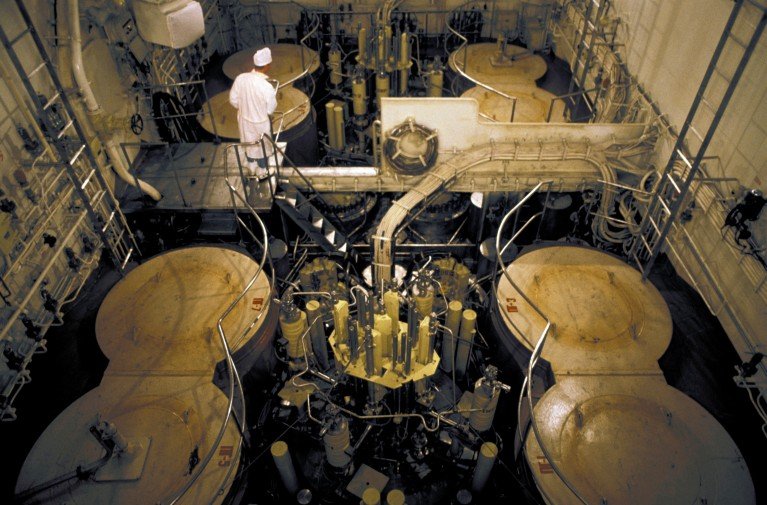
One of two nuclear reactors on board the Russian ship Rossiya. Credit: Patrick Landmann/Science Photo Library
Military records show where stress and poor planning can lead. Soviet nuclear-powered submarines have experienced loss-of-coolant accidents, unexpected power surges and damage to the reactor core. On the K-19 submarine in 1961, emergency repairs to restore cooling exposed sailors to lethal radiation. On K-27 in 1968, a liquid-metal-cooled reactor accident led again to fatal radiation exposures. On K-431 in 1985, a power surge during refuelling at Chazhma Bay, near Vladivostok, caused a steam explosion, killing several workers and contaminating the surrounding area.
Newer reactor designs can reduce some of the hazards, especially when they operate at low pressure and have sealed cores, systems for removing excess heat and robust containment structures8. But advanced approaches mainly shift problems rather than eliminating them. A molten-salt reactor might avoid high-pressure coolant accidents, but regulators still need to know whether salt corrosion can be managed after prolonged exposure to vibration. They will also be concerned about management of tritium and volatile fission products, adequate shielding and reliable removal of heat from radioactive decay after shutdown.
A port licence is also a safety licence
A nuclear-powered ship will require a reactor licence, ship certificates and port authorizations. Each involves separate judgements and permissions.
For the nuclear regulator, the core questions surround reactor safety, radiological protection and nuclear security. For the flag state, they include seaworthiness and crew safety. The port authority is concerned mainly with whether the vessel can enter the harbour, berth, discharge cargo, take refuge or be held in port without risk to the surrounding community.
For a conventional ship, these decisions are standard. For a nuclear-powered vessel, the relationships are more complex. If the harbour master, pilot, terminal operator, underwriter or emergency services are unable to understand the safety assurances provided by the reactor licence, then the document has little practical meaning.
Savannah’s port calls, for example, required extensive negotiations about berthing and transit as well as procedures to deal with emergencies and actions to reassure the public. Mutsu showed that, once confidence is lost, no rational argument is of any use; the ship won’t be welcome.
The war-risk gap
Threats of war and terrorism also pose risks that must be taken seriously. The cost–benefit analysis for nuclear shipping assumes orderly marine traffic and peacetime cooperation between ports. Current events in the Red Sea and the Strait of Hormuz since US and Israeli strikes on Iran challenge this assumption. Iranian-supported Houthi militias in Yemen have repeatedly used drones, missiles and unmanned boats against commercial shipping. In the Strait of Hormuz, restrictions and attacks have disrupted traffic and stranded thousands of seafarers.
If a nuclear-powered ship were to transit such waters, it could face the same missiles, drones, terrorist boarding attempts and electronic disruption as do conventional tankers, but with much greater consequences.
A marine reactor cannot explode like a nuclear weapon; the fuel and geometry of a civilian reactor make that impossible. But other risks cannot be ignored: damage to fuel, loss of shielding or coolant, hydrogen fires or steam explosions can release radioactive material and contaminated firefighting water, and create a shipwreck that no port is willing to receive.
Would a missile attack make a maritime reactor unsafe? It depends. A strike that hits the bow or a container stack might not reach a reactor located near the middle of the ship. However, a strike that hits the engine room, switchboard, emergency generator, control cables or cooling-water intakes could disable the systems that support a safe shutdown.
A container fire could burn for days and block rescue attempts. A hole below the waterline could compromise the vessel’s stability and flood compartments that are assumed to stay dry in the reactor design.
Autonomous ships are on the horizon: here’s what we need to know
Follow-up strikes might hit rescuers. A boarding party could evacuate the crew after the reactor is shut down, but decay heat still needs to be managed.
Check back often for more exciting news!