This Falcon 9 was in orbit since January last year, when it blasted off from Florida. The same booster section from the January 2025 mission is due to set off on its 18th flight on 10 August. SpaceX says the mission hopes to launch 29 Starlink satellites to low-Earth orbit. The rocket that blasted from
This Falcon 9 was in orbit since January last year, when it blasted off from Florida.
The same booster section from the January 2025 mission is due to set off on its 18th flight on 10 August. SpaceX says the mission hopes to launch 29 Starlink satellites to low-Earth orbit.
The rocket that blasted from Florida last January was carrying two lunar landers into space.
Its job was to fire the upper stage hard enough to send both of the landers out of Earth’s orbit and onto a path towards the Moon.
The spent stage was left drifting in a long, looping orbit that swung out towards the Moon and back again.
Over the next 18 months, the gentle gravitational tug of the Earth, Moon and Sun, along with light from the Sun, gave it a faint push.
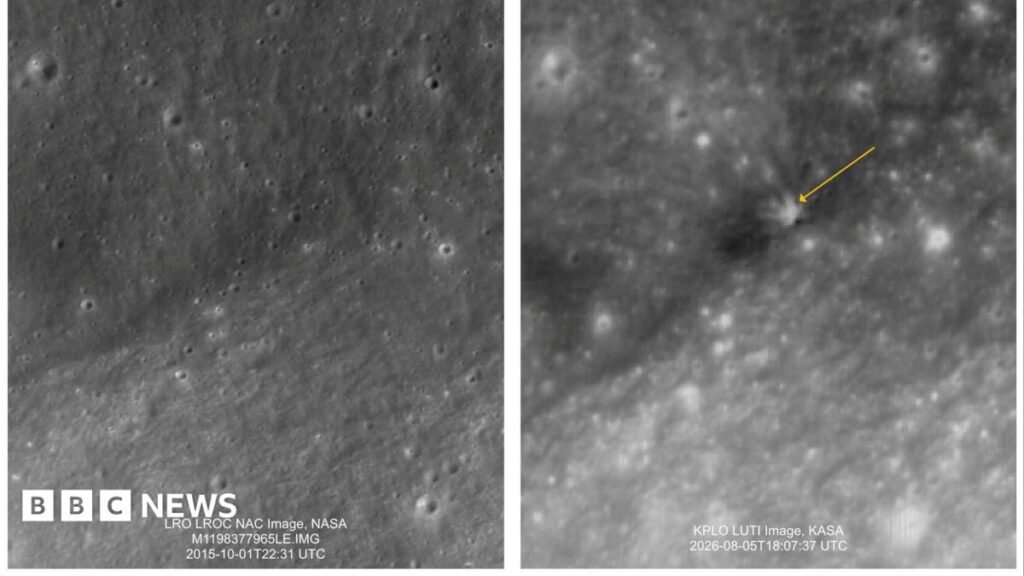
Astronomers tracking the rocket part eventually worked out that those small nudges had put it on a course towards the Moon, and it was picking up speed every day.
The impact on Wednesday happened in broad daylight for many parts of the world, but the tiny flash it produced would have been far too faint to see, even through a telescope.
Keep following us for the latest insights.