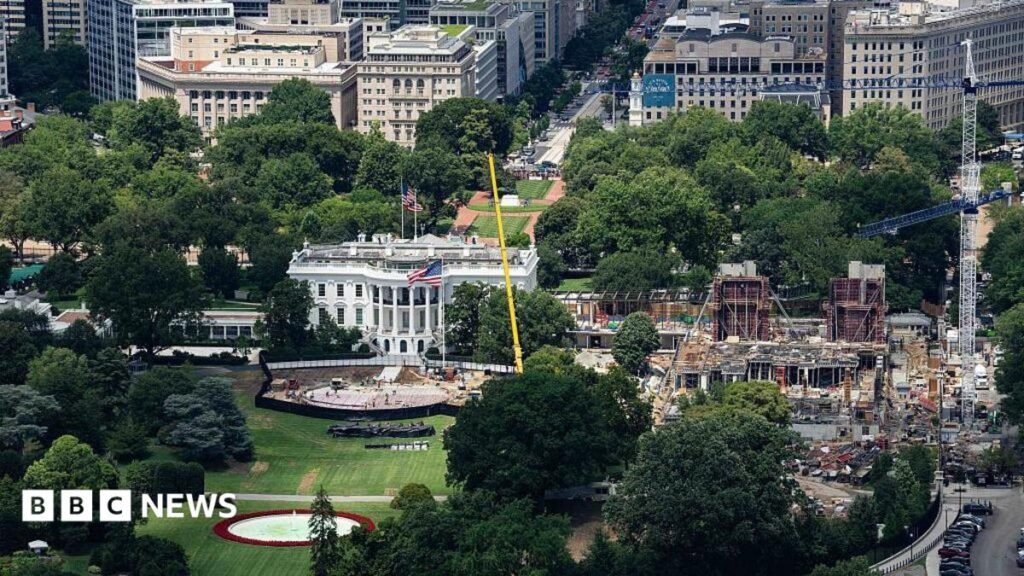
President Trump has asserted that the new ballroom is needed to “accommodate people for grand parties, State Visits”, and has also said that it is “vital for National Security”. The ballroom building would consist of the large entertaining space above ground and also a security complex below ground. Trump doubled down on the need for
President Trump has asserted that the new ballroom is needed to “accommodate people for grand parties, State Visits”, and has also said that it is “vital for National Security”.
The ballroom building would consist of the large entertaining space above ground and also a security complex below ground.
Trump doubled down on the need for the space after an assassination attempt at the White House Correspondents’ Association dinner in April.
Trump has repeatedly touted the ballroom project since he unveiled plans for it in July 2025. It would have been the most substantial structural change to the presidential residence in more than 70 years.
But the project has been mired in legal issues since October, when the Trump administration demolished the East Wing, which was built in 1902 to begin construction. Trump had initially said the project would be “near” the East Wing not that it would be demolished.
Government lawyers have argued the additional security complex and features included in the ballroom project are needed to protect the White House complex from drones, ballistic missiles, biohazards and other threats – changes essential to protecting the president, his family, and staff.
But the preservation group that sued to stop construction said there was no basis to “disturb” the White House and argued that having a ballroom isn’t a national security emergency.
The three-judge appeaks court panel said on Friday that its ruling “has nothing at all to do with whether the proposed ballroom is desirable”, nor does it weigh in on whether the administration may ultimately construct the ballroom.
“What it does mean is that the Defendants may not do so during the district court’s expeditious litigation without securing Congress’s authorization, as the Constitution and laws require,” the order said.
The National Trust for Historic Preservation celebrated the ruling, noting that no above-ground construction can take place “unless and until” Congress takes action.
“The White House, a global landmark that symbolizes American identity and the ideals of democracy, belongs to the American people,” said Brent Leggs, President and CEO of the National Trust.
“The National Trust for Historic Preservation and its partners are proud to defend this irreplaceable monument on behalf of all Americans.”
This breaking news story is being updated and more details will be published shortly. Please refresh the page for the fullest version.
You can receive Breaking News on a smartphone or tablet via the BBC News App. You can also follow @BBCBreaking on X, external to get the latest alerts.
Keep following us for the latest insights.