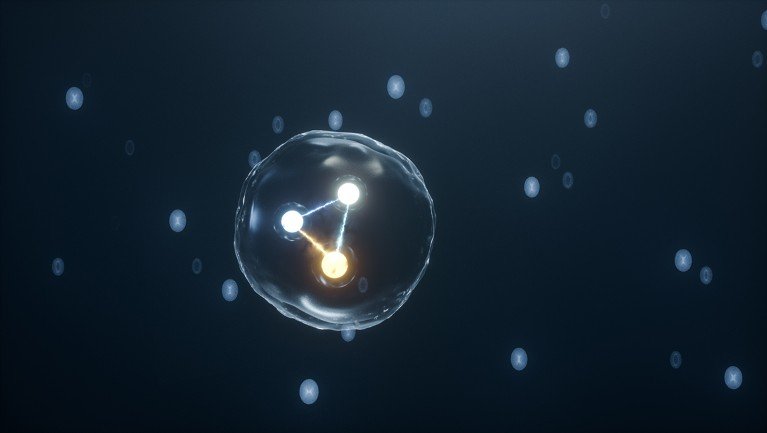
Glueballs are made of gluons, which bind quarks to form protons and neutrons.Credit: Sefa kart/Getty After almost two decades of searching, a team of physicists in China says it has observed strong evidence of a mysterious particle called a glueball that is made entirely of force-carrying particles. Researchers at the Beijing Spectrometer III (BESIII) Collaboration,
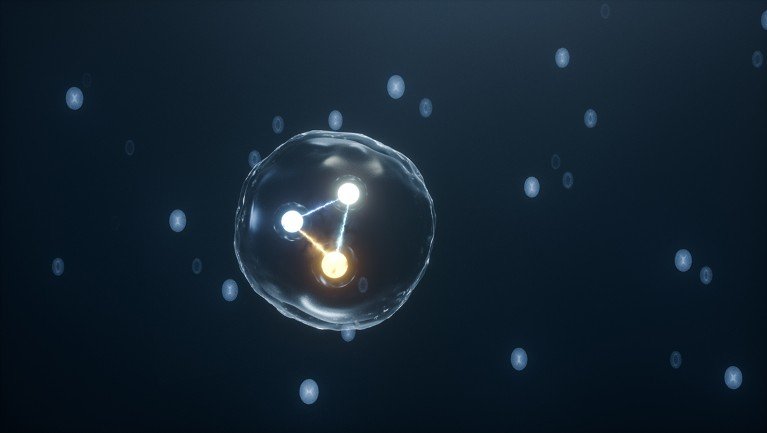
Glueballs are made of gluons, which bind quarks to form protons and neutrons.Credit: Sefa kart/Getty
After almost two decades of searching, a team of physicists in China says it has observed strong evidence of a mysterious particle called a glueball that is made entirely of force-carrying particles.
Researchers at the Beijing Spectrometer III (BESIII) Collaboration, an international particle-physics experiment, presented their results at the International Conference on High Energy Physics in Natal, Brazil, last week. They say that a particle known as X(2370) — which was discovered in 2011 — is mostly made up of glueballs. These are clusters of gluons, which are the elementary particles that bind quarks to form protons and neutrons and hold them inside the nucleus of an atom.
There is no single smoking gun that proves that this particle is made of glueballs, says Bruce Yabsley, a particle physicist at the University of Sydney in Australia, who has reviewed the results from BESIII. But looking at the cumulative evidence that they have built over decades makes the current findings “quite persuasive”, he adds.
“It is quite convincing evidence,” adds Ulrik Egede, an experimental particle physicist at Monash University in Melbourne, Australia, who saw the conference presentation.
The discovery of glueballs would provide direct evidence that gluons can interact with themselves, researchers say. This is a key prediction of quantum chromodynamics — the theory describing quarks and gluons.
Observation of glueballs can also improve physicists’ understanding of the origin of mass itself, says Yabsley. Although protons are made of quarks, the sum of the masses of those quarks does not add up to the total mass of a proton. Gluons are massless, but strong interactions between them must create mass, he says.
Hunting for glueballs
BESIII, which runs at the Beijing Electron–Positron Collider II at the Institute of High Energy Physics (IHEP), Chinese Academy of Sciences, is uniquely placed to observe glueballs. The experiment started in 2008 and is designed to study collisions between electrons and positrons, which can create short-lived particles that are predicted to decay into glueballs.
Yanhping Huang, a particle physicist at the IHEP, says she identified X(2370) when she was a PhD student.
“At that time it was quite exciting for us,” Huang says. X(2370) was suspected to contain glueballs because it was the first particle with a mass that is consistent with a specific type of glueball predicted by quantum chromodynamics, she adds.
It was also notable that X(2370) was detected when a heavier particle known as a J/ψ meson broke down. Theory has suggested that the decay of a J/ψ particle is the golden place to search for glueballs, says Shan Jin, a particle physicist at Nanjing University in China, who presented the results at the conference. BESIII can produce vast numbers of J/ψ particles, enabling researchers to study their decays.
But that evidence was not enough to rule out X(2370) being made of other types of particle, says Yabsley.
For 13 years, Huang and other scientists at the BESIII Collaboration have been poring over data from nearly ten billion J/ψ decays. Finally, in 2024, they determined the particle’s spin parity, a quantum number that describes how a particle behaves1.
That result showed that X(2370) is a ‘pseudoscalar’ particle, with a spin parity of 0−+, which was consistent with predictions of the lightest glueball.
But it still wasn’t enough. Many particles can have similar properties, says Jin.
Check back often for more exciting news!