
Oil producers in the Middle East have been experiencing disruptions to maritime traffic through the Strait of Hormuz. But this could present a strategic opportunity to rethink how energy infrastructure can be deployed in an increasingly uncertain world. The global transition towards low-carbon energy sources is often framed as a challenge for fossil-fuel-producing nations. Yet
Oil producers in the Middle East have been experiencing disruptions to maritime traffic through the Strait of Hormuz. But this could present a strategic opportunity to rethink how energy infrastructure can be deployed in an increasingly uncertain world.
The global transition towards low-carbon energy sources is often framed as a challenge for fossil-fuel-producing nations. Yet many of the assets developed during the oil era, including ports, refineries, tanker fleets, aviation hubs and government-operated investment funds, could accelerate the transition to clean energy.
Here’s how oil producers in the Middle East could leverage these assets to become architects of a global supply chain for sustainable aviation fuel (SAF).
Sustainable-fuel demand gap
The aviation sector produces more than 2% of global anthropogenic carbon dioxide emissions and is under increasing regulatory and societal pressure to decarbonize. For long-haul routes, electric and hydrogen-fuelled planes are many years away. But in the near term, SAF, which is produced from waste oils and fats, agricultural residues, industrial waste gases and wastewater sludge, and biomass-based or synthetic feedstocks, is a credible option for delivering emissions reductions this decade1 (see go.nature.com/4wrwfws).

A cleaner future for flight — aviation needs a radical redesign
Current production of SAF remains low, however, making up less than 1% of global jet-fuel use. Bridging this gap will require innovative technologies and policies, and strategic leadership. But the benefits stretch beyond aviation.
For the Gulf Cooperation Council (GCC) — which comprises Bahrain, Kuwait, Oman, Qatar, Saudi Arabia and the United Arab Emirates (UAE) — and neighbouring oil-producing nations, developing a SAF industry offers a powerful means of diversifying economies and establishing a fresh revenue stream as global oil demand begins to plateau.
It would also generate employment across the SAF supply chain — from feedstock collection and refining to research, certification and port operations — building a workforce that is equipped for future-facing industries.
At first glance, the Gulf States might seem to be unlikely champions of SAF. Advocates for biofuel development in the region are often told that there is no biomass in the desert. However, this dismissal overlooks the area’s advantages: world-class energy infrastructure, globally connected transport hubs and government investment capacity that is unmatched in most other regions.
A bridge to global trade
Three factors make the Middle East a compelling place for SAF leadership.
First, many Gulf nations have highly connected aviation networks. Airports in the UAE, Saudi Arabia and Qatar are some of the busiest in the world. Their flag carriers, including Saudia, Riyadh Air, Qatar Airways, Emirates and Etihad, already have to comply with the European Union’s ReFuelEU aviation mandate, which has obliged fuel suppliers to include rising proportions of SAF in jet-fuel blends since last year2. All carriers refuelling planes in Europe will have to purchase SAF mixes, which are more expensive.
Oil and gas drilling is shifting to the deep sea — here’s what is at stake
The EU’s mandate creates a rationale for ‘green flight paths’: key routes between busy international airports that swap to SAF blends to support demand for alternative fuels, and lower the risk of investing in them3. European and Middle Eastern nations would be ideal leaders for such initiatives.
Second, the Middle East hosts some of the world’s most advanced crude-oil and fossil-fuel export terminals and infrastructure — including the Ruwais Industrial Complex in Al Dhannah and the Port of Fujairah in the United Arab Emirates, Ras Tanura port in Saudi Arabia and the Ras Laffan Industrial City in Qatar — as well as extensive refining and storage capacity. This backbone could be rapidly adapted for SAF blending, storage and export, a transition that few regions could replicate at a comparable scale and speed.
Third, the culture of engaging in strategic investment is strong in the Middle East. Most GCC governments manage large investments known as sovereign wealth funds. Examples include the Saudi Public Investment Fund and the Qatar Investment Authority. These sovereign funds, as well as national energy companies (such as Saudi Aramco and the Abu Dhabi National Oil Company), have a well-established history of acquiring, investing in and operating energy assets worldwide. Extending these funding models to support biomass production for SAF in other regions, from southeast Asia to Africa, would allow energy companies to secure feedstocks, optimize shipping economics and deliver low-carbon fuel to markets in Europe and Asia4.
Nations in the Middle East can act as a bridge between biomass-producing regions and large SAF markets in Europe and Asia. They can also strengthen their climate leadership, aligning their fuel strategies with emerging net-zero targets in Saudi Arabia, the UAE and Oman, for example, and building on the UAE having hosted the United Nations’ COP28 climate summit in 2023.
Untapped logistical advantage
A vast opportunity for putting the Middle East at the centre of SAF trade networks lies with the region’s maritime logistics. Very large crude-oil carriers, each transporting around two million barrels, carry roughly 70% of the region’s oil exports to southeast and East Asian countries. These include China, India and Japan, as well as Singapore, which acts as a regional trading, refining and transfer hub. Smaller quantities are transported to the Mediterranean on Suezmax-class vessels — designed to fit through the Suez Canal — which can carry one million barrels.
Because these trade flows are one-way, most tankers return to the Gulf with ballast of little or no value, typically just enough water to stabilize the vessels. These return journeys generate no revenue, which is inefficient.
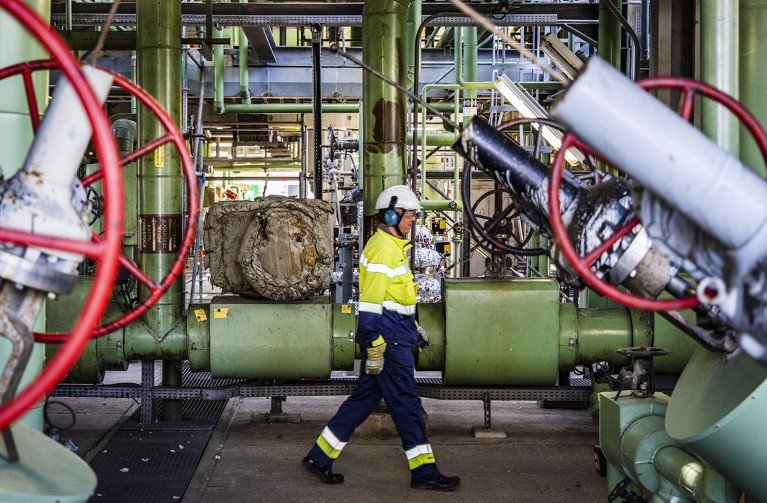
Sustainable aviation fuels are produced by refining waste oils, gases and biomass. Credit: Jeffrey Groeneweg/ANP/Alamy
Yet, several major importers of crude oil from the Middle East, such as China, India and Europe, possess abundant agricultural and forestry biomass resources. Gulf nations could make use of backhaul cargo — revenue-generating cargo transported on the return leg of a voyage to help offset the journey’s costs — to transport biofuel feedstocks. A logistics model in which feedstocks produced in Asia and Europe are sent back in empty tankers to the Middle East for processing into quality SAF would use assets more efficiently. GCC nations could invest in overseas biofuel-processing facilities or support international refineries that produce finished SAF and ship it to the Middle East as backhaul cargo.
Using tanker return legs to meet SAF demand would require a fraction of the cargo space available. For example, each year, Europe consumes around 400 million barrels of aviation fuel, which is mainly fossil-fuel based. If demand stays constant, meeting the EU’s 6% blending mandate by 2030 would require 24 million barrels of SAF per year.

Carbon credits are failing to help with climate change — here’s why
Meeting this demand, assuming a 50% volumetric yield of SAF during refinement, would require an estimated 48 million barrels of bio-crude, equivalent to 2.4% of the combined annual backhaul tanker capacity of exports from Gulf nations (which we conservatively estimate at around 2 billion barrels). Meeting a 20% mandate by 2035 would require around 160 million barrels of bio-crude, equivalent to roughly 8% of backhaul capacity.
Even if the entire global aviation industry — which consumes 2.2 billion barrels of aviation fuel per year — adopted the same 6% and 20% mandates, the corresponding volumes of bio-crude would take up only 13% and 44% of Gulf nations’ annual backhaul capacity, respectively.
Investment in overseas SAF plants should be planned strategically, however. Funding should be targeted towards regions in which sustainable feedstocks are abundant and compliant with international standards — for example, places that generate agricultural by-products, food waste and used cooking oil.
Placing SAF facilities near important shipping corridors would allow GCC nations to integrate SAF logistics into existing crude-oil networks, turning the Middle East’s legacy trade routes into enablers of the global energy transition.
Clearing house for development
The Middle East can also establish a regional SAF clearing house, which would coordinate fuel testing, certification and sustainability assurance for SAF produced across the Middle East, Africa and South Asia. The clearing house would serve as a regional platform comparable to existing SAF certification and verification systems in the United States, the European Union and the United Kingdom. This would build knowledge, skills and human capital; attract global partnerships; and position GCC nations as nodes in the emerging SAF trade ecosystem5,6.

Severe turbulence ahead – how scientists can keep air travellers safe in a warming world
Keep following us for the latest insights.