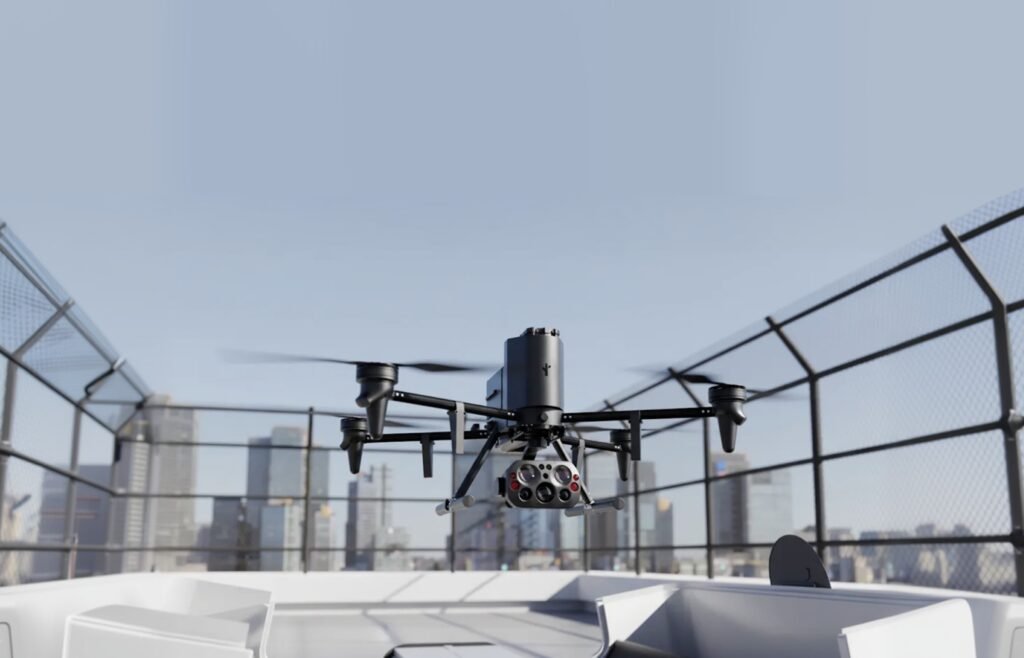
Surveillance company Flock Safety, one of the most controversial technology companies in the US, is expanding its footprint beyond automated license plate readers and its vast AI-powered camera network. Facing growing backlash over its partnership with law enforcement and its tracking of activists and protesters, Flock is now betting on drones — flying cameras dispatched
Surveillance company Flock Safety, one of the most controversial technology companies in the US, is expanding its footprint beyond automated license plate readers and its vast AI-powered camera network. Facing growing backlash over its partnership with law enforcement and its tracking of activists and protesters, Flock is now betting on drones — flying cameras dispatched from the sky for use in first-responder situations.
Civil liberties groups and digital rights advocates have long warned that Flock’s surveillance network, which relies on the broad collection and sharing of location data, poses a threat to individual privacy. If anything, the recent publicity over its burgeoning drone business will only intensify scrutiny of a vendor already under fire.
During an appearance on the All-In Podcast, Flock CEO and founder Garrett Langley gave the clearest indication yet of how much of a role drones will play in Flock’s future.
Describing drones as the company’s “fastest-growing business unit right now,” Langley said on the podcast that drones will account for nearly half of the company’s future revenue. He described drones as “the next big chapter in law enforcement,” with the potential to be as impactful as police body cameras.
Reading license plates from the sky
The emphasis on drones comes with the spread of “deflock” actions and grassroots opposition to license plate readers. After complaints that the LPRs can misidentify vehicles and that Flock’s network can be abused to target vulnerable populations, cities, including Los Angeles, have paused or canceled their contracts with the company.
In some communities, activists have taken down Flock cameras or physically disabled the hardware as a form of protest against surveillance. Organizations and individuals have crowdsourced the locations of local cameras, while municipalities that asked Flock to disable the cameras have put trash bags on them when their requests weren’t met.
Drones equipped with high-resolution cameras could be even more capable of identifying license plate numbers and tracking vehicle movement. And, of course, they’re harder to disable from the ground.
Instead of responding to a request for comment, the company sent CNET an automated response via email that read in part: “Our media team is currently touching grass and taking a break. Unlike our cameras, we can’t work 24/7, so we’ll get back to you when we’ve had a snack and regained the ability to form coherent sentences.”
Safety versus privacy
Flock’s website has product pages for drones that can be used as first-responder units in emergencies or by companies as automated security devices. The company told Business Insider that it plans to start manufacturing its own drones in Georgia and has about 200 of them deployed as first-responder devices.
During the All-In Podcast interview, Langley acknowledged that Flock sits dead center in the debate over personal privacy versus community safety. “What kind of society do we want to live in? I want to live in one where we’re safer. I want to keep my privacy while I do it, but it’s hard,” he said. “We’ve gotta find a common ground.”
Langley said that, unlike some of Flock’s competitors, the company does not use its cameras (presumably including those on drones) for facial recognition or for looking inside cars.
However, a recent investigation from Wired found that the company already has code that would expand its product’s capabilities to identify drivers and vehicles based on their movement patterns alone. While Flock Safety maintains that the software remains in a testing phase, privacy critics argue that the tool — called OS Investigate — integrates vehicle scan data with police incident reports and arrest records, transforming Flock’s camera network into a powerful system for generating suspect lists.
The expanded capabilities of drones used for surveillance have been met with criticism from the American Civil Liberties Union, which issued a report in March about the privacy dangers they present.
“If there is a drone in the sky above us, we should have a way to know whether that drone belongs to Amazon, the police, ICE, a real estate agent, or an ordinary citizen,” the ACLU report said. “We should also be able to see what the purpose of its flight is, what equipment it is carrying, and what its privacy practices are.”
For more tech updates, stay tuned to our blog.