Nvidia will officially cap off tech earnings season today after the closing bell. It’s been a tumultuous several weeks for the AI trade and mega-cap tech more broadly, with investors reacting sharply to results on both ends of the spectrum. On one side you had Alphabet and Tesla, which drew investor ire after ramping up
Nvidia will officially cap off tech earnings season today after the closing bell.
It’s been a tumultuous several weeks for the AI trade and mega-cap tech more broadly, with investors reacting sharply to results on both ends of the spectrum.
On one side you had Alphabet and Tesla, which drew investor ire after ramping up AI-spending plans. The near-trillion-dollar wipeout that followed was part of what led to the collapse of hedge fund Situational Awareness.
On the other side was Microsoft, whose earnings were a best-case scenario of strong cloud growth and restrained AI spending. Investors rewarded it with the biggest single-day market cap gain in history.
Nvidia, as always, comes in as the closer. It will offer the final word on AI demand for the upcoming quarter, among other key insights.
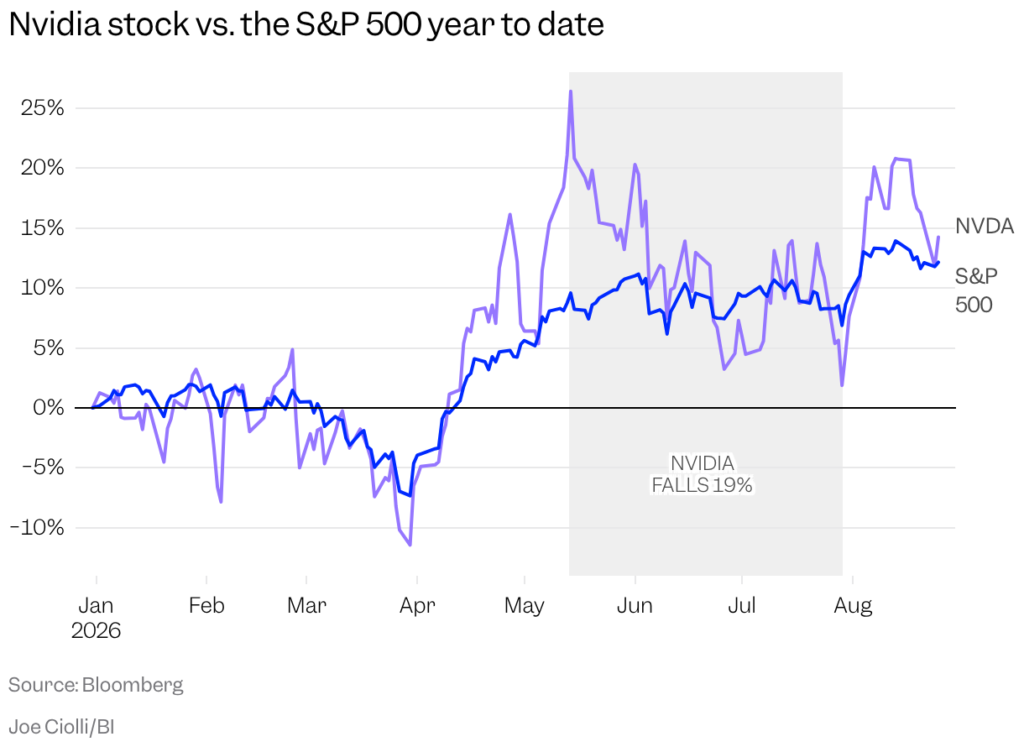
What’s slightly different this time around is how mortal Nvidia’s stock feels. After a multiyear stretch of otherworldly dominance, Nvidia’s 14% gain in 2026 is “only” two percentage points ahead of the S&P 500.
The shaded portion of the chart below shows when Nvidia gave up its lead. Shares tumbled 19% over the period during a broader chip-stock unwind, as investors questioned whether AI demand and spending could keep justifying the sector’s lofty valuations.

That brings us to the first of three questions investors will want answered when Nvidia reports:
1. How is demand looking?
The revenue guidance and commentary on hyperscaler, enterprise, sovereign-AI, and cloud demand offered by Nvidia management will set the tone going forward for the whole chipmaking sector. The fates — and near-term stock fortunes — for companies like AMD, Broadcom, Marvell, and TSMC are also at stake.
More specifically, investors will be watching for updates on demand and supply for Nvidia’s Blackwell and next-generation Rubin systems. The ultimate question they’ll want answered: Is demand still accelerating, or are customers starting to get more selective about what they spend?
2. Is Nvidia becoming the Bank of AI?
Earlier this month, Nvidia announced partnerships with Apollo, BlackRock, Blackstone, Brookfield, Goldman Sachs, and KKR to help bankroll more than $500 billion in AI infrastructure. The idea is to help Nvidia customers finance the data centers — and, by extension, the computing power — they need to keep expanding.
This has revived concerns about circular financing. Investors will want to know whether Nvidia is taking on financial risk to support customer demand. They’ll also be curious about whether the platform is unlocking new spending, or merely funding spending that would have happened anyway.
3. How much is the memory crunch hurting?
The global memory shortage has pushed up the cost of the chips that sit alongside Nvidia’s GPUs in its AI systems. That means more expensive servers for customers — and a potential margin headache for Nvidia if it can’t pass those costs along.
The question is whether higher prices are actually delaying data-center orders, or simply raising the total bill for an AI buildout that customers are determined to complete. The latter outcome would be a reassuring sign of demand, even if it means hyperscalers have to spend more to get the computing power they want.
Stock stats
Wall Street remains ultra-bullish on Nvidia stock heading into earnings. Out of the analysts that cover the stock, 79 have buy ratings, while there are just two holds and one sell.
The implied one-day move for Nvidia is 5%, according to Bloomberg data. The direction of that supposed move will depend on how well the company answers the three questions outlined above.
Your guide to what’s moving markets
Check back often for more exciting news!