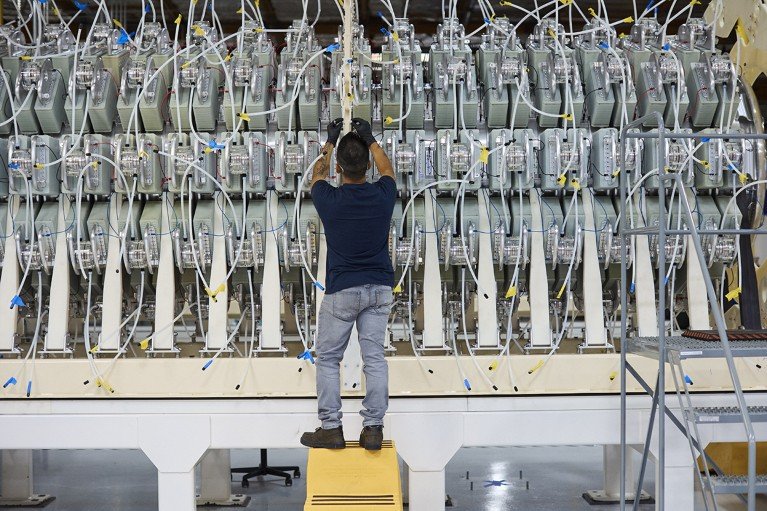
Hello Nature readers, would you like to get this Briefing in your inbox free every day? Sign up here. A worker assembles a huge impedance-matched Marx generator, which will be used to send powerful electrical pulses to the heart of Pacific Fusion’s machine.Credit: Pacific Fusion A company called Pacific Fusion has started to build a
Hello Nature readers, would you like to get this Briefing in your inbox free every day? Sign up here.
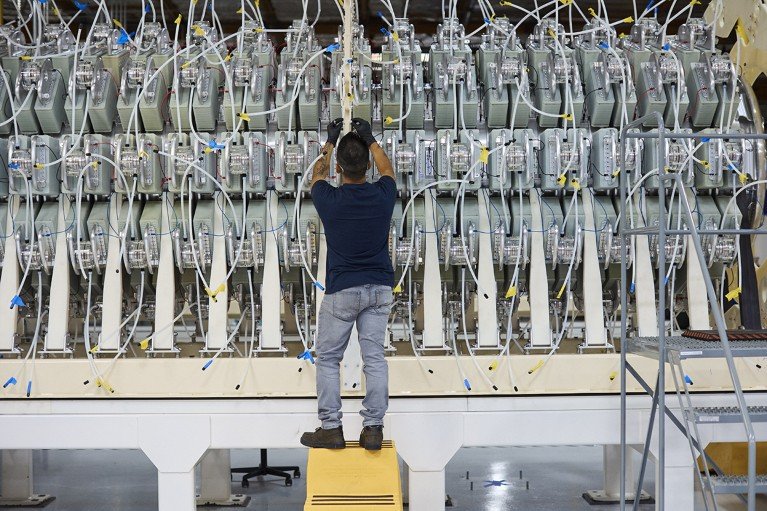
A worker assembles a huge impedance-matched Marx generator, which will be used to send powerful electrical pulses to the heart of Pacific Fusion’s machine.Credit: Pacific Fusion
A company called Pacific Fusion has started to build a fusion machine that it hopes will be the first to generate more energy than it consumes, thanks to the use of immense pulses of electricity to squeeze capsules of hydrogen fuel. The billion-dollar facility, which will sit down the road from a major US nuclear-weapons laboratory, could also be used for research on the country’s ageing stockpile of nuclear warheads. It is one of dozens of start-ups flush with investment, all fuelling the dream of a fusion power plant that supplies virtually limitless clean energy.
Nature | 9 min read
Researchers have gathered more evidence for the idea that the first spark that spawned us all — the last universal common ancestor (LUCA) — was a part-organic, part-rock chemical system that formed in the energetically and chemically rich environment of hydrothermal vents. New findings also suggest that the two oldest single-celled domains of life, bacteria and archaea, sprang independently from this first source.
Scientific American | 12 min read
Reference: Science Advances paper
Taking inspiration from a TV series, Margo’s Got Money Troubles, in which a character uses an explicit OnlyFans account to stay afloat financially, a group of researchers at the Rocky Mountain Biological Laboratory have launched a (safe-for-work) OnlyFans for marmots. Viewers can see videos of marmots in the wild from remote cameras, and the account is now earning around US$100 a day in tips.
Nature | 7 min read
Features & opinion
“In Intertwined Creatures, cognitive scientist Anthony Chemero explains how much of the buzz around the consciousness of artificial intelligence is built on, at best, reductive notions of cognition and consciousness and, at worst, a misconception of what human minds are and do,” writes cognitive scientist Abeba Birhane in her review. The whole idea of the human brain as a computer is misguided, agree Chemero and Birhane, because it ignores how interactions with other people and surroundings influence a person’s thinking. AI systems “do not inhabit worlds, form relationships or have feelings. They are not entities that can be conscious.”
Nature | 8 min read
As multilateral aid budgets are cut by countries such as the United States, China — with its focus on bilateral partnerships — is emerging as a major global-health provider, writes Ruby Wang, who advises on political, technological and clinical interactions between China and the rest of the world. China’s approach can provide cheap diagnostics, medicines and more — but global institutions should help to ensure that partnerships also strengthen local capacity and preserve sovereignty, Wang argues.
Nature | 7 min read
“Most people, when they think of pumping blood in the body, they think: ‘Yeah, we’ve got a pump. It’s called the heart,’” says physician-scientist Robert McBane. But not so fast. The heart can only pump blood that’s returned to it, and that relies, in part, on muscles in the lower leg. “You can think of it like toothpaste. You’re squeezing one tube after another, and they’re ejecting the toothpaste north,” McBane says. Poor ‘calf muscle pump function’ has been associated with higher mortality, swollen ankles and an increased risk of deep vein thrombosis. Exercising your calf muscles can help — even raising your heels while sitting and reading the Nature Briefing.
BBC Science Focus | 5 min read
Check back often for more exciting news!