Every week, it seems, a fresh opinion poll leads to shocking headlines: never have people been more afraid of the future, believed that their children won’t be as well off as them, or thought that their country is going in the wrong direction. Feelings of gloom about what lies ahead are particularly rife in the
Every week, it seems, a fresh opinion poll leads to shocking headlines: never have people been more afraid of the future, believed that their children won’t be as well off as them, or thought that their country is going in the wrong direction.
Feelings of gloom about what lies ahead are particularly rife in the Western world. At first glance, this makes sense: there are plenty of reasons to be worried, from the prospect of war to an artificial-intelligence apocalypse and climate change.
AI has a democracy problem — here’s why
In 2026, two out of five US respondents told pollsters that they think that the United States won’t exist in 2276, when it should turn 500 (see go.nature.com/4gdgmvx). The majority of respondents to another poll thought that in 2050, compared with now, the country would be less important in the world and more politically divided, and its economy would be weaker1. The United Kingdom and France ranked well below the global average in a 2025 survey of people’s views of their country’s economic prospects, alongside nations such as Lebanon and Morocco (see go.nature.com/4x5zrmc).
Yet, elsewhere in the world, the future seems brighter. A study by the United Nations children’s charity UNICEF2, spanning 55 countries, found that each population had different feelings about what lies ahead, regardless of shared challenges.
Your feelings about the future depend not so much on observable, objective facts but on personal features ranging from where you live to income level, culture and age. Here’s how.
Demographic trends
Optimism is not a rational assessment of coming reality, as scientists thought until the 1960s. Instead, it is “a mood or attitude associated with an expectation about the social or material future — one that the evaluator regards as socially desirable”, as anthropologist Lionel Tiger wrote in Optimism (1979).
And this mood or attitude is much more about possibility and direction than about a pleasant present day, meaning that current wealth and happiness are no ingredients for optimism about the future.
This helps to explain why optimism is found mainly in low- and middle-income countries (see ‘Mixed outlook’). Four in five (82%) young Indonesians (aged 15–24) think that the world is becoming better with each generation, whereas only half as many (42%) young people in France said the same22.
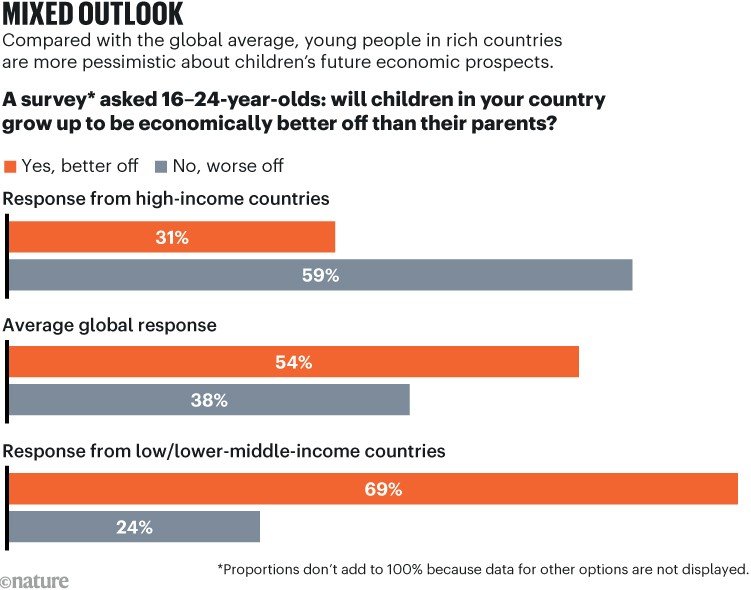
Source: Ref. 2
In part, this geographical split is age-related. With every year people age, they are 1% less likely to think that the future will be a better place2, with 55 being the cut-off age at which pessimists begin to become a majority. And because Western countries have the oldest populations in the world — 31% of people in the United Kingdom, 30% of the US population, 38% of Germans, 34% of French being over 55 — it makes sense that these populations are, on average, also the most pessimistic.
The most-hopeful countries tend to have populations that are, on average, younger: in 2025 (see go.nature.com/4g6xufy), these included Kenya (7.5% of the population over 55), Syria (11%), Saudi Arabia (13%), South Africa (12%) and Colombia (18%). By contrast, European nations led the least-hopeful group, with Bulgaria, Bosnia and Herzegovina, Austria and Belgium in the top 5 — all countries in which people aged over 55 make up more than one-third of the population.
Even in the gloomy West, young people hold the torch for a better future more than do their elders, on issues ranging from the prospects for peace to the economy (see ref. 3 and go.nature.com/4g6xufy).
Income levels are another factor working against the West. People become happier as they get richer, up to a point. But they also become more pessimistic about the future of their country and the world. Whereas Westerners top the global happiness list (see go.nature.com/4x7qfI1), which measures the present, they also have the strongest doubts about the future4.
Why we need to measure people’s well-being — lessons from a global survey
Paradoxically, projected economic growth is more important for optimism than is actual growth5, suggesting that optimism is more about possibility and expectation than about reality (see go.nature.com/4x7qfI1). Optimism is less about how wealthy and happy you are and more about the direction in which you think you are going.
Logically, the less wealthy you are, the more space for improvement there is. But, make no mistake, being less well off alone is not a recipe for optimism; the perception of possible improvement is the determining factor.
Agency has a role in optimism, too. The more influence you have over your future, the more likely you are to be upbeat about it5, which is why countries that rank high on individualism also tend to display more optimism6.
And whereas optimism about one’s country can fluctuate wildly, optimism about our own lives tends to be stable (see ref. 7 and go.nature.com/4qvezam). People can simultaneously be worried about the next generation in general but not worried about the future of their own children, a phenomenon that researchers refer to as local optimism versus national pessimism.
Political pressures
To make sense of these different results, it helps to categorize optimism into three kinds: personal optimism (‘my future will be good’), social optimism (‘my country is heading in the right direction’) and historical optimism (‘the future will be better than the past’).
Almost universally, across countries and time, people tend to score high for the first type of optimism and lower on the second and third. Yet, oddly, pessimism is generally higher in democracies — despite the improvement in citizens’ lives thanks to civil liberties, upward mobility and economic prospects5.
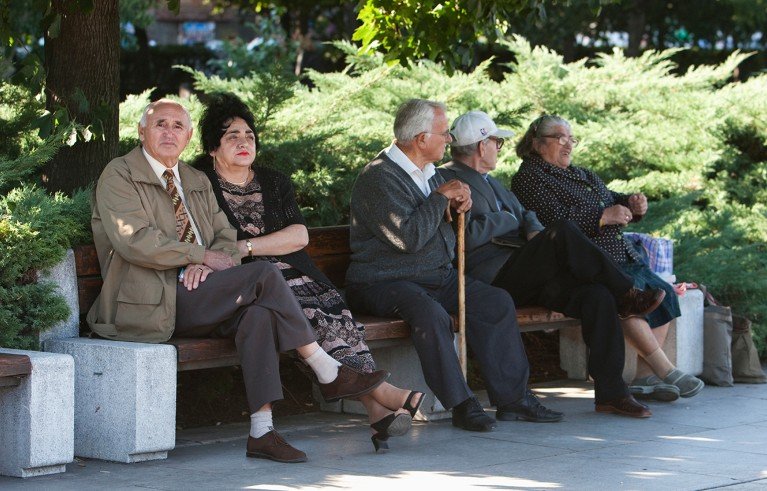
Bulgarian people are among those least hopeful about the future. Credit: Insights/UIG/Getty
The reason is that, even though democracies make the future more egalitarian, give us some influence over it and try to create predictability, they also come with negative side effects that affect views of the future.
Elections encourage politicians to keep promising improvements, and a free media constantly highlights problems and compares performance with that of other countries. Citizens are told they can shape policy, creating an expectation that the government should solve problems. And rights-based political cultures encourage people to expect high-quality public services, fairness and responsiveness, which can be hard to attain in practice.
By contrast, authoritarian systems promise stability, long-term economic growth, national pride and security. Citizens have narrower paths for hope. But their goals might be realized, especially if there’s rapid economic growth and if official control of the narrative suppresses contrary information. Approval responses in surveys might be inflated if citizens are unwilling to register dissent honestly.
Keep following us for the latest insights.