728 x 90

Daily briefing: Thousand years of coral show El Niños are getting stronger

Daily briefing: Thousand years of coral show El Niños are getting stronger

Hello Nature readers, would you like to get this Briefing in your inbox free every day? Sign up here. Robots compete during a combat event at the second World Humanoid Robot Games in Beijing. Credit: Lintao Zhang/Getty At the second annual World Humanoid Robot Games in Beijing, a human-sized robot sprinted faster than any human

Hello Nature readers, would you like to get this Briefing in your inbox free every day? Sign up here.

Two humanoid robots compete in the free combat fight in a boxing ring.

Robots compete during a combat event at the second World Humanoid Robot Games in Beijing. Credit: Lintao Zhang/Getty

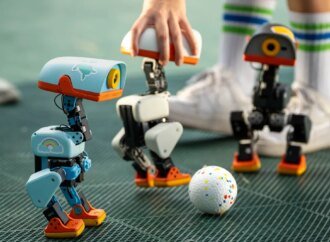
At the second annual World Humanoid Robot Games in Beijing, a human-sized robot sprinted faster than any human has before, among other physical feats. But when it comes to tasks most of us would actually want a robot to do, sprinting is low on the list. “If I ask you which is harder — folding laundry or doing a backflip — most people will say folding laundry is way easier,” says computer scientist Karen Liu. “But for humanoids, doing a task that we do in our daily lives is actually way harder than a backflip.”

Nature | 8 min read

A reconstruction of sea surface temperatures based on the geochemistry of Galápagos coral skeletons suggests that more strong El Niño events have been happening over the past 100 years as fossil-fuel emissions heat the world, compared to the millennium before the industrial revolution. However, the interactions between the ocean and the atmosphere that drive El Niño events are complex, so there is still uncertainty about how cycles of Pacific temperature will change this century. “Corals give us a time machine to look into the past,” says palaeoclimatologist Julia Cole. “They don’t give us a time machine to look into the future.”

Nature | 7 min read

Reference: Science paper

On 30 August, NASA’s long-awaited Nancy Grace Roman Space Telescope is planned to make its ascent into Earth’s orbit. With its crisp infrared vision and expansive field of view, Roman is a powerhouse: one month of Roman’s Milky Way observations would take about a century for the Hubble Space Telescope. It should give scientists insights into the early Universe and the mysterious force called dark energy, and give a huge boost to the number of planets we can detect outside the Solar System.

Nature | 8 min read

A large, rectangular satellite component being carefully lifted by a yellow overhead crane inside a spacious industrial facility. Four technicians wearing helmets observe and guide the process from elevated platforms, with a banner labeled "Roman Space Telescope" visible on the left side.

The Nancy Grace Roman Space Telescope undergoes vibration testing before its launch, scheduled for 30 August. Credit: Sydney Rohde/NASA/Roman Space Telescope (CC BY-NC-ND 4.0)

Features & opinion

An ex-soldier and the self-aware AI living in his head go out for ice cream in the latest short story for Nature’s Futures series.

Nature | 6 min read

Andrew Robinson’s pick of the top five science books to read this week includes a new book by forest ecologist Suzanne Simard — who popularized the idea of the ‘Mother Tree’ — a history of the unconscious mind and a look at the wide-ranging health impacts of the COVID pandemic.

Nature | 4 min read

Why extreme temperatures are expected to weaken ocean carbon sinks — plus, how mitochondrial injections could treat vision loss and astronaut vests cut radiation exposure in half.

Nature Podcast | 27 min listen

Subscribe to the Nature Podcast on Apple Podcasts, Spotify or YouTube Music, or use the RSS feed.

Quote of the day

Heisuke Hironaka, a prominent figure in algebraic geometry, was renowned for his landmark 1964 proof of the “resolution of singularities”, for which he received the Fields Medal in 1970. Hironaka has died aged 94. (Nature | 7 min read)

Reference: Annals of Mathematics paper 2 & paper 2

Today Leif Penguinson is braving the frothing seas of Færder National Park in Norway. Can you find the penguin?

Monday is a holiday here in Briefingland, so the answer will be in Tuesday’s e-mail, all thanks to Briefing photo editor and penguin wrangler Tom Houghton.

This newsletter is always evolving — tell us what you think! Please send your feedback to briefing@nature.com.

Thanks for reading,

Flora Graham, chief editor, Nature Briefing

• Nature Briefing: Careers — insights, advice and award-winning journalism to help you optimize your working life

• Nature Briefing: Microbiology — the most abundant living entities on our planet — microorganisms — and the role they play in health, the environment and food systems

• Nature Briefing: Anthropocene — climate change, biodiversity, sustainability and geoengineering

• Nature Briefing: AI & Robotics — 100% written by humans, of course

• Nature Briefing: Cancer — a weekly newsletter written with cancer researchers in mind

• Nature Briefing: Translational Research — covers biotechnology, drug discovery and pharma

Keep following us for the latest insights.

Posts Carousel

Latest Posts

Top Authors

Most Commented

Featured Videos