The human genome is made up of roughly 3 billion bases, or letters, of DNA.Credit: Yuichiro Chino/Getty The human genome is an easy place to get lost. Only 2% of its 3 billion letters encode proteins and the rest is diabolically hard to decipher. An AI-generated ‘atlas’ of the human genome unveiled1 today by Google
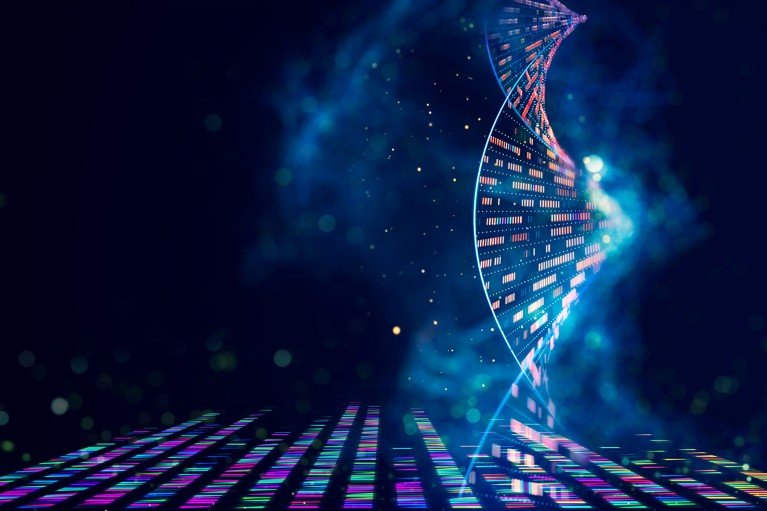
The human genome is made up of roughly 3 billion bases, or letters, of DNA.Credit: Yuichiro Chino/Getty
The human genome is an easy place to get lost. Only 2% of its 3 billion letters encode proteins and the rest is diabolically hard to decipher. An AI-generated ‘atlas’ of the human genome unveiled1 today by Google DeepMind aims to guide scientists through our biological code.
One of the most common types of variation in the human genome are changes to individual nucleotides, or letters, which contribute to differences between people including disease risk; some rare single letter changes can directly cause disease.
The AlphaGenome Atlas charts the effects of 9 billion single DNA letter changes to the human genome — every possible mutation — using predictions generated by the AlphaGenome AI model released by DeepMind in London last year. It is freely available for non-commercial use.
The atlas could help to diagnose rare, unexplained diseases and uncover the hidden biology of common illnesses and biological traits, say researchers. It might even reveal some of the hidden rules by which DNA sequences control gene activity.
But it won’t replace experiments or, in the case of diagnosing disease, accounting for details of individual cases, says Martin Kircher, a bioinformatician at the Max Delbrück Centre for Molecular Medicine in Berlin. “This is a useful and generous way to scale up access to a strong model.”
Instant access
Since AlphaGenome’s release, around 9,000 researchers have accessed the model’s predictions through an automated programming interface (API), says Dhavi Hariharan, a DeepMind product manager. But doing so requires writing software code — a barrier for some biologists, she says.
To create the AlphaGenome Atlas, DeepMind computed predictions for each of the 3 possible nucleotide changes across every DNA letter in the human genome — 1 petabyte’s worth of data. It also captures more than 100 million short insertions or deletions observed in human genomes. The effort was inspired by DeepMind’s AlphaFold database of more than 200 million protein-structure predictions, which has been accessed by millions of users, according to DeepMind.
“If you remove the friction you also increase the curiosity for people to dive in,” says Žiga Avsec, who leads the AlphaGenome team. “Instant access is something that feels magical.”
The atlas, like AlphaGenome, provides thousands of predictions about different potential effects of a variant, from how it affects the tissues in which a nearby gene is expressed to the shape of folded-up DNA called chromatin. But a repeated ask from API users, says Hariharan, was simplicity: “Can you give me a single score that’ll help me understand: do I care about this variant, do I dig deeper?”
DeepMind’s AlphaGenome Atlas provides predictions about different potential effects of genetic variants.Credit: Google DeepMind
So for the atlas, Avsec’s team developed a metric of a variant’s predicted effect on biology, the AlphaGenome Variant Impact (AVI) score. This lone number reliably discerned disease-causing mutations from harmless changes in a clinical genomics database, DeepMind and academic researchers report today in a preprint1. The AVI score and other predictions in the atlas also helped a team at the Broad Institute in Cambridge, Massachusetts, to prioritize a non-coding variant as a possible cause of a case of severe epilepsy.
Rare-disease researchers have usually relied on less computationally demanding models to interpret such variants, because applying models like AlphaGenome across an entire human genome is unfeasible for most researchers, say Mafalda Dias and Jonathan Frazer, computational biologists at the Centre for Genomic Regulation in Barcelona, Spain, in an e-mail to Nature. “By removing that computational barrier, the Atlas should be a valuable resource.”
DNA motifs
Avsec is especially excited about using the atlas to try to uncover the function of short stretches of DNA, called motifs, that are found throughout the human genome. Scientists know that some help to control the production of messenger RNA (mRNA) that carry instructions for individual proteins. Others attract transcription factor proteins that regulate the expression of individual genes, but the picture is incomplete.
Using atlas predictions as a guide, the researchers mapped thousands of DNA motifs across the human genome and then inferred the roles those motifs could have in different cell types — be it activating genes, repressing them or altering DNA accessibility. The work “gives us a searchable dictionary for non-coding DNA”, Julia Zeitlinger, a molecular biologist at the Stowers Institute for Medical Research in Kansas City, Missouri, and preprint co-author, said at a press briefing.
Keep following us for the latest insights.