The human genome is made up of roughly 3 billion bases, or letters, of DNA.Credit: Yuichiro Chino/Getty The human genome is an easy place to get lost. Only 2% of its 3 billion letters encode proteins and the rest is diabolically hard to decipher. An AI-generated ‘atlas’ of the human genome unveiled1 today by Google
Xinhua Hospital in Shanghai, China, hosted one of the gene-therapy trials that led to the death of a child last year.Credit: Costfoto/Sipa USA/Alamy The deaths of two children in separate gene-editing trials in China raise serious questions about oversight and could have a profound effect on the country’s biomedical industry, say researchers, ethicists and legal
Ethics The work reported on TwinsUK samples was carried out with informed consent under TwinsUK BioBank ethics, approved by the North West–Liverpool Central Research Ethics Committee (REC reference 19/NW/0187), IRAS ID 258513 and earlier approvals granted to TwinsUK by the St Thomas’ Hospital Research Ethics Committee, later the London–Westminster Research Ethics Committee (REC reference EC04/015).
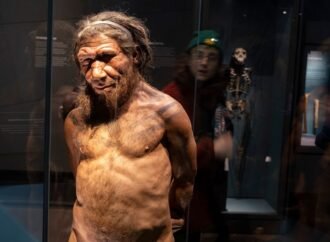
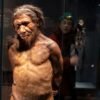
Neanderthals are known to have had physiological differences from Homo sapiens, including thicker bones and defined brow ridges, as in this model.Credit: Mike Kemp/In Pictures via Getty Two genetic changes in the genomes of Neanderthals contributed to the extinct hominin’s characteristic robust physique — and the differences persist in modern humans. The variants make carriers
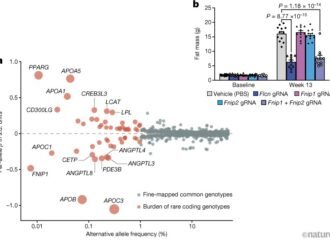
RESEARCH BRIEFINGS 05 August 2026 A study of more than one million people shows that rare genetic variants that disrupt the FNIP1 gene are associated with a favourable metabolic profile and a roughly 60% lower risk of cardiometabolic disease than the general population. Silencing genes in the FNIP1 pathway in mice induces fat breakdown and
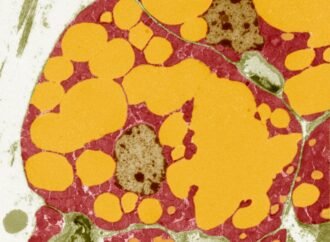
The ratio of fat tissue (fat droplets in yellow; artificially coloured) to muscle mass is reduced in people with newly identified variants of a gene that affects cellular metabolism. Credit: Steve Gschmeissner/Science Photo Library A massive genomic study has linked mutations in a specific gene to an increased proportion of muscle, decreased levels of belly