
We’ve seen gaming grow over the past few years. Big events like DreamHack and PAX Aus are driving gaming to the masses. Indie studios that developed the likes of Hollow Knight and Cult of the Lamb show Aussie Indie developers have what it takes to make it on the big stages. Even things like ACMI’s
We’ve seen gaming grow over the past few years. Big events like DreamHack and PAX Aus are driving gaming to the masses. Indie studios that developed the likes of Hollow Knight and Cult of the Lamb show Aussie Indie developers have what it takes to make it on the big stages.
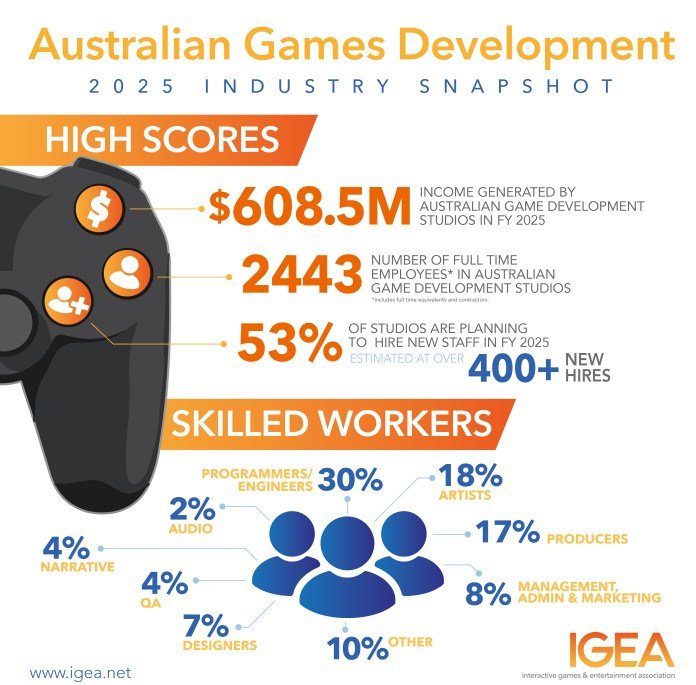
Even things like ACMI’s Game Worlds exhibition show Australians are hungry for gaming content. It probably comes as no surprise then, that the latest report from Interactive Games & Entertainment Association (IGEA) puts the Australian games industry at $608.5 million AUD in revenue for FY25.
That’s a big number. And it’s a big jump. Compare this to the $185 million AUD in revenue back in 2021. And after digging into it a bit, it’s pretty clear the headline isn’t the most interesting part. The real story is how much the industry has changed, and why this large number now exists. It says something about where the industry is headed.
The revenue jump isn’t what you think
When you see a number like $608.5 million, it’s easy to assume the industry just had a breakout year. That’s not really what’s happening.

As IGEA explained, this year’s report includes additional data thanks to a partnership with Sensor Tower, which helped capture revenue from game studios that weren’t previously included. Ron Curry, CEO of IGEA, says the industry is growing:
The industry has been experiencing steady growth […] The huge jump this year is because we have expanded the platforms from which we report data.
So yes, the number is bigger, but more importantly, it’s more accurate. And honestly, this is probably a better outcome long term. You can’t properly support an industry if you don’t fully understand its size. Now we have a better picture thanks to Sensor Tower’s involvement where IGEA “were able to identify a select panel of Australian studios who did not provide a response to the Bond University study and report their revenue, which we haven’t been able to do in the past.” Curry explains getting this accurate data has led to this significant, yet accurate reporting.
This isn’t a startup scene anymore
One of the things that stood out most in the report is just how many studios have stuck around. In the past, we’ve seen some studios who make a game, or give it a shot, but they don’t last. The IGEA report found that:
- 30% studios have been operating for 10+ years
- 19% studios have been around for 6-9 years
That’s not early-stage anymore. These are studios that have shipped games, learned hard lessons, adapted, and are still here. It also explains why we’re starting to see more consistency. Studios aren’t just trying to get a game out. Now, they’re building pipelines, planning ahead, and thinking about sustainability.
That’s a big shift from even five years ago.

Jobs are holding steady (and that matters)
There’s been a lot of noise globally about layoffs, not just in the gaming industry but everywhere. So it’s worth calling out that, yes, Australia has seen some impact, but overall things are relatively stable:
- 2,443 full-time roles
- More hiring planned in 2026, especially from larger studios
That doesn’t mean everything is perfect. It does however, suggest the local industry isn’t swinging wildly. If anything, it feels like studios are settling into something more sustainable.
The industry is finally being seen properly
Gaming has long been in the limelight as an anti-social, kids-stuck-in-the-basement, go-touch-grass kind of mentality. So it’s really important the gaming industry is finally been taken seriously. This is probably the part that matters most.
For a long time, games in Australia have kind of sat in this weird space where everyone knows they exist, but not really how big or important they are. This report helps change that, and it “highlights the impact that game development can have on the creative and cultural economy of Australia”. As Curry outlines:
people who make games are highly skilled across different disciplines […] These skills are highly transferable into other sectors and offer a lot of potential across the digital, creative, and technical economy.
That’s the bit that often gets missed. Game development isn’t just “making games.” It’s:
- Software development
- Art and animation
- Audio production
- Writing and storytelling
- Marketing and live operations
It’s a full creative and technical stack.
And when you look at it that way, it becomes a lot easier to understand why governments are starting to take it more seriously.
Why things feel different right now
We’ve seen positive reports before, but this report from IGEA feels a lot more grounded. And here’s a few reasons why I believe this to be true:
- Better data: We’re finally getting a clearer picture of the industry, not just parts of it.
- Government support is doing something: Initiatives like the Digital Games Tax Offset are giving studios confidence to stick around and grow. Pair this with Creative Victoria’s funding for indie studios and there’s a lot more support in the industry.
- New studios are still coming through: 31% of studios are working on their first game, which means the pipeline isn’t slowing down.
- Experienced studios are scaling up: At the same time, older studios are hiring and expanding.
That combination is pretty powerful.
So… What’s next?
If you zoom out a bit, the trajectory is pretty clear. The Australian games industry isn’t just growing. It’s stabilising, maturing, and becoming easier to understand from the outside.
And that last part is important. Because once people understand it properly—governments, investors, even the general public—it becomes a lot easier to support.
There’s still work to do, but compared to where things were when I started here (over ten years ago), and even more so in the last few years, it really feels like the industry is gaining real momentum.
Not hype. Not a spike. Just steady, meaningful progress.




















Leave a Comment
Your email address will not be published. Required fields are marked with *