
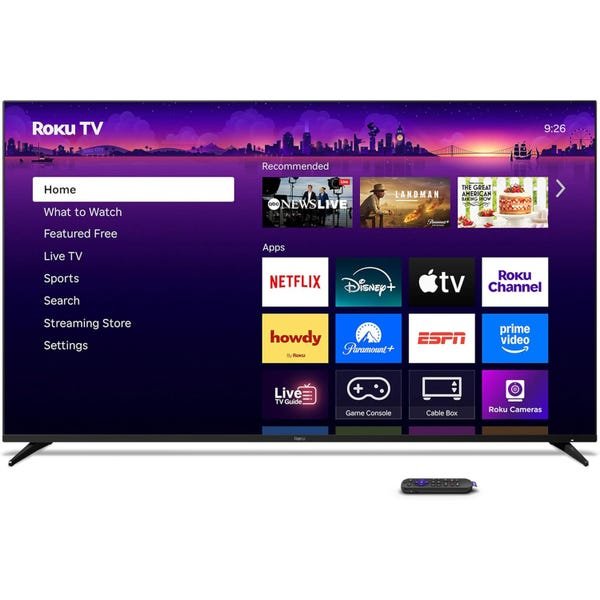
Roku’s software has long stood out for its simple, uncluttered interface. Instead of cramming the home screen with endless rows of recommendations, it keeps things clean, with big app icons and quick access to the streaming services you actually use. The best Roku TVs build that same no-fuss experience directly into the set, while also
Roku’s software has long stood out for its simple, uncluttered interface. Instead of cramming the home screen with endless rows of recommendations, it keeps things clean, with big app icons and quick access to the streaming services you actually use. The best Roku TVs build that same no-fuss experience directly into the set, while also delivering solid picture quality and prices that feel reasonable for what you get.
I’ve been reviewing home entertainment gear for more than a decade, and I’ve leveraged that experience to pick the two best Roku TVs right now. The Roku Pro Series is my top pick overall. It offers a bright, high-contrast picture that makes movies, shows, and sports look great. Meanwhile, the Roku Plus Series is the better pick if you want to save some money. It doesn’t quite match the Pro’s brightness, but it still delivers good color performance for the price.
Roku’s platform is also used on budget TVs from brands like TCL, Hisense, and Onn, but Roku’s own TVs have generally delivered better, more consistent picture quality. That’s why this guide focuses specifically on Roku-branded models. Both picks are available in a range of sizes, so you can choose the one that best fits your room and budget.
Our top picks for the best Roku TVs
Best overall: Roku Pro Series QLED 4K TV – See at Amazon
Best budget: Roku Plus Series QLED 4K TV – See at Amazon
Best overall
Roku 65-inch Pro Seires QLED 4K TV (2025)
Roku’s flagship Pro Series is a strong all-around 4K TV. TCL and Hisense offer slightly better picture quality at similar prices, but the Pro Series stands out for its simple and reliable interface, rechargeable voice remote, and hassle-free setup.
When it comes to balancing performance and price, the Roku Pro Series stands out as the best Roku TV available. It hits that sweet spot between premium features and everyday value, all while showcasing Roku’s clean design and famously easy-to-use interface.
Our reviewer tested the first-generation Pro Series, but Roku has since rolled out a slightly updated second-generation model. The newer version offers a modest brightness increase but otherwise delivers the same overall experience. Since the older edition is now tough to find, the second-generation Pro Series is the smarter pick moving forward.
The TV uses a QLED panel paired with a Mini LED backlight and full-array local dimming, producing a bright, contrast-rich picture that’s a noticeable upgrade over Roku’s entry-level sets. Black levels look solid, highlights have punch, and colors pop — especially when watching HDR10, Dolby Vision, or HDR10+ content (you can learn more about HDR formats in our HDR TV guide). Some minor light bleed cropped up in a few scenes during testing, but overall performance is in line with that of other Mini LED TVs in this price range.
Gamers will appreciate the 120Hz refresh rate and variable refresh rate (VRR) support, which help deliver smooth, responsive gameplay on consoles like the PS5 and Xbox Series X. That said, the Pro Series lacks a dedicated gaming bar menu and 144Hz PC support, both common features among competitors.
As with most QLED models, viewing angles are a bit limited. The picture looks fantastic when you’re sitting front and center, but color and contrast start to fade when viewed from the side. If wide viewing angles are a priority, I recommend a high-end Samsung QLED, such as the QN90F, or switching gears to an OLED TV. Though those options will cost more.
Roku rounds out the package with its latest Voice Remote Pro 2, one of the most intuitive remotes available. It offers hands-free voice control, a USB-C rechargeable battery, automatic backlighting when you pick it up, and even a “lost remote finder,” which is a lifesaver when it disappears between couch cushions.
Setup is pleasantly simple, too. The stand attaches tool-free using Roku’s quick-fit knob system, and you can choose between low or high stand positions depending on whether you want to accommodate a soundbar or prefer a cleaner, lower profile.
While the Pro Series costs more than Roku’s Plus and Select models, its combination of premium picture quality, sleek design, and thoughtful features firmly establishes it as Roku’s flagship. It’s available in 55-, 65-, and 75-inch sizes.
Read our Roku Pro Series 4K TV review (2024 model).
Check out our guides to all the best TVs, best smart TVs, and best 4K TVs.
Best on a budget
Roku 65-inch Plus Series QLED 4K TV (2025)
The Roku Plus Series is the brand’s most affordable QLED TV model. This second-generation edition uses a Mini LED backlight for improved local dimming, but it still can’t match the HDR brightness capabilities of the step-up Pro Series.
The Plus Series is the best Roku TV for budget-conscious buyers. This QLED display sits one step below the brand’s flagship Pro Series, and though it omits some of that pricier model’s more advanced features, it still offers good value.
The Plus Series we tested was the original model released in 2023. Roku has since discontinued that edition and replaced it with an upgraded second-generation model. The new Plus Series offers similar capabilities but has a couple of improvements.
Notably, the latest Plus Series now features a Mini LED backlight, offering improved contrast control compared to the older model. This should improve black-level performance. That said, the Plus Series is still noticeably dimmer than Roku’s brighter Pro Series TV, so its HDR highlight performance isn’t quite as impactful.
Aside from brightness, the latest Plus Series also falls behind the Pro Series in gaming performance. The Plus Series features a 60Hz refresh rate rather than 120Hz. It also lacks HDMI 2.1 ports and VRR (Variable Refresh Rate) capabilities. This means the TV doesn’t support high frame rate modes on gaming consoles and can’t reduce screen tearing or stuttering. It’s still perfectly fine for casual gaming, but it’s not suited for enthusiasts who want the smoothest performance.
Roku has added a physical “remote finder” button to the new Plus Series, similar to the one found on the Pro Series. This is a nice perk, but the remote itself is actually a downgrade compared to the remote included with the original Plus Series. The TV now comes with an Enhanced Voice Remote rather than a Pro Remote. It still supports voice search but lacks hands-free control and a rechargeable battery. The display’s stand consists of separate left and right feet, but they attach with screws rather than using the tool-less knob system found with the Pro Series. The setup is still straightforward but not quite as convenient.
Even with its backlight upgrade, the new Plus Series makes some concessions to keep its cost low. However, it’s still a very solid budget QLED, offering a clear step up in image quality over Roku’s cheaper Select Series. The Plus Series is sold in 55-, 65-, and 75-inch sizes.
Check out our guides to the best budget TVs and best TVs under $500.
How we test Roku TVs
Ryan Waniata/Business Insider
To select the best Roku TVs, our team used a combination of research and testing. When we evaluate TVs, we focus on what matters most in daily use: picture quality and how easy the TV is to live with. We measure brightness, color, contrast, local dimming (when available), viewing angles, menu speed, design, and overall value.
We measure brightness using a colorimeter and test patterns from the Spears & Munsil UHD Benchmark 4K Blu-ray disc or a pattern generator, but numbers alone don’t tell the whole story. We spend plenty of time watching actual movies and TV shows in both bright and dark rooms. Our demo content is chosen to highlight HDR performance, black levels, color gradients, clarity, and upscaling, across sources ranging from 4K and HD down to standard-definition cable and streaming.
Because this guide focuses specifically on the best Roku TVs, we compare models across Roku’s own lineup to highlight meaningful differences in performance and features — and to help match each TV to the type of viewer it’s best suited for.
For more information on our review process, check out our breakdown of how we test tech products.
Meet the expert behind this guide:
Steven Cohen, senior tech editor: I’ve been reviewing home entertainment products for over a decade, and every year my team tests the latest displays from every major brand. I also attend annual product launches and reviewer workshops to get an early look at new TV models. My experience with TVs from every company helps me highlight the specific features that make Roku TVs unique, while also addressing areas where they may fall short of the competition.
Learn more about the Reviews team at Business Insider.
Our TV coverage extends across all brands, sizes, and types, so be sure to check out our other guides for more recommendations:
Roku TV FAQs
Ryan Waniata/Business Insider

Do other brands sell Roku TVs?
Though Roku sells its own smart TVs, the brand also licenses its operating system to other manufacturers. Companies like TCL, Hisense, Sharp, Philips, and Walmart’s Onn brand sell TVs with the Roku OS built in. However, most Roku TVs from those partners are entry-level models. Generally, the best Roku TVs available today are those manufactured by Roku itself.
What kind of TVs does Roku make?
Roku’s current lineup includes QLED TVs with Mini LED backlights (the Pro and Plus Series) and standard LED TVs (the Select Series). Roku does not currently offer any in-house OLED or Micro RGB TV models.
Will Roku release new TVs in 2026
Roku is still relatively new to the TV market, so it’s unclear whether the brand plans to release new TV models annually. For instance, it introduced its first-generation Plus Series TV in 2023 but did not release a second-generation model until 2025. Meanwhile, the first-gen Pro Series was released in 2024 and did get a follow-up model a year later in 2025. We’ll update this guide if the brand announces any upcoming smart TVs. You can learn about 2026 models from other brands in our 2026 CES TV roundup, 2026 LG OLED TV roundup, and 2026 Samsung OLED TV roundup.
What’s the Roku OS like to use?
Roku’s interface is one of our favorite smart TV operating systems thanks to its reliability and streamlined design. It’s one of the easiest platforms to navigate and avoids a lot of the bloat that other interfaces suffer from.
The homepage features large icons for all your favorite services, which you can reorder as you like. There are also icons for the devices you have connected to your Roku TV, so you can switch video inputs from the same screen.
Many rival operating systems, such as Fire TV OS, place greater emphasis on content recommendations and sponsored apps on their homepages, leading to a cluttered appearance. But if you do prefer to see content suggestions, you can access the “What to Watch” section on the Roku interface’s sidebar menu. This screen features various recommendations across genres and services. It also lets you save a watchlist for titles you want to stream later.
The Roku system’s voice search works well and presents a comprehensive list of streaming services that offer the movie or show you’re looking for.
Can you add the Roku interface to a TV?
Roku sells several stand-alone streaming devices that allow you to add the Roku system to an existing TV. These devices are ideal for older displays that lack streaming capabilities or for individuals who prefer to use Roku’s interface over the OS built into their TV.
There are no significant differences between a Roku TV and a Roku streaming player in terms of app support and interface design. Navigation speed can vary slightly depending on the model you buy, with the Roku Ultra offering the quickest performance. Video quality capabilities also vary, with some models limited to HD and others supporting 4K Ultra HD with HDR. The company also sells soundbars, such as the Roku Streambar, that include built-in video streaming support.
If you already own a Roku TV, there’s no reason to purchase a separate Roku player. For more media player recommendations, check out our guide to the best streaming devices.
Do Roku TVs support Alexa, Google Assistant, or Siri?
Roku TVs do not have built-in support for Amazon Alexa, Google Assistant, or Siri. Instead, Roku uses its own voice control platform that lacks the functionality of a full-fledged digital assistant.
However, the best Roku TVs do support pairing with separate Alexa, Google Assistant, and Siri devices (like a smart speaker). Once paired, you can use that device’s built-in assistant to control your Roku TV.
What other products does Roku sell?
In addition to smart TVs and streaming players, Roku sells soundbars, wireless speakers, a subwoofer, and a collection of smart home devices, including cameras, doorbells, lights, plugs, and motion detectors. These products are designed to work together, allowing you to create a unified Roku smart home setup.
Does Roku have its own streaming service?
Yes, Roku offers two of its own streaming services: the Roku Channel and Howdy. The Roku Channel is a free ad-supported service that offers a mix of live internet TV stations and on-demand content, including a few original programs. Meanwhile, Howdy is an ad-free subscription service with a selection of licensed movies and TV shows from various studios. It costs $3 a month.
The Roku Channel is available on Roku TVs, Roku streaming players, web browsers, mobile devices, and certain smart TVs and streaming devices from other brands. Howdy is available on Roku TVs, Roku players, web browsers, and mobile devices.




















Leave a Comment
Your email address will not be published. Required fields are marked with *