
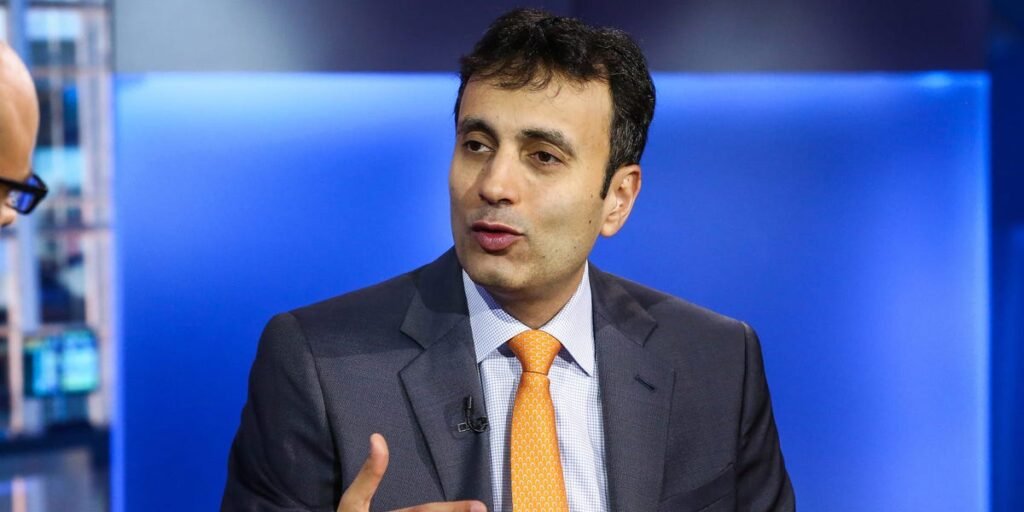
Don’t expect the Fed to rush to prop up the US economy if it runs into trouble, Ruchir Sharma says. Loading audio narration… The famed investor and Rockefeller Capital Chairman said he believes the Fed’s hands are tied when it comes to cutting interest rates to prop up economic growth. That’s because — despite the
Don’t expect the Fed to rush to prop up the US economy if it runs into trouble, Ruchir Sharma says.
The famed investor and Rockefeller Capital Chairman said he believes the Fed’s hands are tied when it comes to cutting interest rates to prop up economic growth. That’s because — despite the risks to growth stemming from higher oil prices — the Fed has little room to ease monetary policy, considering that inflation has remained above the Fed’s 2% price target for 60 months in a row, Sharma said.
Inflation clocked in at 3.3% annually in March, up from the 2.4% yearly increase in February. The increase largely stems from the 10.9% year-over-year growth in energy costs, according to the Bureau of Labor Statistics.
Inflation hasn’t grown at or below a 2% pace since early 2021.
The Fed’s stance on monetary policy now looks very different from several years ago, Sharma said, referring to the period when the central bank cut interest rates aggressively to bolster economic growth during the pandemic. That response — also called the “Fed put” in markets — is likely gone, he suggested.
“I think the Fed is out,” Sharma said of rate cuts, speaking to CNN this week. “When you got any shock to the economy, central banks would rush to the aid of the economy at the slightest hint of trouble. I don’t see that happening this time.”
Investors have grown hopeful again about Fed rate cuts since the US announced a ceasefire with Iran, but markets are largely expecting the central bank to remain hawkish. Investors are pricing in just a 29% chance the Fed will issue more rate cuts this year, down from an 84% chance a month ago, according to the CME FedWatch tool.
The economy is also unlikely to get any fiscal support the longer the oil price shock goes on, Sharma said, referring to the Trump put — the idea that the administration will respond to an economic shock with stimulus to boost growth.
He pointed to the recent rise in bond yields, which suggests that markets are more concerned about the growing budget deficit, and that any further fiscal support could stoke a negative reaction in Treasurys.
The benchmark 10-year US Treasury yield ticked up to 4.30% on Friday, up 34 basis points from where it was prior to the start of the Iran war.
“The bond markets this time aren’t tolerating that,” he said. “The doomsayers have been around a long time worrying about the debt and the deficits, and the question many people ask is, ‘So what? The bond market is not really reacting to any of this.’ That’s changing now.”



















Leave a Comment
Your email address will not be published. Required fields are marked with *