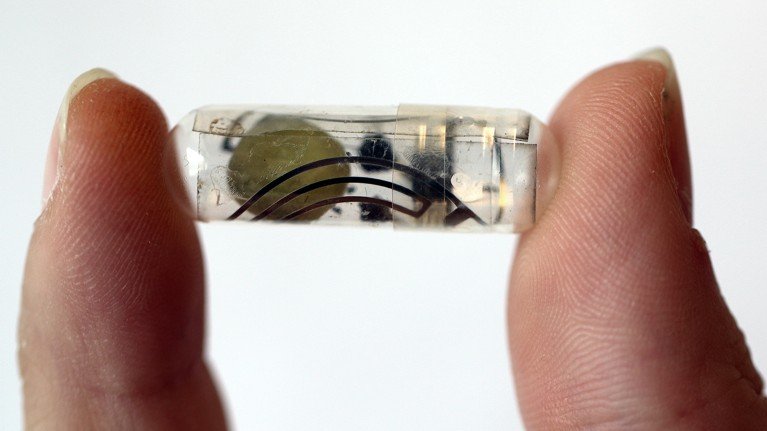
This ingestible capsule, tested in pigs, contains a biodegradable paper battery (large brown circular structure) and a radio-frequency identification (RFID) tag (black lines).Credit: Mehmet Say A battery made with a substance resembling edible rice paper can power swallowable electronic medical devices. And after the battery has been safely digested, its broken-down ingredients can be absorbed
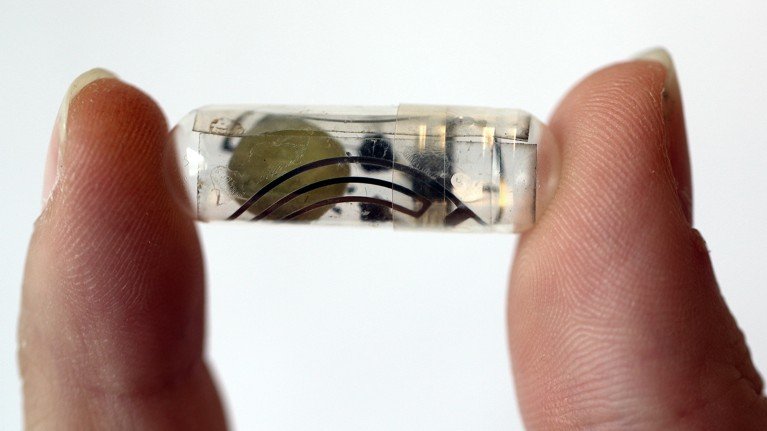
This ingestible capsule, tested in pigs, contains a biodegradable paper battery (large brown circular structure) and a radio-frequency identification (RFID) tag (black lines).Credit: Mehmet Say
A battery made with a substance resembling edible rice paper can power swallowable electronic medical devices. And after the battery has been safely digested, its broken-down ingredients can be absorbed by the body. The tiny power source has so far been tested in pigs, but the hope is that one day it could provide electricity for ingestible personalized devices that monitor human health or implanted ones that deliver electrical impulses to treat disease.
The researchers who built the battery tested it in two devices: one with a radio-frequency identification (RFID) tag that can transmit data from inside the body, and one that electrically stimulates the stomach to trigger the release of hunger-regulating hormones. Their findings are described today in the journal Nature Chemical Engineering1.
Ingredient overhaul
Conventional batteries can be dangerous, says Giovanni Traverso, a mechanical engineer at the Massachussetts Institute of Technology in Cambridge and a co-author of the study. If an ingested medical device breaks open and the battery inside it leaks, it can cause chemical burns. The battery can also release toxic materials as it passes through the digestive system. So Traverso wanted to build a battery entirely from non-toxic materials that would be absorbed by the body, making accidents unlikely.
“We were highly restricted in what materials to use,” Traverso says. Batteries normally contain electrodes for storing chemical energy, electrolytes that ferry charges between the electrodes and packaging to hold it all together. Lithium-ion and alkaline batteries often contain toxic metals, organic electrolytes that would accumulate in the body and plastic casings that can fragment into sharp pieces.

Rice paper, shown here drying on a bamboo lattice, was the inspiration for the coating on an edible battery.Credit: Mel Longhurst/VW Pics/Universal Images Group via Getty
Traverso’s group chose magnesium and molybdenum trioxide for their electrodes. Magnesium and molybdenum are metallic micronutrients that the body needs in small amounts, and when paired together in a battery, they provide a voltage high enough to power electronics. For an electrolyte, the researchers chose a biodegradable ionic liquid, instead of the poorly performing buffered saline used in some previous biocompatible battery designs.
Packaging was also key. The researchers needed a material that would support the other parts of the battery, without dampening overall performance by being electrically insulating. It also needed to have a large surface area and be made of a material the body can safely absorb when the device is no longer needed. “We were partly inspired by candies that have an edible rice-paper wrapper,” Traverso says. The cellulose-based coating they used for the battery dissolves over time, like those sweet wrappers. And the whole thing is dipped in beeswax to slow down the effects of stomach acid.
Open wide
The team tested the batteries in simulated gastric fluid, and found that they began coming apart within two weeks and completely dissolved after several months. Next, the researchers packaged the batteries together with other fully biodegradable, non-toxic electronics inside gel capsules, and tested them in pigs. An RFID-tracking device inside a swallowable gel capsule transmitted signals to a reader outside the pigs’ bodies. And an electrical stimulation device placed in pigs’ stomachs through endoscopy caused an increase in levels of the hunger hormone ghrelin. Traverso, who is also a gastroenterologist, says that such ‘electroceutical’ devices are being explored as a way to regulate the gut–brain connection. They are potentially less invasive than are procedures such as bariatric surgery and implants that regulate the activity of the digestive system.
Check back often for more exciting news!