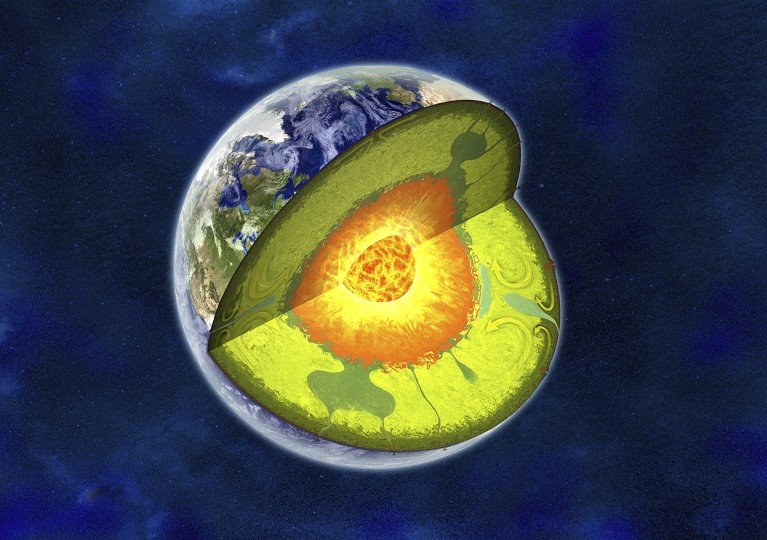
Interactions between Earth’s solid inner core, its molten outer core and its rocky mantle control how fast the planet rotates.Credit: Gregoire Cirade/SPL Small fluctuations in the length of Earth’s 24-hour day can be explained by a battle between forces generated by the movement of the planet’s metallic core. The finding, reported today in Nature1, suggests
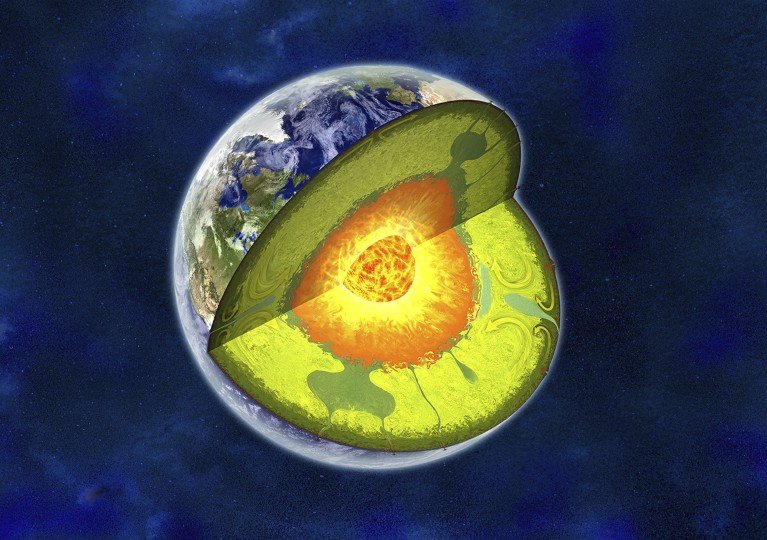
Interactions between Earth’s solid inner core, its molten outer core and its rocky mantle control how fast the planet rotates.Credit: Gregoire Cirade/SPL
Small fluctuations in the length of Earth’s 24-hour day can be explained by a battle between forces generated by the movement of the planet’s metallic core. The finding, reported today in Nature1, suggests that geophysicists could be on the right track to understanding mysterious structures in Earth’s deep interior.
The planet’s rate of rotation changes subtly over time, giving rise to variations in the length of our day that are on the order of just a few milliseconds over decades. Geophysicists measure these changes by observing Earth’s position relative to distant cosmic objects.
Researchers have suspected that these variations are linked to interactions between Earth’s core and its rocky mantle, but it wasn’t clear what forces were involved, says Mathieu Dumberry, a geophysicist at the University of Alberta in Edmonton, Canada. Scientists know that it is the core “that’s responsible for these decadal changes. But how does it do it?” he says. “This is the part that’s unclear.”
Core torque
Earth’s core is a Mars-sized ball at the centre of the planet made up mostly of iron. The inner core is solid and can rotate independently within a molten, flowing outer core. There are a few ways researchers have proposed that these parts of the core can couple with the rocky mantle that surrounds them to either slow or accelerate the planet’s overall rotation.
Has Earth’s inner core stopped its strange spin?
One is by creating mechanical torque, which is a twisting force: the flow of the molten outer core could push against bumps and bulges at its interface with the mantle, like a river flowing around rocks. Another possibility is that the magnetic field generated by the flow of the outer core attracts iron-rich parts of the mantle, generating electromagnetic torque. And a third force could come from gravity pulling dense regions of the inner core towards anomalously dense regions of the mantle.
Dumberry and his colleague Huifeng Zhang, also at the University of Alberta, developed a model to explore how different combinations of these forces would alter the length of Earth’s day. A key part of this model relied on research published in 20232 that used seismic waves from earthquakes to measure the inner core’s rate of rotation relative to the rest of the planet since the 1960s. The work found that the inner core spun slightly faster relative to the rest of the planet until around 2010, when it began rotating more slowly.
Gravity always wins
The researchers found that their model best matched the record of changes in Earth’s length of day when gravitational torque was the dominant force. But it had to be balanced by the electromagnetic and mechanical torques pushing in the opposite direction in a kind of geophysical tug-of-war. “Before we obtained the result, we didn’t know they are competing with each other,” Zhang says.
This push-and-pull battle also seems to influence the rate of rotation of the inner core. According to the model, the inner core ‘wants to be aligned’ with the mantle because its dense regions are attracted to the mantle’s dense regions, Dumberry explains. But over time, it gets pulled out of alignment by the generally westward flows of the outer core, before being slowly pulled back eastward into position by gravity.
Keep following us for the latest insights.