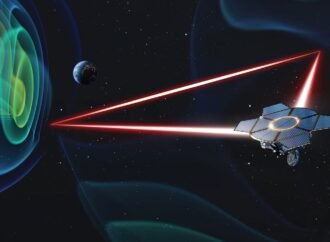
The LISA (Laser Interferometer Space Antenna) observatory, now in development, will detect gravitational waves, the tiny ripples in space-time caused by orbiting masses. Now two studies led by NASA astrophysicists show in new detail how LISA could reveal a new and unique population of exoplanets — worlds beyond our solar system — throughout our galaxy.
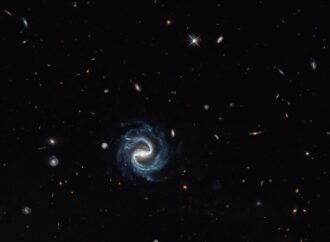
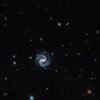
A sweeping barred spiral galaxy marks the spot in this image, but the real treasure is the gravitational lens in the lower-right corner, where a distant background galaxy is being magnified and distorted by the gravity of a closer galaxy. This observation is one of many gravitational lensing images taken by NASA’s Hubble Space Telescope
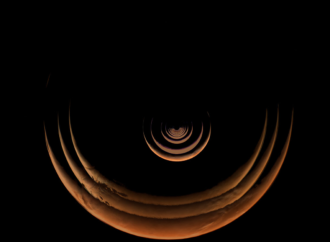
Explanation: Solar System bodies make deep space exploration more fuel efficient! Today’s video shows the Psyche spacecraft gaining speed and changing its trajectory with minimal fuel expenditure thanks to the gravitational assistance of Mars in May 2026. Mars has an average orbital speed of almost 87,000 km/h (54,000 mph) around the Sun. Its orbital motion