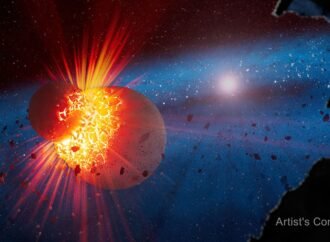
In the early history of our solar system, scientists theorize that a Mars-sized object called Theia smashed into the infant Earth, vaporizing massive amounts of rock and blasting it into space. Some of that material coalesced into the Moon, where NASA’s Artemis program is returning humans, preparing for Mars, and shaping the future of space
NASA’s Hubble Space Telescope completed its 200,000th orbit around Earth on Sept. 19, marking another new milestone for an observatory that continues to transform our understanding of the universe. Hubble has traveled more than 5 billion miles around Earth over its 36-year lifetime, exceeding 1.7 million total observations. An observation completed on the day of
NASA announced Wednesday a mission to explore the history and evolution of the universe, PRIMA (PRobe far-Infrared Mission for Astrophysics), is advancing to the next phase of development. This space telescope is the first in a new class of NASA astrophysics missions, called Probe Explorers, within the agency’s longstanding Explorers Program. “The PRIMA mission is
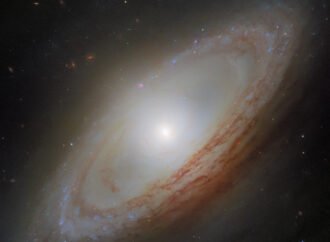
Though the spiral galaxy in this new image from the NASA/ESA Hubble Space Telescope seems serene, it hides a chaotic secret. This galaxy is NGC 4698, and it lies about 55 million light-years away in the constellation Virgo. It’s one of over a thousand galaxies in the Virgo Cluster, the nearest large cluster of galaxies bound together by
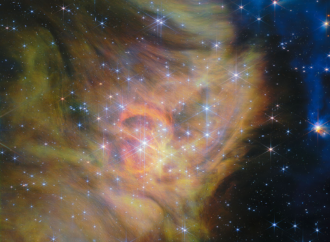
This starry view of the nearby star-forming region IC 348 is one of the largest images released to date from NASA’s James Webb Space Telescope. Using Webb, astronomers searched IC 348 for brown dwarfs, which are less massive than the smallest stars. The researchers discovered brown dwarfs just twice the mass of Jupiter, bringing the
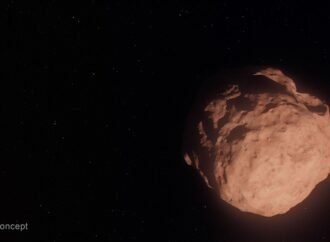
This artist’s concept depicts a Trans-Neptunian Object, a small, faint, icy body orbiting the Sun beyond the orbit of Neptune. These objects are so small that even with NASA’s Hubble and Webb space telescopes, they appear only as tiny points of light. Artwork: NASA, ESA, Leah Hustak (STScI) For the first time, scientists used the