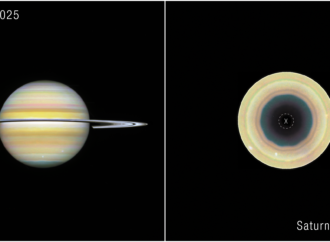
Recent NASA Hubble Space Telescope images show the gas giant Saturn and its southern pole, where astronomers have discovered a 10-sided atmospheric wave. Observations show the decagon extends through multiple layers of Saturn’s atmosphere. Image: NASA, ESA, STScI, Agustin Sánchez-Lavega (UPV), Amy Simon (NASA-GSFC), Michael Wong (UC Berkeley); Image Processing: Alyssa Pagan Recent observations with
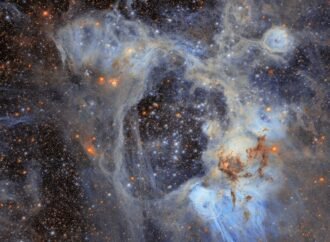
This NASA/ESA Hubble Space Telescope image features a sprawling cosmic vista in the Large Magellanic Cloud, or LMC, the largest of the small galaxies that orbit our Milky Way galaxy. At just 160,000 light-years away, the LMC offers a close look at highly active star birth sites like the one in this image. This photogenic
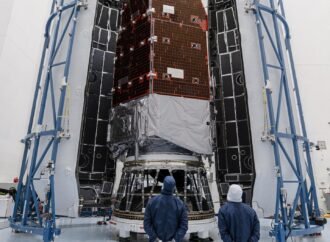
Coverage plans are ready for NASA’s Nancy Grace Roman Space Telescope prelaunch and launch activities. Roman is NASA’s next-generation observatory designed to explore some of the universe’s biggest mysteries, including dark energy. NASA and SpaceX are targeting Roman’s liftoff for no earlier than 7:26 a.m. EDT Sunday, Aug. 30, aboard a SpaceX Falcon Heavy rocket
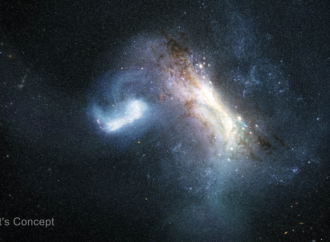
About 12 billion years ago, a dwarf galaxy known as LKH collided with a young Milky Way and merged with it. This artist’s concept portrays that collision. NASA’s Hubble Space Telescope uncovered definitive evidence of this collision by studying globular star clusters. Illustration: NASA, ESA, Joseph Olmsted (STScI) Our home galaxy, the Milky Way, grew
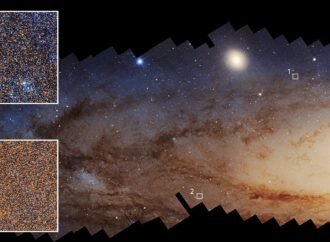
A new study using data from NASA’s Hubble Space Telescope finds that star formation in the nearby Andromeda galaxy has seen a 500-million-year decline, with an even steeper decline over the past 40 million years. Andromeda, a spiral galaxy comparable in size to our Milky Way, is close enough to be seen with the naked
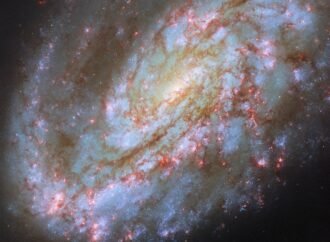
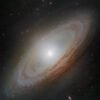
The subject of this NASA/ESA Hubble Space Telescope image is a spiral galaxy battling titanic forces appearing on galactic scales in space. This is NGC 4654, an intermediate spiral galaxy in the constellation Virgo (the Maiden). It is classified as “intermediate” because its overall shape falls between spiral galaxies that have a bar in their