In the early history of our solar system, scientists theorize that a Mars-sized object called Theia smashed into the infant Earth, vaporizing massive amounts of rock and blasting it into space. Some of that material coalesced into the Moon, where NASA’s Artemis program is returning humans, preparing for Mars, and shaping the future of space
In the early history of our solar system, scientists theorize that a Mars-sized object called Theia smashed into the infant Earth, vaporizing massive amounts of rock and blasting it into space. Some of that material coalesced into the Moon, where NASA’s Artemis program is returning humans, preparing for Mars, and shaping the future of space exploration.
That long-ago, violent collision reshaped our home planet. Astronomers have used NASA’s James Webb Space Telescope to examine a class of young stellar systems that show signs of similar upheavals, providing clues to the amount of energy in their collisions. The results offer insights into the composition and evolution of these chaotic systems.
The team’s findings published Thursday in The Astrophysical Journal.
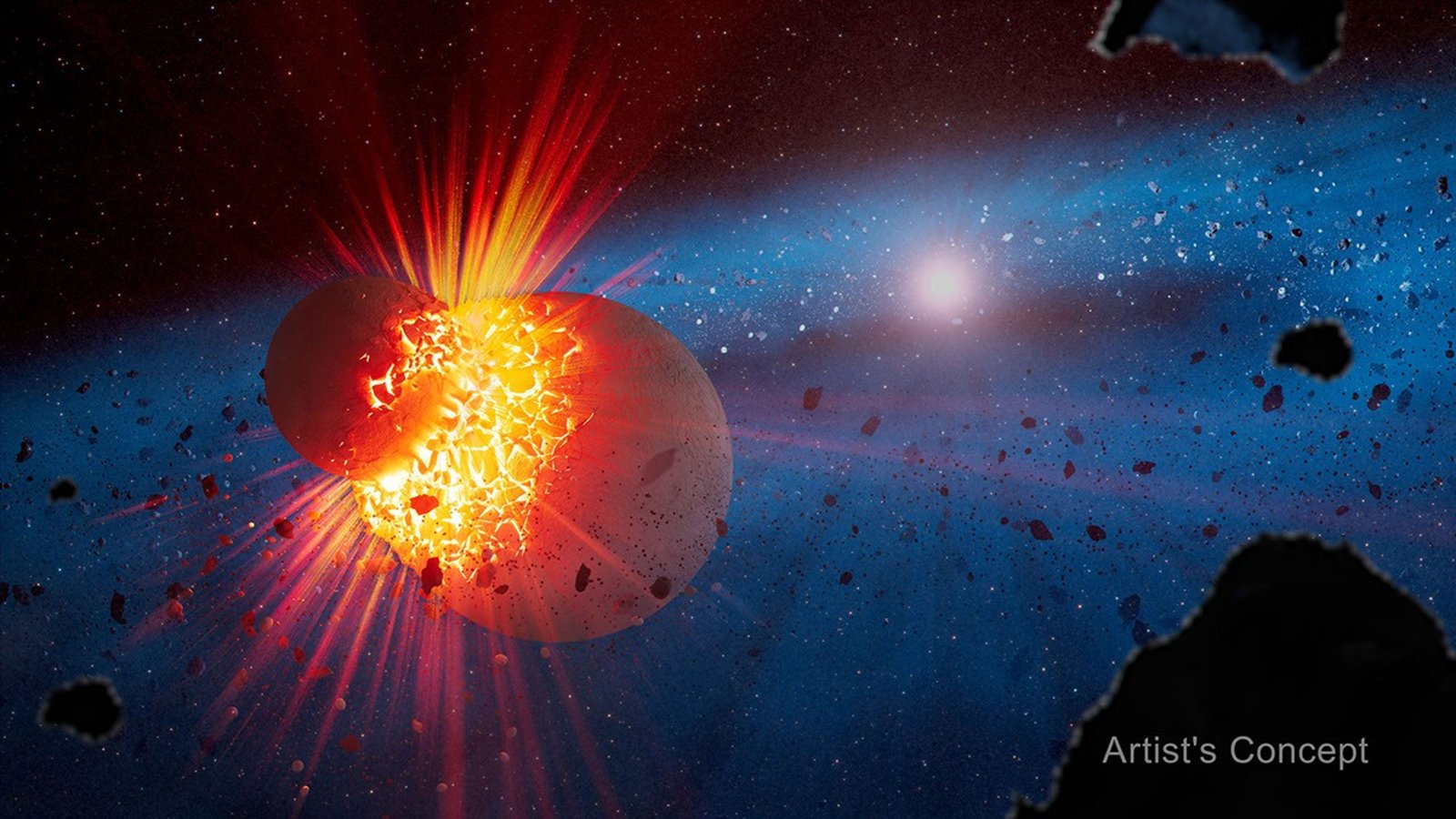
The types of collisions within young stellar systems known as extreme debris disks are relevant to scientists’ understanding of our own solar system, which is thought to have undergone similar impact events that created our Moon and shaped Earth’s initial state.
Artwork: NASA, ESA, CSA, Joseph Olmsted (STScI)
The environment surrounding a star changes as it ages, beginning with a juvenile, gas-rich protoplanetary disk where forming planets can reside, before evolving to a gas-poor debris disk. During its mission lifetime, NASA’s retired Spitzer Space Telescope examined the debris disk stage and discovered a subclass termed extreme debris disks. These systems harbor unusually large amounts of warm dust close to the star, in the region comparable to where rocky planets orbit in our solar system. A team of astronomers led by Kate Su of the Space Science Institute in Boulder, Colorado investigated these intriguing objects with Webb.
Contrary to theoretical predictions, which suggest we should observe many extreme debris disks, observations indicate that these environments are rare. Scientists estimate roughly only 1% of young stars show observable signatures of this phase based on the data collected so far, including possibly our own solar system during its formation. Despite their rarity, the team was able to compile a sample of 21 extreme debris disks, including five from Spitzer’s archival data and 16 from Webb, with 12 newly observed disks and follow-up observations on four of Spitzer’s.
“This is the first time we have gathered enough systems to truly understand this subclass that we call extreme debris disks,” said Su, lead author of the paper. “Before Webb, we had limited information. We knew that they are weird and very different from the typical cold debris disks that we know, like Vega and Fomalhaut. Now that we have more data, we can pin down what these disks represent for planet formation and evolution.”
The team confirmed that extreme debris disks share three key properties: smaller dust grains than those in protoplanetary or classic debris disks, a high concentration of warm dust, and irregular brightness variations, all revealed by mid-infrared spectra from Webb and Spitzer.
To determine the driving factor for these qualities, the team studied the mineralogical makeup of the disks. They found that their sample could be categorized into silica-rich and silica-poor disks. Volcanic glass like obsidian is one example of silica-rich material found on Earth, whereas the silica-poor mineral forsterite appears as green sand grains on some beaches in Hawaii. An extreme debris disk’s category relays information on the type of collisions producing the impact debris and may help account for its variability in infrared brightness.
“To just see their mid-infrared emission and beautiful spectral features with Webb, which allowed us to identify their compositions, was the most exciting thing for me,” said Agnes Kospal of Konkoly Observatory in Budapest, Hungary, and a coauthor of the study. “We have no other way to study these planetary embryos directly because they are too small.”
Of their sample, about one-third is silica-rich, suggesting these disks are produced by high-energy impacts between Mars-sized bodies where a significant portion of the material is vaporized. The remaining two-thirds of their sample is silica-poor, indicating that the collisions are occurring on smaller scales, like grazing, between Moon-sized objects. Silica-rich disks are found only around stars younger than 300 million years, while silica-poor disks persist across a broad range of ages and often show greater brightness variability. The team proposes that this variability is driven by the rapid evolution of fresh debris through orbital changes and additional impacts.
Their findings can be applied to our own solar system, which may have experienced more than one extreme debris disk phase.
“How rocky planets formed and giant planets evolved are part of the broader story of the solar system’s formation. It’s all one story,” said Su. “Our work on extreme debris disks helps us bring together the big picture of what we currently understand.”
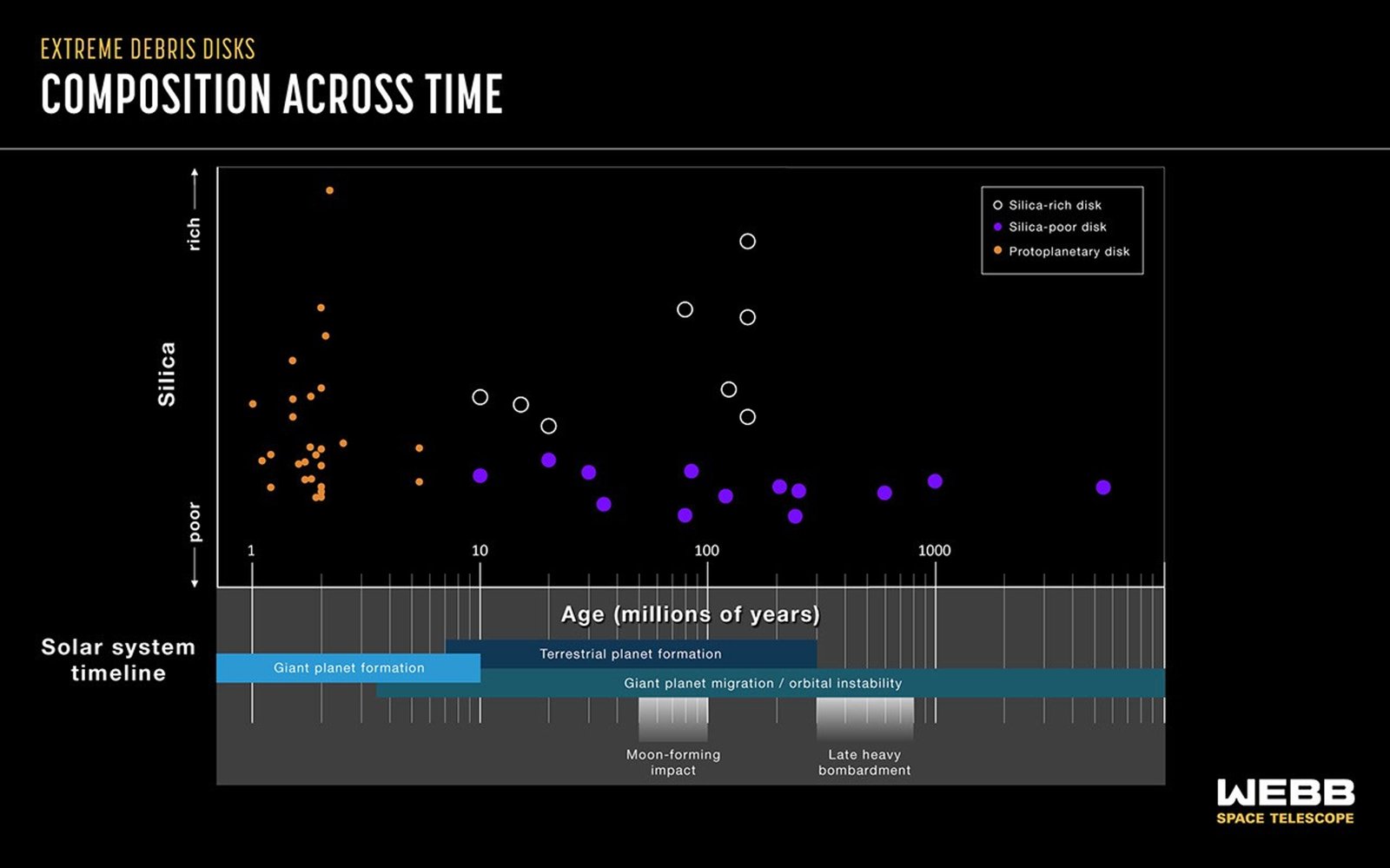
By investigating the compositions of extreme debris disks, scientists inferred that silica-rich disks are produced by high-energy impacts of Mars-sized objects, while silica-poor disks are created by less energetic events from Moon-sized bodies.
Illustration: NASA, ESA, CSA, Joseph Olmsted (STScI)
Simulations suggest that terrestrial planets, such as Earth, should form within the first few hundred million years of a solar system’s formation. This period fits with the ages of silica-rich extreme debris disks observed so far and aligns with the estimation that Earth and the Moon formed around 100 million years after the Sun formed, with the Moon likely being the result of a collision between Earth and a Mars-sized object.
As for whether our Sun underwent a silica-poor extreme disk phase, if older silica-poor disks and their random intervals of infrared brightness do reflect orbital instability, this would be broadly consistent with the Late Heavy Bombardment hypothesis for our solar system. In that scenario, the gas giant planets migrated significant distances, gravitationally disrupting the orbits of smaller bodies and triggering catastrophic collisions that generated the short-lived, dust-rich phases observed in extreme debris disks.
“Of course, there’s many things we still don’t know about these disks,” said Attila Moor of Konkoly Observatory, a coauthor of the study. “We expect no silica-rich systems among older extreme debris disks. We only have three disks in our sample that fit that age criteria, so it’ll be nice to observe more of these systems to confirm our hypothesis.”
The James Webb Space Telescope is the world’s premier space science observatory. Webb is solving mysteries in our solar system, looking beyond to distant worlds around other stars, and probing the mysterious structures and origins of our universe and our place in it. Webb is an international program led by NASA with its partners, ESA (European Space Agency) and CSA (Canadian Space Agency).
To learn more about Webb, visit:
https://science.nasa.gov/webb
The following sections contain links to download this article’s images and videos in all available resolutions followed by related information links, media contacts, and if available, research paper and Spanish translation links.
Keep following us for the latest insights.