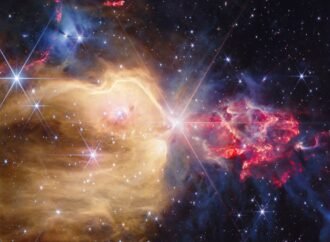
Explanation: How do stars form? To help answer this question, NASA used the James Webb Space Telescope to take the featured detailed image of the star-forming region NGC 7129 in infrared light. Star formation progresses when gravity pulls together massive amounts of gas, but soon things can get complicated when previously formed stars emit powerful
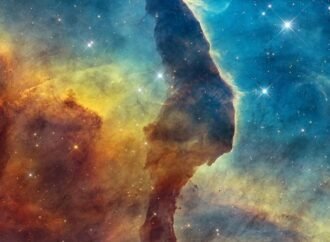
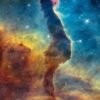
Intricate structures within the Cat’s Head Nebula are illuminated in this mid-infrared view from NASA’s James Webb Space Telescope released on Oct. 29, 2026. The distinctive “cat’s head” shape of the nebula was likely sculpted over time by the intense ultraviolet radiation and winds from massive stars in the Carina Nebula. As this stellar feedback
Like a spectral form rising out of a cold mist, NASA’s Hubble and James Webb Space Telescopes have captured a hauntingly dynamic star-forming scene. It lies within the vast Carina Nebula, a diffuse star-forming region located about 7,500 light-years away from Earth. The small, select area both telescopes observed is nicknamed the Cat’s Head Nebula
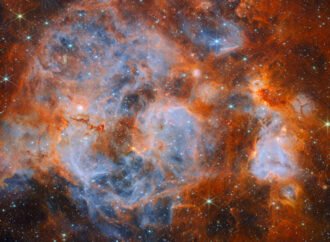
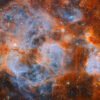
In this Webb image released on Oct. 22, 2026, we see a turbulent cauldron of star formation filled with dense clumps of gas. This region is named N159 and is located 161,000 light-years away in the Large Magellanic Cloud, one of the satellite galaxies orbiting the Milky Way galaxy. This region has a lower metallicity
This starry view of the nearby star-forming region IC 348 is one of the largest images released to date from NASA’s James Webb Space Telescope. Using Webb, astronomers searched IC 348 for brown dwarfs, which are less massive than the smallest stars. The researchers discovered brown dwarfs just twice the mass of Jupiter, bringing the
This artist’s concept depicts a Trans-Neptunian Object, a small, faint, icy body orbiting the Sun beyond the orbit of Neptune. These objects are so small that even with NASA’s Hubble and Webb space telescopes, they appear only as tiny points of light. Artwork: NASA, ESA, Leah Hustak (STScI) For the first time, scientists used the