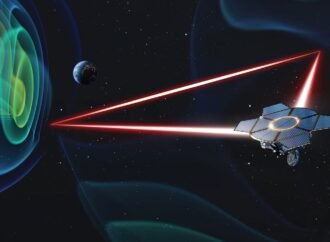
The LISA (Laser Interferometer Space Antenna) observatory, now in development, will detect gravitational waves, the tiny ripples in space-time caused by orbiting masses. Now two studies led by NASA astrophysicists show in new detail how LISA could reveal a new and unique population of exoplanets — worlds beyond our solar system — throughout our galaxy.
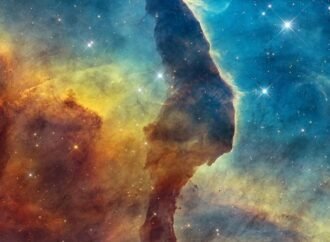
Like a spectral form rising out of a cold mist, NASA’s Hubble and James Webb Space Telescopes have captured a hauntingly dynamic star-forming scene. It lies within the vast Carina Nebula, a diffuse star-forming region located about 7,500 light-years away from Earth. The small, select area both telescopes observed is nicknamed the Cat’s Head Nebula
This starry view of the nearby star-forming region IC 348 is one of the largest images released to date from NASA’s James Webb Space Telescope. Using Webb, astronomers searched IC 348 for brown dwarfs, which are less massive than the smallest stars. The researchers discovered brown dwarfs just twice the mass of Jupiter, bringing the
This artist’s concept depicts a Trans-Neptunian Object, a small, faint, icy body orbiting the Sun beyond the orbit of Neptune. These objects are so small that even with NASA’s Hubble and Webb space telescopes, they appear only as tiny points of light. Artwork: NASA, ESA, Leah Hustak (STScI) For the first time, scientists used the
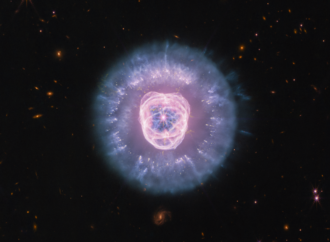
Observing across the starry “plains” of space, NASA’s James Webb Space Telescope has taken new images of NGC 2392, nicknamed the Lion Nebula. NASA’s Hubble Space Telescope previously viewed this planetary nebula in 2000, imaging the lion face-shaped target in visible light and revealing features such as the “mane” of hazy, comet-shaped objects. Now Webb
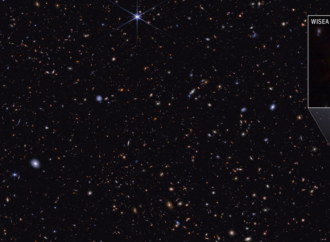
Since their discovery by NASA’s James Webb Space Telescope in 2022, small red dots (LRDs) have been the subject of great interest to astronomers. Understanding the nature of these compact and extremely distant red sources has been a perplexing scientific endeavor. One popular theory is that the small red dots are supermassive black holes known