The subject of this NASA/ESA Hubble Space Telescope image is a spiral galaxy battling titanic forces appearing on galactic scales in space. This is NGC 4654, an intermediate spiral galaxy in the constellation Virgo (the Maiden). It is classified as “intermediate” because its overall shape falls between spiral galaxies that have a bar in their
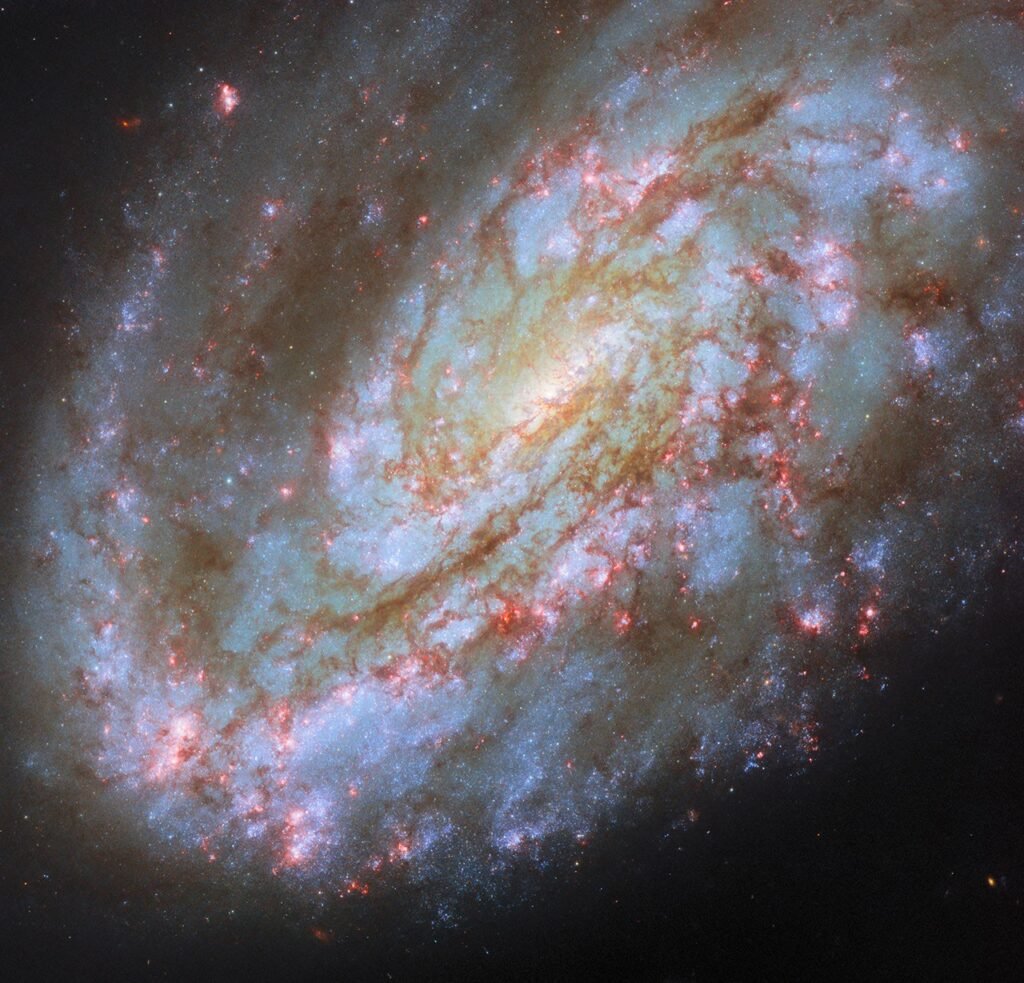
The subject of this NASA/ESA Hubble Space Telescope image is a spiral galaxy battling titanic forces appearing on galactic scales in space. This is NGC 4654, an intermediate spiral galaxy in the constellation Virgo (the Maiden). It is classified as “intermediate” because its overall shape falls between spiral galaxies that have a bar in their centers and those that do not. NGC 4654 has a weak bar structure at its center and is located 72 million light years from Earth in the Virgo Cluster, a particularly massive and populated galaxy cluster.
NGC 4654 is particularly asymmetric, with a clearly defined, rounded edge on one side and a long tail of gas extending from the opposite side, outside the field of view captured in this image. This gaseous tail is the result of ram pressure, a force that galaxies can experience as they hurtle through space. NGC 4654 is moving at such a high speed that it sweeps through the hot, rarefied gas that fills the space between the Virgo Cluster galaxies. This intracluster medium, in turn, exerts “ram pressure” on the galaxy, compressing the galaxy’s leading edge and dragging its gas behind the galaxy, creating the elongated tail.
It’s not just the galaxy’s gas that is unevenly distributed: its stars are too, and this is most unusual for a spiral galaxy. While the spiral arm at its leading edge is rich in stars and gas, the opposite arm is notably starless, influencing the galaxy’s twisted spiral shape. Astronomers believe that ram pressure alone is unlikely to cause this effect. Rather, NGC 4654 was also subject to the gravitational pull of the Virgo Cluster galaxy NGC 4639. While the two galaxies are far apart now, a flyby interaction between them about 500 million years ago is thought to have stripped gas from NGC 4654 along one side, limiting star formation there and creating an asymmetry in its shape.
Many galaxies that are subjected to ram pressure suffer reduced rates of star formation as the cold gas that collapses to form their stars moves away and is lost. NGC 4654, however, is still forming nearly two suns of stars each year, a rate comparable to other galaxies of similar size. Active star formation is visible in the latest Hubble data included in this image. The data captures a wavelength of red light emitted by clouds of energized gas where newborn stars lurk. The bright pink bubbles that appear along NGC 4654 (from its leading spiral arm to around its faint bar and to the edge of its disk) are areas where these newborn stars shine.
The data used in this image come from two observing programs (#15654, #17502) that aim to link gas in galaxies with star formation. By observing many prominent galaxies in the vicinity of our own, researchers hope to better understand how gas moves in galaxies, where and when it collapses to form stars and star clusters, and what effect those new stars have on the gas around them.
Text credit: ESA/Hubble
Media contact:
Claire Andreoli
from NASA Goddard Space Flight Center, Greenbelt, Maryland, USA
claire.andreoli@nasa.gov
Keep following us for the latest insights.