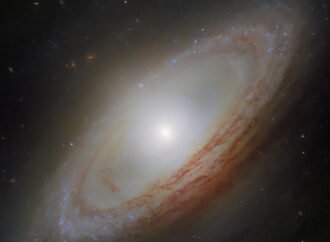
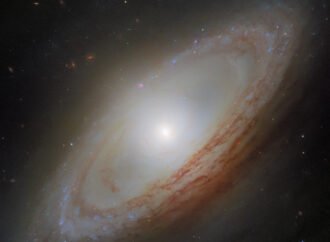
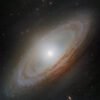
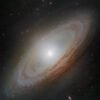
A chaotic secret hides within this seemingly serene image of spiral galaxy NGC 4698 taken by NASA’s Hubble Space Telescope and released on Sept. 18, 2026. As a spiral galaxy like our own Milky Way galaxy, NGC 4698 has spiral arms that curl around within a thin disk of stars, gas, and dust. These arms
NASA’s Hubble Space Telescope completed its 200,000th orbit around Earth on Sept. 19, marking another new milestone for an observatory that continues to transform our understanding of the universe. Hubble has traveled more than 5 billion miles around Earth over its 36-year lifetime, exceeding 1.7 million total observations. An observation completed on the day of
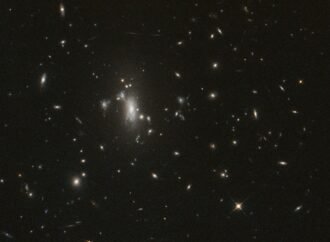
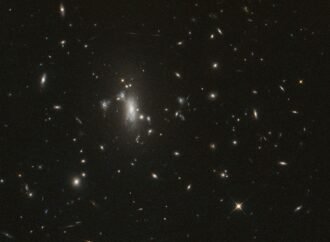
NASA’s Hubble Space Telescope captured this image of massive galaxy cluster MACS J0417 (left of center) on Sept. 19, 2026. This galaxy cluster acts as a gravitational lens, bending and magnifying light from objects far behind it. Supernova Athena, discovered by NASA’s James Webb Space Telescope in 2025, is predicted to reappear between now and
Though the spiral galaxy in this new image from the NASA/ESA Hubble Space Telescope seems serene, it hides a chaotic secret. This galaxy is NGC 4698, and it lies about 55 million light-years away in the constellation Virgo. It’s one of over a thousand galaxies in the Virgo Cluster, the nearest large cluster of galaxies bound together by
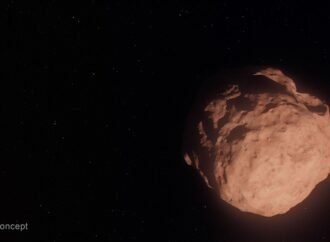
This artist’s concept depicts a Trans-Neptunian Object, a small, faint, icy body orbiting the Sun beyond the orbit of Neptune. These objects are so small that even with NASA’s Hubble and Webb space telescopes, they appear only as tiny points of light. Artwork: NASA, ESA, Leah Hustak (STScI) For the first time, scientists used the
Early in her career, Nancy Grace Roman ignored those who advised her not to become a scientist because of her gender.Credit: NASA/Science Photo Library Astronomers have a new tool for peering into the Universe to probe dark matter, dark energy and exoplanets. The Nancy Grace Roman Space Telescope, launched on 30 August, is the first