
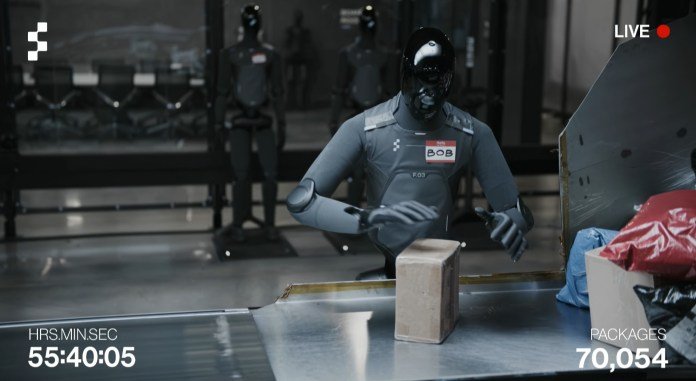
Robotics company Figure has just raised the bar for what we can expect from autonomous humanoids in the workplace. In an impressive display of stamina, a fleet of their latest Figure 03 robots has successfully sorted more than 80,000 packages over a gruelling 64-hour continuous run. The entire marathon event is being broadcast live to
Robotics company Figure has just raised the bar for what we can expect from autonomous humanoids in the workplace. In an impressive display of stamina, a fleet of their latest Figure 03 robots has successfully sorted more than 80,000 packages over a gruelling 64-hour continuous run.
The entire marathon event is being broadcast live to the world on YouTube, moving far beyond the polished, heavily edited promo videos we typically see in the tech space. This real-world demonstration shows exactly what these machines are capable of when left to do actual work for days on end.

Testing to failure in a closed loop
The testing configuration is designed as a closed-loop system inside the Figure facility to allow for continuous, repeatable testing. Packages of all different shapes and sizes come sliding down a metal chute directly into the workspace of the robot.
The Figure 03 units are tasked with picking up a variety of soft and hard packages, including plastic mailer bags and standard cardboard boxes. Each item must be rotated and oriented so that its shipping label is placed flat on the conveyor belt facing downwards.
Once the robot places the package correctly, it moves down the line to simulate what happens inside a real logistics distribution centre. In a production environment, this allows a scanner to read the barcode from underneath and automatically route the parcel to the correct delivery truck.
To keep the test running nonstop without needing massive amounts of inventory, the conveyor belt simply loops back around to the top. The parcels are dumped right back into the initial metal chute, creating an endless cycle for the robots to process.

Giving the fleet a human touch
When the livestream first kicked off, the robots were completely identical and carried no distinct identifying markers. Following feedback from viewers watching the stream online, the team at Figure decided to give the hard-working humanoids some personality.
One by one, the robots received their very own custom name tags slapped right onto their chests. So far, the rotating shift crew consists of four distinct robots named Frank, Rose, Jim, and Bob.
Seeing the names on the front of the chassis adds a surprisingly human element to an otherwise entirely mechanical operation. It also makes it much easier for viewers tracking the stream to see which specific unit is currently taking its turn on the floor.
Redefining safety in industrial workspaces
One of the most remarkable moments of the stream occurred when a human staff member calmly walked right up into the active workspace. The employee stepped directly into the robot’s reach to hand-label one of the units while it was right in the middle of processing packages.
Traditional industrial robots almost always operate behind heavy steel fencing or light curtains to prevent catastrophic injuries to humans. The fact that Figure felt comfortable enough to allow close human interaction shows incredible confidence in their onboard safety systems.
The challenge originally started out as a standard eight-hour endurance test to see how the hardware would hold up. However, the scope of the project was quickly updated by the engineering team to run to absolute failure instead.
At this stage, it is still anyone’s guess as to what might eventually cause the operation to grind to a halt. It could be a physical jam where packages get wedged in the chute, a localised power failure, an unexpected trip, or even a software glitch that causes a collision.

The power of the Helix 02 model
The brains behind this impressive physical display are Figure’s new Helix 02 AI model. The system operates by taking visual inputs from cameras integrated directly into the head of the robot and translating that data into fluid limb movements.
If you sit and watch the stream for a decent block of time, you will definitely notice the robot making occasional mistakes. It sometimes misjudges a grip or drops a plastic bag, which are errors a human worker likely wouldn’t make as frequently.
The crucial difference here is that when the Figure 03 fails a grasp, it does not freeze up or require a manual reset. It simply identifies the failure in real time, adjusts its approach, tries again, and ultimately gets the job done.
Despite these minor fumbles along the way, the quality control appears to be remarkably high. Throughout the hours of footage, every single package that leaves the station on the conveyor belt is correctly oriented with the label facing down.


Seamless teamwork and autonomous charging
Because the test is running 24 hours a day, the robots have to manage their own power requirements without human intervention. When a specific unit reaches a low battery threshold, it autonomously stops its sorting task and walks away from the conveyor belt.
The tired robot heads over to a dedicated charging station to top up its cells for the next shift. At the exact same time, a freshly charged robot steps up from its dock and walks over to the station to seamlessly take over the workload.
Upon arriving at the conveyor belt, the incoming robot pauses for a couple of seconds to scan the workspace with its cameras. Once it understands the current layout of the packages in front of it, it immediately picks up right where the last robot left off.
After 64 hours of continuous operation, this test proves that high-volume logistics sorting can be successfully handled by a fleet of humanoids. The next step for Figure will be showcasing this same level of autonomy across a wider variety of commercial tasks.
You can check out the stream for yourself right here: https://www.youtube.com/watch?v=luU57hMhkak or, for more information, head to https://www.figure.ai




















Leave a Comment
Your email address will not be published. Required fields are marked with *