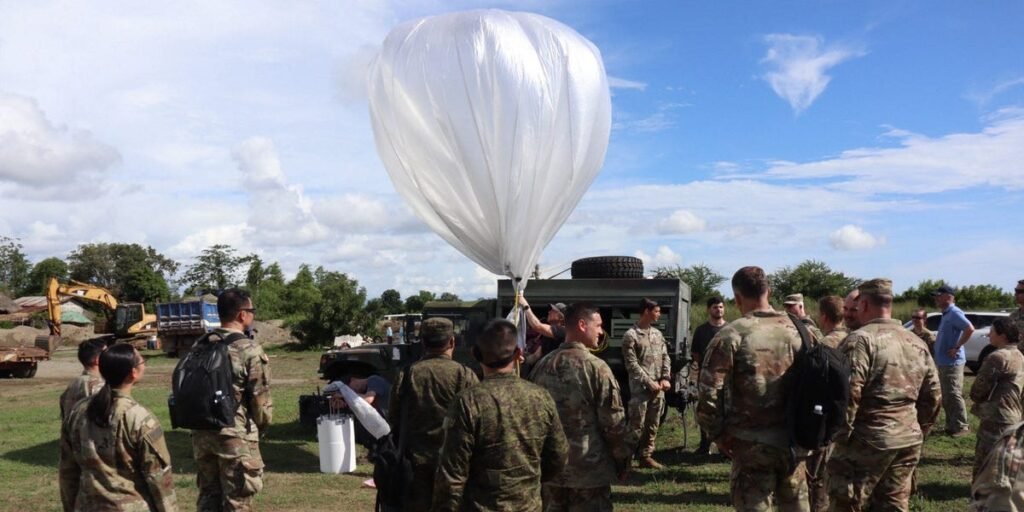
The US Army is looking to expand its use of high-altitude balloons as the service builds out its capabilities near and in outer space. These balloons operate in the stratosphere, roughly 60,000 to 100,000 feet above Earth, the space in between where conventional aircraft fly and satellites. Army officials say they see an opportunity to
The US Army is looking to expand its use of high-altitude balloons as the service builds out its capabilities near and in outer space.
These balloons operate in the stratosphere, roughly 60,000 to 100,000 feet above Earth, the space in between where conventional aircraft fly and satellites. Army officials say they see an opportunity to use the balloons to deliver satellite-like surveillance and communication capabilities closer to the battlefield.
Lt. Gen. John Rafferty, commander of Army Space and Missile Defense Command, said he was initially skeptical of the technology. He recalled hearing proposals to use high-altitude balloons while serving in what was then Army Futures Command and questioning whether they’d prove practical.
The general’s view, however, changed after he saw the balloons hold their positions and conduct high-altitude surveillance during a training exercise.
“I went from nowhere to a huge believer very quickly once I saw them in action,” Rafferty said at this week’s Association of the United States Army conference in Washington, DC.
The Army is exploring a range of balloon systems for different missions, from surveillance and communications to supporting long-range strikes.
Col. Joseph Mroszczyk, who oversees the efforts to integrate emerging space capabilities into Army operations as the director of Transformation Integration Space Superiority, said at AUSA that he wants a “family of stratospheric systems.”
Unlike satellites, which travel set paths in orbit, high-altitude balloons can exploit different wind currents to maneuver or maintain a presence over an area of interest, he said.
Mroszczyk said the Army could use favorable winds to position balloons carrying sensors, communications equipment, or payloads supporting strikes.
“What that enables us to provide is space-like capabilities, really exploiting a transition point between what is normally considered the aerial layer and the space domain,” he said.
Operating at those altitudes could give the Army persistent coverage across large areas from the stratosphere without relying exclusively on satellites or conventional aircraft.
The Army plans to conduct multiple experiments involving various stratospheric systems over the coming year, building on tests conducted in Europe and the Pacific. The service has also experimented with the technology alongside combat operations in the Middle East, a senior Army official told Breaking Defense earlier this week.
Those efforts followed the cancellation of a large-scale balloon demonstration planned for the Indo-Pacific last year.
The growing interest in high-altitude balloons comes as the Army expands its role in space and near-space operations, with ground forces increasingly reliant on space-based capabilities for navigation, communications, and intelligence.
For more tech updates, stay tuned to our blog.