
The landscape of personal computing just experienced a massive shift that will fundamentally alter how you choose your next computer. For decades, the dominant force in the PC industry was built on a reliable partnership: Windows software running on Intel processors. This combination became so ubiquitous that it earned its own shorthand in the tech
The landscape of personal computing just experienced a massive shift that will fundamentally alter how you choose your next computer. For decades, the dominant force in the PC industry was built on a reliable partnership: Windows software running on Intel processors. This combination became so ubiquitous that it earned its own shorthand in the tech world: WinTel.
That era is officially giving way to something entirely new. We are witnessing the birth of WiNvidia, a fresh alliance where Microsoft Windows is pairing directly with NVIDIA silicon at the architecture level to redefine the personal computer.
The transition is driven by a massive, multi-year collaboration between the two tech giants that has culminated in a brand-new category of hardware. Announced at the NVIDIA GTC event, the companies unveiled a hardware stack built from the ground up for localised artificial intelligence, heavy creative workloads, and high-end gaming. It represents a dramatic pivot away from traditional x86 processor infrastructure toward ultra-efficient, highly integrated AI superchips.
The Architecture: NVIDIA RTX Spark
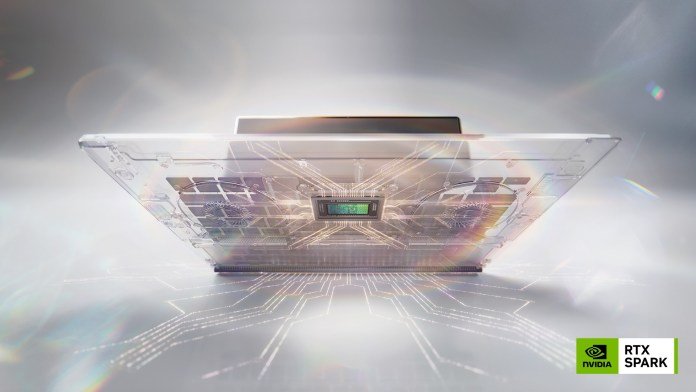
At the absolute centre of this hardware revolution is the newly announced NVIDIA RTX Spark superchip. This processor effectively combines thirty years of proprietary graphics and compute architecture into a single, highly efficient package designed for thin and light laptops. It represents an engineering shift away from disparate components toward unified silicon that houses both processing and graphical muscle on a single board.
The design architecture pairs an NVIDIA Blackwell RTX GPU containing 6,144 CUDA cores with a high-performance, 20-core NVIDIA Grace CPU. This pairing is tied together via an NVLink-C2C interconnect, allowing the processing units to communicate with incredible speed. MediaTek collaborated with NVIDIA on the custom CPU design, bringing its expertise in mobile system-on-a-chip engineering to maximise energy efficiency.
This hardware combination achieves up to 1 petaflop of localised AI compute performance. To put that in perspective, this brings the raw processing capabilities previously reserved for data centres directly into premium laptops that are as thin as 14 millimetres. The system also supports up to 128GB of unified memory, which eliminates the data transfer bottlenecks that typically slow down traditional PC systems.

“The PC is being reinvented. For forty years, you launched apps. Click. Type. With RTX Spark and Microsoft Windows, you ask – and the PC does the work. RTX Spark brings everything NVIDIA has built – CUDA, RTX, our AI platform – into a single superchip.
Local agents. Frontier models. Creative workflows. RTX games. All on a laptop. This is the new PC. The personal AI computer.”
Jensen Huang, founder and CEO of NVIDIA
Purpose-Built for Localised AI Agents
While previous generations of “AI PCs” focused heavily on basic cloud-connected tricks or simple photo editing filters, this new wave of hardware is purpose-built to handle autonomous AI agents locally. This marks a critical inflection point for software developers and power users who want to run highly capable open-source agents without sending sensitive data to the cloud.
Running complex agents locally has historically been limited by hardware constraints and security vulnerabilities. To solve this, Microsoft and NVIDIA have co-developed a robust security environment directly inside the Windows operating system. This framework integrates new Windows security primitives with a dedicated runtime environment called NVIDIA OpenShell.
The new system gives users granular control over exactly what an on-device agent can see, track, and modify across various Windows applications. The OpenShell runtime acts as an intelligent gatekeeper, checking queries against local privacy policies and even masking personal details if an agent needs to reach out to a cloud-based model. This secure foundation allows users to deploy advanced, multi-app workflows right on their desktop with complete privacy.
Because the system relies on massive localised processing power and a 128GB unified memory pool, these PCs can run incredibly complex language models completely offline. Users can execute tasks across different applications, write code plug-ins, and structurally search through massive directories of local files. Developers can even run 120-billion-parameter large language models (LLMs) with a context window of up to 1 million tokens without needing an active internet connection.
“Our goal is to deliver unmetered intelligence to every home and every desk with Windows. RTX Spark marks a real breakthrough towards that vision.”
Satya Nadella, chairman and CEO of Microsoft
Rearchitecting the Creative Application Stack
This massive injection of localised processing power is already forcing major software vendors to completely rewrite their applications to take advantage of the WiNvidia stack. Adobe is currently leading this charge by rearchitecting its core creative suite, including Photoshop and Premiere, from the ground up, specifically for the RTX Spark platform.
The creative workflows in these updated applications will leverage the unified memory architecture and Blackwell GPU infrastructure to deliver up to double the performance of older systems. Video editors working in Adobe Premiere will gain access to a completely overhauled video pipeline that offers real-time editing and colour correction for ultra-high-resolution files, including 12K video formats. Complex timelines with heavy effects can be rendered far more efficiently without stuttering.
Photoshop is receiving a similar structural upgrade, with its next-generation engine being optimised for GPU-accelerated compositing and modern natural brushing. The underlying AI pipelines are being tuned to harness the TensorRT software stack, speeding up generative AI features like Generative Fill. Furthermore, these creative apps will soon integrate directly with the new Windows agents, giving digital artists a virtual assistant that can actively collaborate on project management and layout creation.
Other major creative platforms are jumping onto the platform to utilise the massive memory capacity. Software packages like ComfyUI and Blender are adding support for advanced neural media tools, allowing creators to run highly complex diffusion models and generate high-resolution AI video with unprecedented local speed.
Uncompromising Performance for Gaming and Design
Beyond creative tools and autonomous software agents, the hardware integration delivers the full suite of NVIDIA gaming and rendering technologies to ultra-portable laptops. Gamers can expect to run demanding AAA titles at 1440p resolution while exceeding 100 frames per second with full ray tracing enabled.
The platform natively supports key graphics technologies, including DLSS, TensorRT, OptiX, Reflex, and G-SYNC. It will also debut DLSS 4.5 Ray Reconstruction, which utilises a second-generation transformer model to enhance visual fidelity in real-time rendering environments like Blender 5.3.
The large unified memory layout means 3D artists can load and render ultra-large 90GB scenes directly on a laptop without running out of video memory. This level of performance was previously restricted to heavy, power-hungry desktop workstations with massive, dedicated graphics cards.
Flagship Hardware: Surface Laptop Ultra
To showcase the absolute limits of this new silicon partnership, Microsoft introduced the Surface Laptop Ultra. Positioned as the most powerful Surface device ever created, this premium machine was engineered alongside NVIDIA from the silicon level up to serve as the ultimate showcase for the RTX Spark platform.
The device features a precision-engineered aluminium chassis that measures just 14 millimetres thick and weighs roughly three pounds. It features a colour-accurate tandem OLED display that supports G-SYNC technology, making it equally suited for professional colour grading and high-refresh-rate gaming.
The internal thermal design has been crafted to handle sustained high-performance workloads without thermal throttling, allowing developers to compile code or render complex 3D scenes for hours on end. Combined with the energy efficiency of the custom Grace CPU architecture, the laptop targets true all-day battery life while maintaining desktop-grade processing capabilities.
Other devices announced include:
- ASUS ProArt P16 and ASUS ProArt P14 combine powerful AI performance with slim and lightweight designs built for creators on the go. Available in 16-inch and 14-inch models with elegant Nano Black and new Neo White color options, the laptops feature ASUS Lumina Pro OLED displays and exceptional all-day battery life for premium creative experiences anywhere.
- Dell XPS 16 Creator Edition delivers serious GPU power built for creative work with smoother playback on 4K timelines, faster exports and a more seamless experience with AI tools. The Tandem OLED display with True Black HDR 600 ensures your visuals look exactly as intended. Add in a built-in SD card reader and HDMI port, and you’ve got a machine that’s as capable in the field as it is back at your desk.
- HP OmniBook Ultra 16 and HP OmniBook X 14 laptops are built for creators, gamers and AI developers, providing powerful local AI performance and experiences that help users accelerate workflows.
- Lenovo Yoga Pro 9n marries Lenovo Yoga’s creator-focused features with NVIDIA’s newest chip to deliver a laptop that is portable, powerful and can last for extended periods away from an outlet.
- MSI Prestige N16 Flip AI+ combines a premium thin-and-light 2-in-1 design, a 16-inch UHD+ Tandem OLED display, NVIDIA AI acceleration and a 99.9Wh battery. It delivers immersive visuals, advanced AI experiences, and exceptional mobility for creators, professionals and gamers.
Hardware Availability and the Road Ahead
The arrival of the Surface Laptop Ultra is just the beginning of a broader hardware rollout that will see the WiNvidia ecosystem expand rapidly across the entire PC market. A massive contingent of global hardware manufacturers is already deep into development on their own custom systems utilising the new superchip.
Consumers can expect to see a wave of slim laptops and compact, ultra-efficient desktop form factors arriving in the market later this year. Major brands, including ASUS, Dell, HP, Lenovo, and MSI, will launch initial designs, with additional models from Acer and GIGABYTE following shortly after.
This coordinated industry push indicates that the shift away from traditional processing models is not a minor architectural experiment. It represents a fundamental changing of the guard for personal computing, creating a future where your operating system, your processor, and your graphics architecture are entirely optimised around localised artificial intelligence.
If you are planning your next premium PC purchase, the classic WinTel baseline is no longer the only, or most powerful, option on the table.



















Leave a Comment
Your email address will not be published. Required fields are marked with *