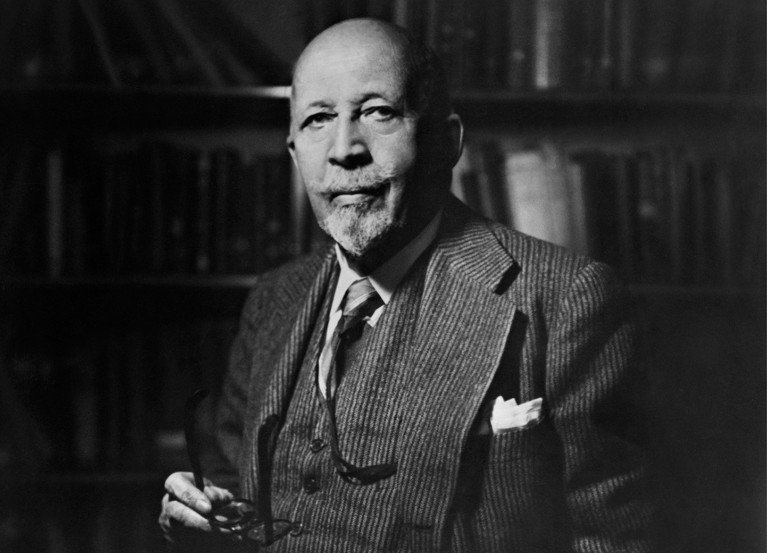
Civil-rights activist W. E. B. Du Bois.Credit: Bettmann/Getty The Ends of Race: The Rise and Fall of a Scientific Myth Geoffrey Galt Harpham Princeton University Press (2026) Two stories about the history of science around race emerge from the nineteenth century. Each tugs at our attention in a different way. Humanities scholar Geoffrey Galt Harpham
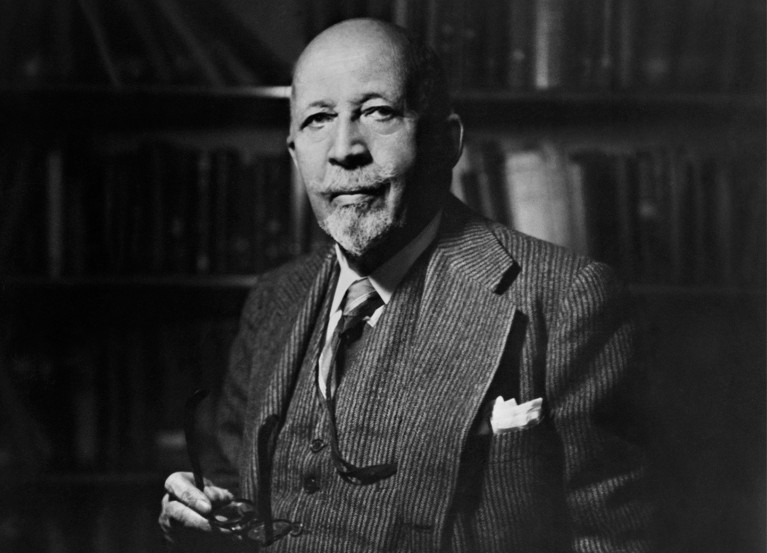
Civil-rights activist W. E. B. Du Bois.Credit: Bettmann/Getty
The Ends of Race: The Rise and Fall of a Scientific Myth Geoffrey Galt Harpham Princeton University Press (2026)
Two stories about the history of science around race emerge from the nineteenth century. Each tugs at our attention in a different way. Humanities scholar Geoffrey Galt Harpham chronicles them in a book with enthralling detail.
The Ends of Race tracks the decades spent by scientists and scholars intending to prove that human races were distinct, using methods such as measuring skulls and facial forms to set them in biologically fixed categories and develop taxonomies to rank humanity.
Why Africans should be telling the story of human origins
The first set of protagonists, including US anthropologist Josiah Nott and French anthropologist Julien-Joseph Virey, likened Black people’s skulls to ape skulls with evidence as threadbare as a spiderweb, intentionally pushing Black people down the ladder of desirable cultures. It was a myth born to provide cover for racism, Harpham writes.
The second story starts in 1900, during a tide-turning moment for science. Scholars began publishing studies countering the oppressive theories of race scientists. Ultimately, the discrediting of the concept of biological race emerged as a triumph of scientific self-correction.
These stories serve as a potent reminder of not just how science can get it so wrong, but how flawed research can eventually be quashed by sensible approaches. In the case of race, inaccuracies were sustained solely by political and social ends.
As with any good story, the author confidently guides us through a heady mix of characters. And Harpham even contends that this tragic era in science offers a happy ending. Once natural science had dismissed race as a biological reality, authors such as W. E. B. Du Bois took the opportunity to reframe race as a social and cultural identity, to invite solidarity among Black people.
Misplaced taxonomy
The scientific muddling of race and species, and its lasting effect on perpetuating division, has its roots with Swedish naturalist Carl Linnaeus. His 1735 book Systema Naturae categorized every kind of organism, a magnificent feat at the time. But this process encouraged questions about divisions among humans, similar to what Linnaeus saw in other species.
This area of research excited the scientific community. Early race theorists, such as Nott, clamoured for the “magnificent opportunity to establish the ability of empirical research and scientific method to engage with issues whose interest and importance could be immediately grasped by the public and even valued by the state”, Harpham writes.
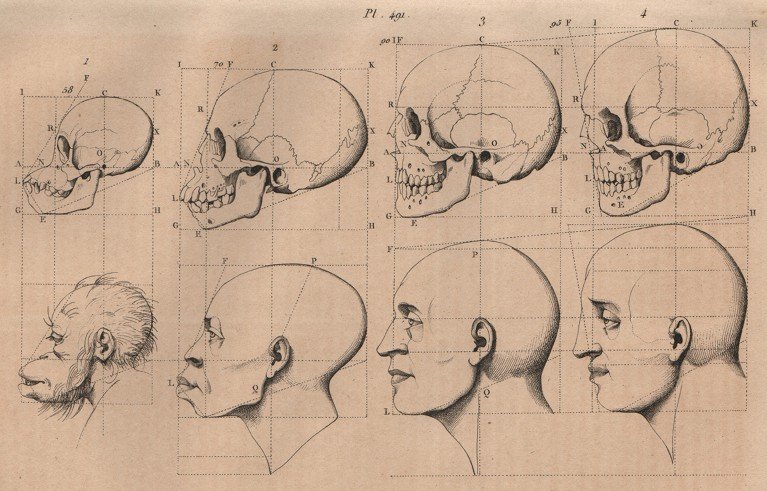
Physician Petrus Camper proposed that the angle between the jaw and forehead could differentiate species, a theory used in scientific racism. Credit: Antiqua Print Gallery/Alamy
Nott took Linneaus’s categorization a step further, arguing that human races were not just environmental varieties of a single family, but separate, fixed species created independently by God. He thought that interbreeding between “remote” races led to weak, disease-prone and infertile offspring, and applied mortality data to his claim that Black people in the United States enjoyed joyous lives under Southern chattel slavery but perished in freedom in cold Northern cities.
You can imagine Harpham’s eyes rolling when he shares Nott’s racist views, but he recognizes that these ideas weren’t just the provenance of one man. US physician Samuel George Morton published work in the 1830s in which he expanded on his theory that skull size and shape reflected brain size and intellectual capacity. He ranked racial cultures on their mean cranial size: Caucasians at the number-one position, followed by Mongolians, Malays, Native Americans and Ethiopians (a catch-all term for Black people) at the bottom.
How ‘organized looting and plunder’ drove Britain’s second scientific revolution
The context of slavery is necessary to fully understand some of these outlandish studies, Harpham stresses. Both Nott and Morton argued that since the time of ancient Egypt, enslaver–enslaved relationships and the physical racial features of each of these groups had remained unchanged, pointing to racial hierarchies laid out as permanent laws of nature rather than temporary social conceptions. At the time, there was little pushback. After all, enslavers benefited from these notions.
Keep following us for the latest insights.