Octopuses are famous for navigating their way through a tight squeeze. Even among invertebrates, their ability to compress themselves into seemingly impossibly tiny passageways is an impressive sight. But for years, marine biologists have remained perplexed by how these cephalopods routinely manage their maneuvers. “There is no information about how octopuses squeeze through an opening
Octopuses are famous for navigating their way through a tight squeeze. Even among invertebrates, their ability to compress themselves into seemingly impossibly tiny passageways is an impressive sight. But for years, marine biologists have remained perplexed by how these cephalopods routinely manage their maneuvers.
“There is no information about how octopuses squeeze through an opening far smaller than [their] body diameter,” Wenci Xin, a marine biologist at the National University of Singapore, said in a statement.
Xin and her colleagues recently provided Mayan octopuses (Octopus maya) and young common octopuses (Octopus vulgaris) with a chance to show off their skills. Their findings, published in a study today in the Journal of Experimental Biology, show that there may not necessarily be a “one size fits all” approach for octopuses.
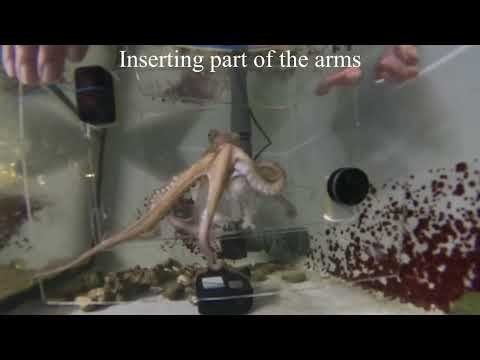
Common octopus approaching a wide hole
First, the team needed some measurements. Previously, researchers assumed that an octopus’ stiff cranial case of cartilage that protects its central nervous system also dictates the limits of how small it can scrunch. Knowing this, Xin measured the distance between each specimen’s eyes to approximate the cartilage sheath’s width. In this case, the space between each octopus’ eyes ranged between about 0.6 and 1.3 inches wide.
The team then constructed customized, clear plastic aquarium boxes linked by holes either slightly larger or smaller than width between each set of octopus eyes. From there, they simply set up cameras,and let the cephalopods do their thing.
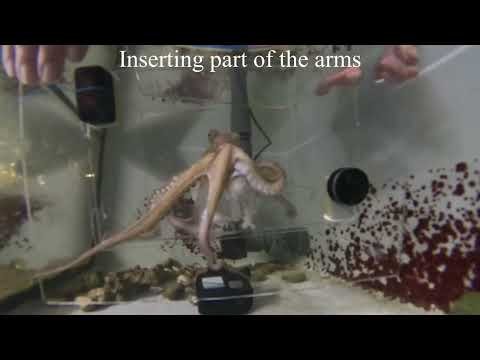
When encountering a comparatively large hole, each octopus initially prodded the opening with its arms before passing one limb through the hole. Usually, this was one of its two left front arms. It then slipped as many as five more arms through the portal, only to reach back with two of those limbs and use their suckers to stick to the initial box’s walls. Finally, they extended and stiffened these arms to push against the wall and maneuver the remaining limbs, mantle, and head through the hole. On average, an octopus successfully transitioned between boxes within about 20 seconds.
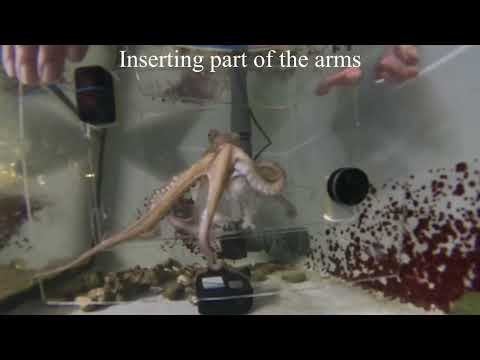
Common octopus squeezing through a small hole
However, the octopuses often changed their approach when facing narrower holes often.. The tighter squeeze limited how many arms an octopus could simultaneously thread through the opening. In these instances, the animals divided their final shimmying stage into two phases—first pulling all of its remaining arms through the hole, then compressing its mantle and scooting the rest of its body through the entry.
Well, only the common octopuses managed this. Xin’s team was surprised to learn the Mayan octopuses had no interest in the narrower holes. Instead, they simply hung out in another corner of the box without even testing the opening with their arms. Only when offered a second, larger passage did they get curious. In those scenarios, they felt around the smaller entry before opting to go through the larger of the two holes.
Although their study only focused on two species, their results indicate octopuses may vary in the ways they navigate tight spaces. At the same time, it appears their cranial cartilage may dictate at least some of their physical limitations. In any case, the biologists’ trials indicate that if an octopus at least thinks it can fit through an opening, it will certainly give it a try.

2026 Popular Science Home of the Future Awards
Keep following us for the latest insights.