Big Math: The Hidden Codes That Run Our World Steven Strogatz & Alex Townsend Little, Brown and Company (2026) When I was studying electrical engineering in India in the 1980s, a professor asked our class: “Why do short- and medium-wave radios produce a crackling sound, or static, when a scooter goes past, regardless of the
Big Math: The Hidden Codes That Run Our World Steven Strogatz & Alex Townsend Little, Brown and Company (2026)
When I was studying electrical engineering in India in the 1980s, a professor asked our class: “Why do short- and medium-wave radios produce a crackling sound, or static, when a scooter goes past, regardless of the station you are listening to?” None of us knew the answer.
How AI is reshaping discovery in maths and physics
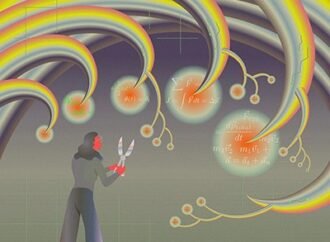
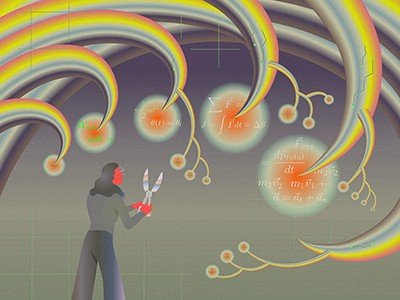
The professor was using the question to introduce a mathematical operation called a Fourier transform. Each time the spark plug in a scooter engine fires, it produces a short pulse of electromagnetic radiation. The Fourier transform reveals that, mathematically, this signal is a summation of thousands of sine and cosine waves. Whatever frequency our radios are tuned to, the pulse produced by the spark plug contains some energy at that frequency, which we hear as static. It was a proverbial ‘aha’ moment for many of us in the class.
Big Math by mathematicians Steven Strogatz and Alex Townsend contains many such aha moments. But the book is so much more. Strogatz and Townsend use the assuredness of mathematicians and the skill of storytellers to paint a vivid portrait of the variety of ways in which mathematics underpins almost every aspect of people’s lives.
The rise of ‘big math’
The authors start with an inspiring story about Regina Barzilay, a computer scientist who had breast cancer and, after she finished her treatment in 2014, decided to do something about the lack of tools for spotting the early warning signs of the disease. The technology that she needed to achieve her goal already existed — machine learning — but it was mostly being used to recommend films to people and steer online buying behaviour, and was not reaching many of the people who would benefit from its use in health care. Barzilay collaborated with radiologists and computer scientists to develop a machine-learning model that could predict a person’s risk of developing breast cancer within the next five years from a single mammogram.
The breakthrough proof bringing mathematics closer to a grand unified theor
In the book, this story is a set-up for talking about the ubiquitousness of what the authors call ‘big math’ — the mathematics behind technologies that are “shaking the foundations of how we work, how we play, how we learn, how we shop and travel and communicate, even how we heal”.
The authors present the book as more of a conversation than a lecture, but warn that their aim isn’t to make maths “cozy or accessible”. Their disclaimer is welcome and follows in the footsteps of other books published in the past fifteen years that haven’t shied away from getting into the weeds of maths. This includes Strogatz’s own books, The Joy of X (2012) and Infinite Powers (2019), as well as Leonard Susskind’s Theoretical Minimum series on classical and quantum mechanics, and Sean Carroll’s series The Biggest Ideas in the Universe, all of which celebrate the nitty-gritty details of maths to varying degrees.
Saying that, Big Math is light on equations, so the book is more accessible than those mentioned above. But it nevertheless reveals the extent to which maths has permeated people’s lives, for better and for worse.
Clear concepts
The seeds of big maths were sown a long time ago. Strogatz and Townsend tell a delightful story about Chinese mathematicians solving accounting problems to estimate the edible rice yield expected from bundles of unprocessed rice still in the husk. The authors neatly pivot to explaining that the problem can be expressed in terms of a system of linear equations (in which variables such as x, y and z do not have exponents, and aren’t multiplied by each other), matrices (rectangular arrays of numbers) and vectors (columns of numbers). This puts us squarely in the middle of the type of maths that is central to artificial intelligence; although the Chinese “reckoners” were solving these equations by moving around sticks of bamboo.
The book is suffused with many such historical anecdotes. We learn, for instance, that nineteenth-century mathematician James Joseph Sylvester thought of the matrix (a term that he coined) as a “mother, a generator, an entity that gave birth to other mathematical objects”. This feels eerily prescient, because the manipulation of massive matrices (with hundreds of billions and even trillions of numbers) is at the heart of generative AI.
How to prevent AI from harming mathematics
They also discuss Leon Festinger’s 1949 idea that repeated matrix–vector multiplications (the kind used to solve the paddy problem) can uncover “hidden structures in social networks”. Over subsequent decades, such matrix methods became key to analysing webs of social relationships to “measure influence, detect clusters, and rank individuals by how connected they were”.
The authors also touch on how the board game of Snakes and Ladders can be used to understand a Markov chain, a mathematical formulation that was key to technology company Google’s early search algorithms. In the game, your next move depends only on your current position and the roll of a die. In maths, a Markov chain is a sequence of random events in which the probability of the next state depends only on the current state and not on any previous one.
Another historical anecdote covered in the book is that of George Dantzig, who, as a graduate student at the University of California, Berkeley, in 1939, arrived late to a statistics class and saw two equations written on the blackboard. Thinking that they were homework assignments, he wrote them down. He eventually solved them, but apologized to his professor for taking a few days to do so. The equations, however, were open, unsolved problems. (The legendary mathematician’s story made it into the 1997 film Good Will Hunting, in which actor Matt Damon’s character, Will Hunting, solves a problem scrawled on a blackboard while working as a janitor at a university.)
Keep following us for the latest insights.