Stubborn inflation might send the Fed into high gear when it meets next month to figure out what to do with interest rates. After the latest consumer price index reading, economists and Wall Street pros are starting to worry that central bankers are going to overdo it in their battle against rising prices, upsetting the
Stubborn inflation might send the Fed into high gear when it meets next month to figure out what to do with interest rates.
After the latest consumer price index reading, economists and Wall Street pros are starting to worry that central bankers are going to overdo it in their battle against rising prices, upsetting the economy by hiking rates too high.
October inflation data came in hot on Tuesday, with consumer prices rising 0.4% month over month. There was no annual reading because the government was shut down last October, but New York Life Investment Management estimated that it stood around 4.1%.
Thats more than double the Fed’s 2% target, and an uptick from the 3.7% reading in September and 3.4% in August.
The hot reading has prompted some senior Fed officials to strike a decidedly more hawkish tone this week. Markets are pricing in a 25-basis-point rate hike at the Fed’s December meeting, but speculation is growing that a more aggressive move may be in the works.
Fed governor Christopher Waller, a voting member of the Federal Open Market Committee, said on Tuesday that the central bank should raise rates by 50 basis points.
“Hiking only 25 basis points would put our credibility at risk, a risk I am not eager to take,” Waller said at the Bank of England Watchers Conference.
Austan Goolsbee, the president of the Chicago Fed but not an FOMC voting member, called October’s inflation print “borderline disturbing” in an interview with PBS Newshour on Tuesday.
So far in 2026, the Fed has implemented one rate hike at its September meeting. Here’s what a few Wall Street economists are saying about the October print and its implications for future Fed policy.
Neil Dutta, Renaissance Macro Research
Dutta said that Fed is indeed behind on fighting inflation, and that investors are still underappreciating the degree of hawkishness the Fed may have to adopt.
While battling inflation is necessary, Dutta also said this creates the risk that the Fed overdoes it.
“Inflation tends to be a lagging indicator, and monetary policy tends to work with lags,” Dutta wrote in a client note on Tuesday. “To the extent Waller is a benchmark for the FOMC, today is a reminder that overtightening is the dominant risk going into 2027.”
David Rosenberg, founder of Rosenberg Research
Rosenberg also expressed the belief that the Fed is going to get more hawkish from here — and suggested that it’s still battling post-Covid runaway-inflation boogeymen that will inform its approach this time around.
“This Fed is still consumed with missing ‘transitory’ in 2021-2022 and, insofar as it is concerned over the lags from energy to the other components of the CPI and focused on ‘breadth’ measures of inflation, one can reasonably expect at this point for December 9th to show a ‘hawkish hike,'” Rosenberg said in a client note on Tuesday.
Aditya Bhave, Bank of America
Bhave said October’s print showed was yet another sign that the Fed is failing on its inflation mandate.
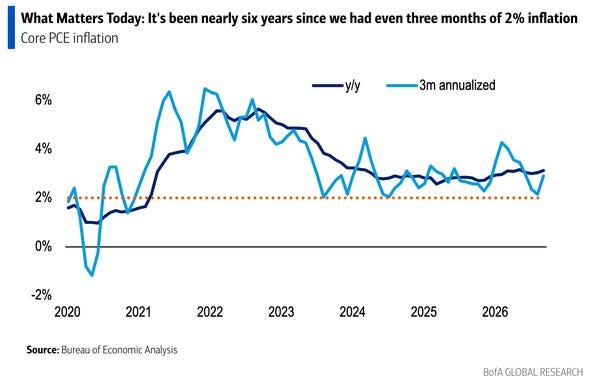
Core PCE, which exludes food and energy prices and is often cited as the Fed’s favorite inflation measure, hasn’t been at 2% since 2020.

Bank of America
That will have to change, Bhave said, or investors and consumers will start to lose confidence in the Fed’s ability to rein in rising prices.
“Had inflation been above target for just a year or two, we think the Fed could have accepted 2-2.5% PCE inflation as ‘good enough’ in exchange for a stable labor market,” Bhave wrote in a note on Tuesday. “But with a large overshoot that’s coming up on six years, the onus is on the Fed to get inflation back to 2.0% (or lower) to prevent losing its credibility.”
{For more tech updates, stay tuned to our blog.|Keep following us for the latest insights.|Check back often for more exciting news!}