UNITED NATIONS — Rights groups are calling for military and economic sanctions against Myanmar after the United Nations’ highest court, in the first ruling of its kind, determined that its government committed genocide against the Rohingya minority in a brutal 2017 military operation. The International Court of Justice has no power to enforce Thursday’s ruling,
UNITED NATIONS — Rights groups are calling for military and economic sanctions against Myanmar after the United Nations’ highest court, in the first ruling of its kind, determined that its government committed genocide against the Rohingya minority in a brutal 2017 military operation.
The International Court of Justice has no power to enforce Thursday’s ruling, which orders Myanmar’s military-supported government to allow those who fled the violence to return home safely, to pay reparations to the Rohingya Muslims and prosecute those suspected of having committed genocide.
Myanmar’s government has denied committing genocide, claiming it acted against insurgents, and is considered unlikely to fulfill any of the court’s demands. President Min Aung Hlaing, the former military leader, was in charge of the 2017 operation. The court said evidence showed Myanmar forces killed about 100,000 Rohingya.
Khine Khine Soe, the president’s spokeswoman, noted the International Court of Justice decision handed down Thursday had been the result of a nine-to-six vote of the judges.
“Not all 15 judges agreed with the decision,” she told reporters in the capital Naypyitaw. “So it was not a decision made unanimously. I would say that it was unfair.”
While the World Court’s rulings are final and legally binding, it has no recourse beyond reporting noncompliance to the U.N. Security Council.
The Security Council scheduled closed consultations on the ruling next Wednesday and a private meeting on Dec. 7 at the request of the United Kingdom, which expelled Myanmar’s defense attache after Thursday’s ruling.
But Daniel Forti, the International Crisis Group’s head of U.N. affairs, said it’s unlikely there will be any immediate action from the 15-member Security Council, which could impose sanctions on Myanmar. He said any action would likely be blocked by China and Russia, both permanent members with veto power.
“China has discouraged the Security Council from acting on the Myanmar file since 2021, as it is reluctant to cede any influence in its own backyard,” Forti told The Associated Press. “The ICJ ruling will not alter China’s calculations, and it is hard to imagine that either Beijing or Moscow would support any potential Security Council resolution that attempts to enforce the court’s recommendations.”
Forti said Gambia, which launched the court proceedings, may eventually pursue a resolution in the 193-member General Assembly calling on Myanmar to comply with the ICJ’s demands, even though its actions are not legally binding, unlike those of the Security Council.
Justice for All, an American human rights organization that advocates for the rights of Muslim minorities, called on the Trump administration to support a General Assembly resolution demanding Myanmar’s compliance with the judgment, and establishing international monitoring and follow-up.
Justice for All, which has a task force of 38 U.S. and Canadian Muslim organizations that have advocated for Rohingya rights since 2017, argued that sanctions should target Myanmar’s oil and gas sector and the networks that provide weapons and other support to its military.
Amnesty International’s Secretary General Agnes Callamard urged governments not to welcome the president “on the international stage, especially as grave violations continue unchecked inside Myanmar.”
“Instead, they should stop any transfer of all weapons, security and surveillance equipment, and military and security assistance to Myanmar,” she said. “The U.N. Security Council should impose a global arms embargo and refer the entire situation in Myanmar to the International Criminal Court.”
That court, however, is under U.S. sanctions along with many of its judges and staff, so any action by the Security Council would face an almost certain U.S. veto.
Prosecutors at the ICC requested an arrest warrant for Min Aung Hlaing in late 2024 alleging he was responsible for crimes against humanity against the Rohingya. There has been no public announcement on a decision by judges at the court who would have to issue a warrant.
The court’s Office of the Prosecutor did not immediately respond to a request Friday for comment.
Human Rights Watch urged governments to step forward to help the Rohingya.
“Concerned governments should strongly support the Rohingya and promote justice for atrocities, press Myanmar’s junta to comply with the judgment, and ensure the safe and voluntary return of Rohingya refugees to Myanmar,” Maria Elena Vignoli, the group’s senior international justice counsel, said in a statement.
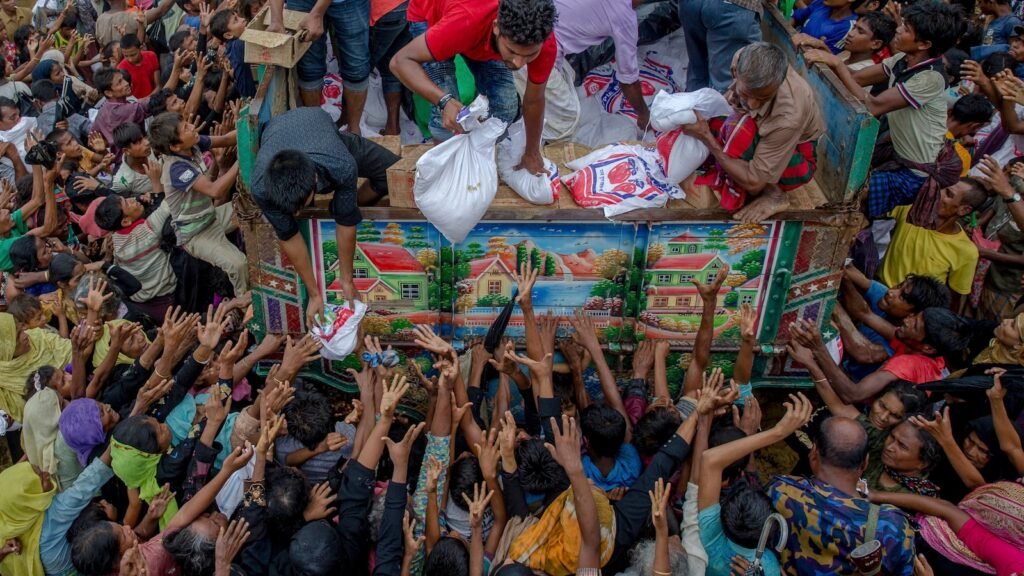
Justice for All called for global support for a Rohingya reparations fund and measures to advance their education, protection, pursuit of citizenship and safe voluntary return from Bangladesh, where some 1.2 million Rohingya now live in overcrowded camps.
Myanmar, which is majority Buddhist, has long claimed the Rohingya are “Bengali” migrants from Bangladesh, even though their families have lived in the country for generations. Nearly all Rohingya have been denied citizenship since 1982, effectively rendering them stateless, and they are denied freedom of movement and other basic rights.
Yasmin Ullah, a Rohingya rights activist who listened to the court ruling in The Hague, Netherlands, said the judgment “will only mean something if governments act on it.”
“So, I say to every U.N. member state, take robust steps to implement the ICJ judgment,” she said, starting with sanctions against the president.
“Make Myanmar pay reparations to the people it destroyed,” she said. “Give us back our lives. Give us a future. We want to be part of a stable, prosperous and thriving Myanmar.”
___
Associated Press writer Mike Corder in The Hague, Netherlands, contributed.
Check back often for more exciting news!